Writing Exercise: “#Poem”

This morning I created a little exercise for myself, a prompt to keep me creative when I don’t have the time or energy (ahem, end of the semester) to keep me writing poems. I collected tweets, with some redaction and the introduction of some punctuation, from three other Twitter users with the name Emilia Phillips, and I created the found poem below. The line breaks are mine. The exercise could easily be adapted for the classroom setting, especially if you have your students search for their online name-twins.

Found Poem Made Up of Tweets By Three Other Emilia Phillipses, All Teenage Girls

Today marks the first time in history
I have ever been satisfied
with my school photo. There’s a special place
in hell for people who think it’s okay
to rip out your earbuds and eat
your food without asking. If only
emotional stress used up
calories. When I say there’s nothing
to eat I mean there’s next to nothing
I enjoy. Quit saying I wish and begin
saying I shall. Scratch that,
I hated summer when it was still
winter. Do you ever just think
to yourself what the hell
are you doing with your life. Oh,
shut up with all this
“Previously on…” crap,
I’ve already binge watched
six episodes today. Can’t do this anymore
and I don’t see why
I have to. Wow I really
like Chance the Rapper
#plottwist. I can’t pretend to smile,
all I do is think about how
my life can be better. You don’t
understand true fear
unless you walk in on somebody
using your laptop
without your permission. I just monster
sneezed all over
my phone. Lana del Ray is
queen. I spent 12 dollars on
frozen yogurt 2 months ago
and I get angrier everytime
I realize it. I don’t feel 18…
My mom is trying to explain
the patriarchy to my sister.
Ain’t nothing gonna put out
that flame — my chem teacher.


UPDATE 12/14/2016

I couldn’t resist trying my hand at another one.

Found Poem Made Up of Tweets By Three Other Emilia Phillipses, All Teenage Girls (II)

All I do is grumble about being bored
and tired. I’m always playing this game
called am I overly sensitive or were you
really being an ass. Politeness is becoming
so uncommon that many people mistake it
for flirting. The friend zone was invented
by guys who are friends with girls
and believe they are owed
sex for being a good friend. We all love
a nice ass. I am so stressed out. I have
way too many things to deal with right
now. My parents are literally watching
a nature documentary and narrating
the thoughts of the animals. My cat thinks
the Christmas tree is grass and keeps trying
to eat it. I actually feel shameful for having to use cutlery
to eat pizza. Braces suck. Who hurt you?
Why are you so pretty! So bored
of my hair. Ok next week I’m going
healthier. Need next payday
already. Christmas just isn’t the same
when it’s in the middle of summer. It’s awesome
how you can read a book, watch a film, listen
to music, speak with someone you love and forget
that there is a world
around you. Does anyone else remember
The Country Bears? I used to love that film.
Fucking vile creatures. They’re the spitting
image of a piece of shit. Peep this
gross pic of me. The proof is in the way
it hurts. I’m not always vulgar.
Sometimes I’m sleeping.

Class Guest (with Board Notes) at Elgin Community College

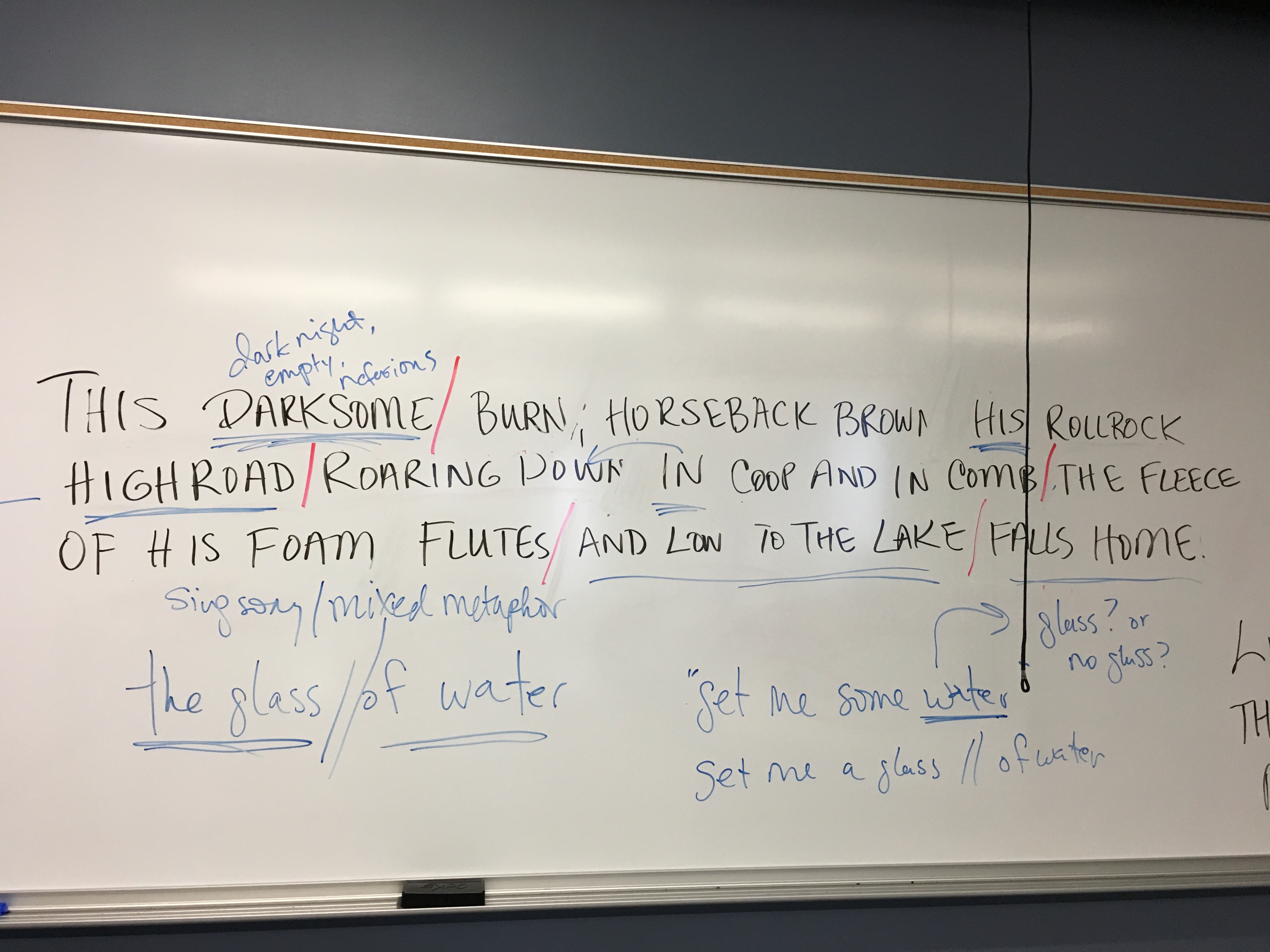
I visited Rachael Stewart’s creative writing class at Elgin Community College today, where I asked students to pay intuitive attention to where lines are broken. I wrote the first stanza of “Inverstaid” by Gerard Manley Hopkins without lineation on the board. I asked them to put line breaks where they think he broke them, and then I asked them to break the lines so that the end rhymes would be subverted. We then discussed how lines have meaning and sentences have meaning, how they can complement one another or come into conflict. We then read Ellen Bryant Voigt’s “The Bear” to talk line break and punctuation, and then Lynda Hull’s “Ornithology” to chart the musicality of free verse.


Presentation & Handouts for Lecture: “It’s Alive: Why Poetry Still Matters”

phillips-rutherford-hall-lecture-11-16-2016On Wednesday, November 16, I gave the lecture “It’s Alive: Why Poetry Still Matters” at Rutherford Hall in Allamuchy, New Jersey. Here are the materials for that talk:

This talk also transformed into my November 2016 blog post for Ploughshares, “Truth & Dread: Why Poetry Still Matters & The Risk of (Too Much) Empathy”:

Can the act of empathy, learned from literature and poetry, become an act of appropriation when we take it to our lived lives? This is a question I haven’t been able to answer. Each of us is not a sun around which others revolve; we cannot, like black holes, pull everything into us without risking erasure, of others, of ourselves. Perhaps more than the practice of empathy, poetry offers us the opportunity to listen, and not just in the way that it appeals to the same areas of the brain music stimulates, and not just in the way that we can hear the cadence and rhythm and sounds of poetry. Perhaps poetry offers us the opportunity to hear its many speakers, to not so much as internalize each of their voices and experiences as to confirm them, to say, you are you, you are a voice, I hear you.


Poetry Workshop Readings and Writing Exercise: “Befriend Me: Poems of Social Media & Technological Engagement”

When I am out of town on November 30th, my colleague will be discussing the poems from the “Befriend Me: Poems of Social Media & Technological Engagement” packet and then leading the Poetry Workshop in the “Befriend Me” writing exercise. I hope to do this again with my spring Craft of Poetry course, and go more in depth with the exercise and the class’s engagement. Thanks to all of those on social media who suggested additional poems for inclusion in this reading packet.

“Barbie Girl” Exercise for Poetry Workshop

In “Barbie Girl,” students read “Barbie Chang’s Tears” by Victoria Change from their assigned October 2016 issue of Poetry and then take a look at “The Last Mojave Indian Barbie” by Natalie Diaz. In doing so, they consider the ways in which poetry can challenge problematic representations in popular culture. Additionally, they are provided with the opportunity to revise a cultural icon through their own persona poem in order toaccurately reflect their own individualized experiences.

Class at Hudson Valley Writers’ Center Tomorrow!

Tomorrow, I’m teaching a one-day course called “Walk the Line: The Tension Between Line & Syntax” at the Hudson Valley Writers’ Center in Sleepy Hollow, New York. We will consider the relationship between poetry’s vehicles of meaning: the line and the sentence. In doing so, we’ll investigate the ways in which these structures support, nuance, and deny one another to achieve resonance, depth, and subtext within a poem. This course will be generative, with exercises that rely on close reading and formal manipulation of texts, as well as the drafting of new pieces. Whether you want to learn more about what your favorite poets are doing with their poems or discover how to break lines in your own, this course will insist that poetry is a craft, honed by exercises and study.

When I finalize the course packet, I will share it here on Ears Roaring with Many Things. If you’re still interested in signing up, register through the HVWC website.

Photos from Field Trip to Princeton

On Wednesday, September 21st, I took my five Poetry Workshop students to see a Reading by Jenny Johnson and Joy Williams at Princeton University.

eng-2015-at-princeton-09-21-2016
ENG 2015 Students Rachael, Ken, Devon, Heidi, and Tina outside Princeton’s Berlind Theatre, September 21, 2016.
eng-2015-with-jenny-johnson-09-21-2016
ENG 2015 Students with poet Jenny Johnson (third from left)


Fall 2016 Required Texts & Course Descriptions

ENG 2015: Poetry Workshop

American poet C.D. Wright once wrote: “If I wanted to understand a culture, my own for instance . . . I would turn to poetry first. For it is my confirmed bias that the poets remain the most ‘stunned by existence,’ the most determined to redeem the world in words.” In this course, we will hold poetry to this noble standard, as an amplifier for the voices in our culture and an invocatory rendering of our world. In doing so, I’ll ask you to not only read and write poetry but also begin to look at your surroundings as a poet would. This requires close examination of images, scrutiny of your thoughts and feelings about subject matter, and consideration for other points of view. Additionally, you will be asked to think deeply about language, in terms of its meanings, its sounds, its rhythms, and its forms. You should bring to this class a hard work ethic supported by curiosity and generosity. As a means of introduction to the craft of poetry, students will submit original poems for workshop, a collaborative discussion about writing techniques and their effects on readers.  In addition to workshop, you will be asked to engage with the writing of contemporary poets, to read like a writer would. I’ve chosen Poetry magazine as our required text so that you will have a lens through which to examine the current landscape of American poetry and to see that even today poets are still trying to “redeem the world in words.”

Required Texts

  1. Hirsch, Edward. A Poet’s Glossary. Houghton Mifflin Harcourt, 2014. ISBN: 978-0151011957.
  2. Poetry magazine student subscription, available at https://www.poetryfoundation.org/poetrymagazine/subscribe


ENG 2016OL: Online Prose Workshop

This course will focus on the prose forms of the short story and personal essay, and emphasize drafting and revision. Students will respond to published prose and write their own pieces for workshop, a collaborative discussion about the effects of a writer’s choices on readers. You should bring to this class a hard work ethic supported by curiosity and generosity. We will base our discussions on how texts work rather than what they mean, after Francine Prose’s ideal of “reading like a writer.” We will use Megan Mayhew Bergman’s collection of short stories, Almost Famous Women, and Zadie Smith’s collection of essays, Changing My Mind, as a touchstone for learning writing skills and discovering genre conventions. My approach to teaching writing is founded on the belief that our writing skills must be practiced and cultivated, and that one must continually challenge one’s aesthetics, habits, and concerns throughout one’s writing life in order to write anything of consequence to one’s readers and, perhaps more importantly, one’s self.

Required Texts

  1. Bergman, Megan Mayhew. Almost Famous Women.  Scribner, 2015. 256 pages. ISBN: 978-1476788814.
  2. Smith, Zadie. Changing My Mind: Occasional Essays. Penguin, 2010. 320 pages. ISBN: 978-0143117957.


ENG 2031: Craft of Prose

In Italo Calvino’s Invisible Cities, Marco Polo tells Kublai Khan that “the city must never be confused with the words that describe it.” In this course, we will shoot high and aim to write so richly and uniquely about our fictional worlds that they will be rendered in our readers’ imaginations as palpable, the words and places indistinguishable, symbiotic, “real.” We will take as our lodestars a number of texts, including Calvino’s Invisible Cities, a short story collection by Centenary’s fall 2016 visiting author Megan Mayhew Bergman, and one of the Harry Potter novels. We will translate these immersive reading experiences into writing skills through discussion, exercises, and workshop. Several times throughout the semester, students will turn in original writing for workshop, a collaborative discussion about writing techniques and their effects on readers, and later revise one of the pieces using the comments received in workshop. Additionally, we will play host to Centenary’s Fall 2016 visiting writer, Megan Mayhew Bergman, and prepare accordingly. You should bring to this class a hard work ethic supported by curiosity and generosity. We will base our discussions on how texts work rather than what they mean, after Francine Prose’s ideal of “reading like a writer.” My approach to teaching writing is founded on the belief that our writing skills must be practiced and cultivated, and that one must continually challenge one’s aesthetics, habits, and concerns throughout one’s writing life in order to write anything of consequence to one’s readers and, perhaps more importantly, one’s self.

Texts and Supplies

  1. Bergman, Megan Mayhew. Almost Famous Women.  Scribner, 2015. 256 pages. ISBN: 978-1476788814.*
  2. Calvino, Italo. Invisible Cities. Harcourt, 1978. 165 pages. ISBN: 978-0156453806. +
  3. Everett, Percival. I Am Not Sidney Poitier. Graywolf Press, 2009. 234 pages. ISBN: 978-1555975272. +
  4. Rowling, J.K. Harry Potter and the Goblet of Fire. Scholastic Paperbacks, 2002. 752 pages. ISBN: 978-0439139601.*
  5. Russell, Karen. Vampires in the Lemon Grove: And Other Stories. Vintage, 2014. +
  6. Writing Journal


ENG 3099: Special Topics: Literary Editing & Publishing

“Editing, like writing, is fundamentally about composing a world,” Peter Gizzi writes in his essay “On the Conjunction of Editing and Composition.” In this course, students will learn how this act of composition takes place, from submissions to printing, by reading first-hand accounts of editors in the profession and through practical application. This reading intensive course will challenge you to read like an editor rather than a reader, writer, or critic, and ask you to consider how literary magazines contribute to literary culture. You will be exposed to many different types of editing styles, and you will be asked to begin to cultivate your own approach to editing a literary magazine or journal while being introduced to all the skillsets needed to create a publication. We will use literary magazines as a case study for all of our publishing inquiries, but we will likewise touch upon the book-publishing process and market. The class will include an investigation into the history of literary magazines; editorial meetings in which students will evaluate and debate sample pieces; papers that analyze literary magazines, editorial roles, and the state of contemporary publishing; and a final editorial project in which student groups will “compose a world” through a mock literary magazine by developing its mission, design, and content. In many ways, this course acts as a kind of introductory practicum for students interested in pursuing future publishing opportunities as editors, production editors, and as writers.

Texts and Supplies

  1. Lupton, Ellen. Thinking with Type, 2nd edition. Princeton Architectural Press, 2010.
  2. Kurowski, Travis. Paper Dreams: Writers and Editors on the American Literary Magazine. Atticus Books, 2013.
  3. Art supplies, paper, etc. and whatever else you may need to create your final editorial project.
Poetry Reading Calibration and a Writing Exercise for the First Day of Poetry Workshop

Note: In an effort to keep this blog updated regularly, I’m going to be storing my writing exercises and handouts in my Google Drive. I will post these exercises as a link here.

This single document includes three different components:

  1. An introduction questionnaire, allowing students to tell me a little about them, their needs, and their preferences.
  2. A Poetry Reading Calibration Exercise, featuring Ari Banias’s poem “A Sunset.”
  3. A Writing Exercise titled “Home” after the Safiya Sinclair poem by the same name.

I’m giving these exercises on the first day of class in order to get a better sense of where the students are in terms of their poetry knowledge and reading ability. Additionally, I wanted to introduce them to some terminology (e.g. line breakstoneconcrete details, etc.) that will make it easier for them to talk about poetry throughout the course.