New relevant reading for my Literary Editing & Publishing class

screen-shot-2016-09-25-at-2-32-15-pm

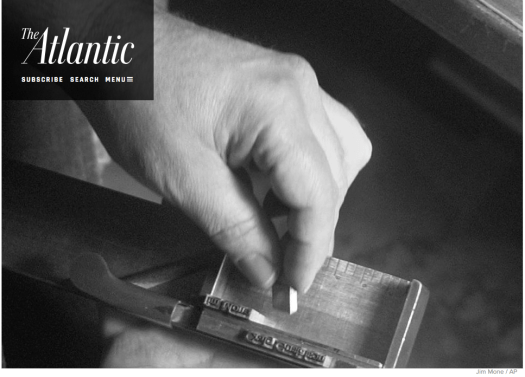
On The Atlantic, Lindsay Lynch writes about typesetting letterpress and the en space in “How I Came to Love the En Space”:

To understand letterpress printing, imagine that every letter you see on your screen is an object, a tiny piece of metal. Not only is every letter an object, but every space between every letter is also an object. Every space between words, every space between lines—every bit of white space is an object. When typesetting, a printer has to think about negative space as something tangible.

This is where the en space comes in. An en space is a rectangular piece of metal or wood whose primary purpose is to be smaller than the metal or wood type being printed. The en space isn’t type-high—it doesn’t sit proud like an ordinary character—so it doesn’t catch ink when it’s run through the press. It just holds printable type together in a tight grid, creating spaces between words. It is never seen, but without it, everything printed would be nonsense.

“Pop Art” Writing Exercise for my Online Prose Workshop

Last week, my Online Prose Workshop read “Hepburn and Garbo” (pgs. 151–165) and “Ten Notes on Oscar Weekend” (212–221) in Zadie Smith’s Changing My Mind; Upon This Rock”  from John Jeremiah Sullivan’s Pulphead;  and “Looking Around” from Anne Lamott’s Bird by Bird. They then completed the following reading discussion:

Changing My Mind is a series of occasional essays. Select one of Smith’s essay from your Introductory week assignments and one from the Week 1 assignments, and compare and contrast the occasions for these pieces. How do the occasions for each piece change the tone of the piece? (Hint: describe the tone of each piece and then make the connection between each essay’s occasion and its tone.) Please upload this by 11:59 pm on Saturday, September 17.

This week, they are completing a writing exercise called “Pop Art”:

Freewrite 250 words about your experience encountering something to do with pop culture. This could be about the time you met a celebrity or the time you camped out for tickets for a concert. It could even be about watching the VMFAs in your pajamas on the couch. Please upload this by 11:59 pm on Saturday, September 24.

“In Medias Res” Writing Exercise for Craft of Prose

In “In Medias Res,” students write and re-write a scene in the three different points of view from a YouTube video of a man texting and running into a wild bear. They likewise create a character profile for their point of view character to navigate Anne Lamott’s suggestion of an “emotional acre.” In doing so, they negotiate the scope, immediacy, and language of each point of view, and consider how “in the middle of things” each point of view feels.

Writing Exercise “Step 1” for Craft of Prose

In “Step 1,” I’m asking students to develop their skills in the imperative and descriptive moods so that a character and/or narrator can demonstrate or walk through an concept or action. They will base their preliminary discussion on “The Unforgivable Curses” chapter of Harry Potter and the Goblet of Fire, the semester’s icebreaker text, as well as read the opening pages of Lorrie Moore’s “How To Be an Other Woman.” In doing so, they will likewise refer to some of the terminology we’ve gone over in previous classes—diction, syntax, dialogue, concrete details, point of view—and demonstrate their understanding of that terminology by relying on those literary concepts to make an effective piece.

Guess Who Reading Discussion Prompt for Craft of Prose

In this reading discussion prompt, students are asked to consider what elements contribute to our understanding of character in this “Guess Who” game in which students draw a character who appears in chapters 3–12 of Harry Potter and the Goblet of Fire and then describe them by answering a series of questions. They will use their descriptions to come up with three clues about the character: one is a concrete detail about the character’s appearance, the second is to identify a scene in which they appear, and the third is a literary craft element that helps reveal their character.

Writing Exercise: “View-master” for Online Prose Workshop

Last week, in ENG 2016OL: Online Prose Workshop, my students read “One Week in Liberia” and “Speaking in Tongues” (pgs. 110–148) of Zadie Smith’s Changing My Mind. Read “Damn Cold in February: Buddy Holly, View-master, and the A-Bomb” by Joni Tevis and Creative Nonfiction Primer on Moodle. They then completed the following writing exercise on a discussion forum.


Writing Exercise: “View-master”

Free-write 250 words about a trip you took to some place that interested you. It could be as dramatic as Liberia (a la Zadie Smith) or as local as your post office.

Introduction of Literary Publication History in Literary Editing & Publishing

Thanks to David Gants at Florida State University for posting some of his course material, including a “Book History Timeline,” from his 2007/2011 ENG 5933: History of the Book, as it proved to be incredibly useful in my ENG 3099: Literary Editing & Publishing course at Centenary University. Yesterday, I gave a brief presentation on the history of the book in order to ask the question, where should we begin our investigation into the history of literary publications, including the focus of our course, literary magazines. I linked to Gants’s timeline on my Moodle for students to read, and, throughout the presentation, we discussed the history of writing, texts, and books in broad strokes, from cuneiform to the little magazines (The Dial, The Little Magazine, and Poetry) of the early 20th century. Students arrived in the lecture having read selections on the history of the literary magazine from Paper Dreams: Writers and Editors on the American Literary Magazine.

“All in Good Sport”: A Writing Exercise for Craft of Prose

In this exercise, I ask my Craft of Prose students to think about the ways in which one element of their worlds—sports—can reveal a great deal about cultural values in addition to demonstrating some of what’s possible. With the class having just read about the Quidditch World Cup in Harry Potter and the Goblet of Fire and been introduced briefly to other examples of games popular fiction, they will create their own sport, have a partner demonstrate, in a charades-like fashion, how that sport works, so that the writer m then ask themselves if they effectively described the sport in “All in Good Sport.”