Class: Introduction to Creative Writing (The College of William & Mary) Genre: Fiction, Nonfiction, and Poetry Purpose: To consider how writers of three genres go about approaching similar subject matter; to introduce distinctions between the genres; and to introduce key drafting and revision considerations based on reading from Janet Burroway’s Imaginative Writing Readings: Chapters 1 (“Invitation to the Writer”) and 7 (“Development and Revision”) in Janet Burroway’s Imaginative Writing
Pick a favorite nursery rhyme, myth, or religious tale that you know by heart. Write a brief summary of the story in 2 to 5 sentences.
If you were writing this narrative as a short story, how would you change it? What elements would you include? How would the style change?
If you were writing this narrative as a poem, how would you change it? What would be your first steps to writing the poem? What would you leave out? What would you add in?
If you were using this narrative as a basis for nonfiction, how would you frame it? How can you approach this subject matter in that way?
Free write for ten minutes and begin to convert your summary into either a short story, a poem, or personal essay.
For my intro to creative writing class at William & Mary this semester, I’m asking students to write one hybrid work as their final workshop piece. Often I feel like these introductory classes set up limits for students, but I wonder if allowing them to see genre as something that’s a little more fluid will encourage continued reading across the genres, an understanding that writing techniques can be used across genres, and creativity with the execution of their ideas. They will be reading a few hybrid texts at the end of the semester, too. The hybrid assignment will also give us a chance to review what we’ve gone over about the three genres by forcing us to consider their respective challenges. I think it will also give students the opportunity to tackle issues they faced across multiple assignments. Say they struggled with point of view in their poetry and concrete details in their nonfiction, but the poems presented strong images and their nonfiction offered an unwavering first-person. Perhaps they’ll be able to double up on their strengths through a hybrid work.
Regardless of the success of their pieces, I hope that we can have a great discussion that will prepare them for debates about form and theory in upper-level, genre-specific courses. Additionally, I don’t want to have a situation where I say, “You’ll discuss these forms if you choose to continue taking creative writing courses.” I want to be able to answer these inevitable questions thoroughly, not offhandedly in a minute or so in the middle of a workshop. Besides, you never know which discussion might excite a student about writing. Maybe those slippery hybrid genres are what really interest some students and they might not know it until you offer it to them!
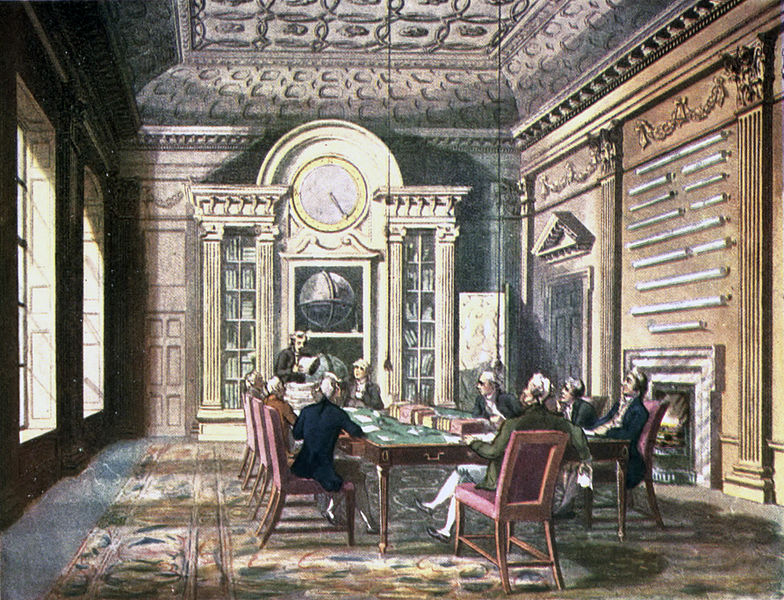
Distillation by Alembic, 1910. (Published before 1923 and public domain in the US.)
In my poetry class, I decided to stagger revision assignments throughout the semester instead of assigning a final portfolio, because I wanted:
to avoid end-of-the-semester-grading fatigue, in order to ensure that I was always fresh and never rushed in grading;
to alleviate students’ end-of-the-semester stress, so that they would be able to concentrate on revising individual poems rather than meeting basic requirements of a portfolio (better— instead of more—work at a time);
to give students a better, ongoing sense of how they are progressing in the course;
and to situate revision as an integral and ongoing part of the writing process that goes hand-in-hand with writing new poems and reading.
Structuring the course in this way, I felt like I was able to give more feedback, and my students’ revisions improved. In previous courses, a revision unit at the end of the semester suggested that revision was an afterthought to the writing process. By having students revise throughout the semester, workshop directly correlated to students’ next steps and, in their self-assessments, they often referred to feedback they received from their peers. Workshop, therefore, was explicitly linked to revision; it wasn’t the end but the means of their creative work—not a junkyard, but an alchemical machine.
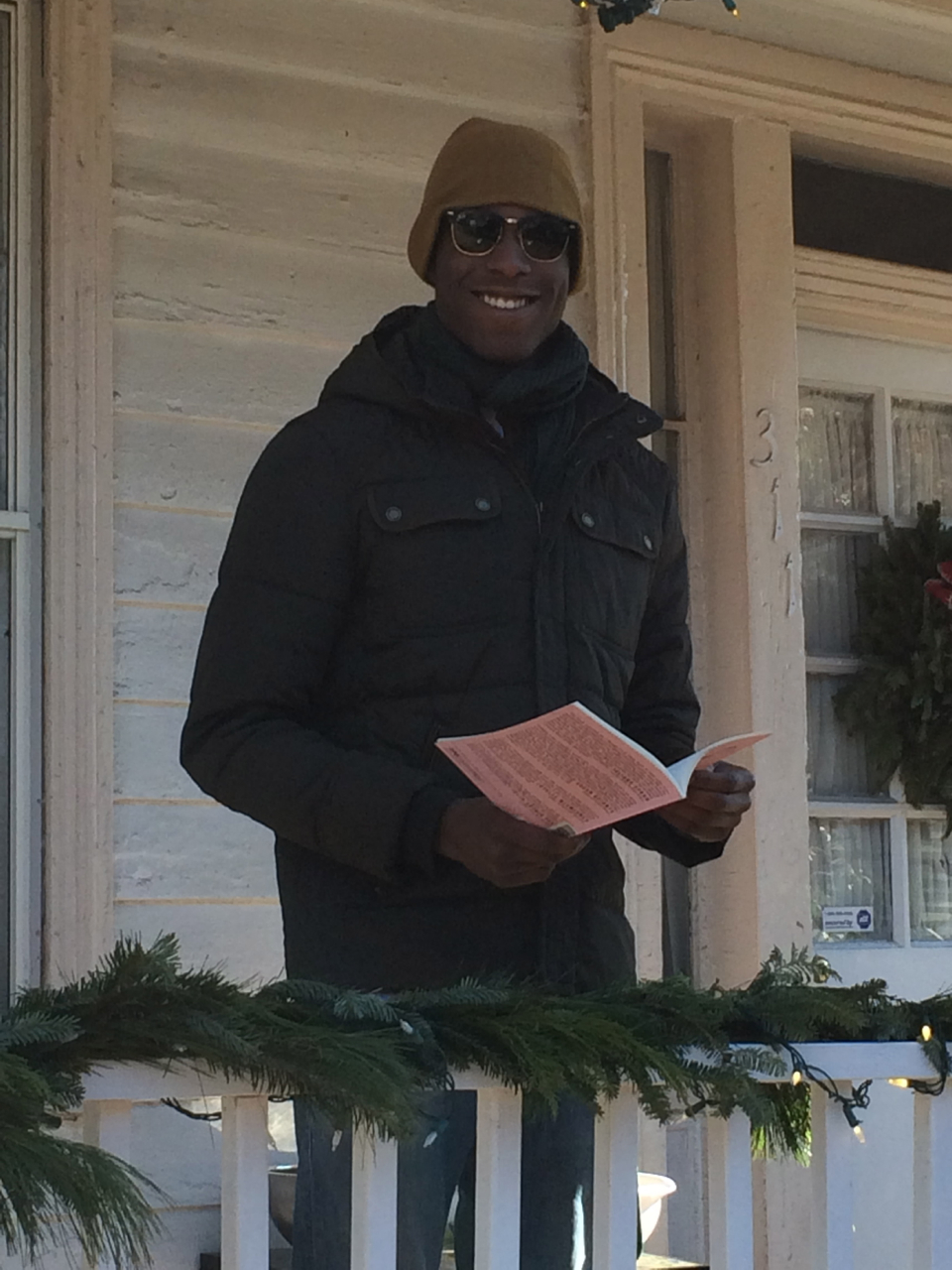
My fifteen students in ENGL 305: Writing Poetry gave a final reading on my front porch yesterday morning. They each read one of their own poems and then a poem that they loved from our required texts. We all stood down on the sidewalk for each reading. Additional audience members included the mailman, pizza guy, and several passersby in cars and on foot. My hope is to continue to have my students do public poetry projects. The following students gave me written permission to share their photos here.
Kierra Collins reading poetryNatalie Esch reading poetry on December 11, 2014 in Richmond, VirginiaGagan Kaur reading poetry on December 11, 2014 in Richmond, VirginiaColin McEligot reading poetry on December 11, 2014 in Richmond, VirginiaKelly-Jayne McGlynn reading poetry on December 11, 2014 in Richmond, VirginiaMariah Monk reading poetry on December 11, 2014 in Richmond, VirginiaAuverin Morrow reading poetry on December 11, 2014 in Richmond, VirginiaTchakalla Romeo reading poetry on December 11, 2014 in Richmond, VirginiaAlyssa Trop reading poetry on December 11, 2014 in Richmond, Virginia
“Grandpa Glenn just chillin’ on his goat cart. Photo taken around 1916. Globe, Arizona” from freeparking.
Class: Writing Poetry (Virginia Commonwealth University) Genre: Poetry Purpose: To talk about not relying simply on the drama inherent to subject matter or narrative Readings: “Song” by Brigit Pegeen Kelly and student poems
Before beginning workshop today, I read aloud Brigit Pegeen Kelly’s poem “Song” to the class as a way to open up the conversation about their own use of inherently compelling or dramatic subject matter. Of course, Kelly’s goat, whose head has been severed from its body and hung in a tree by a group of boys, is interesting; but it’s only a good poem for the ways in which Kelly works with sound, imagery, and lines. As this isn’t a close reading of the poem, I won’t go in depth about our discussion, but we did consider how poems with interesting dramatic situations, narratives, or images might fool us into thinking they are “good” poems simply because we remember the content. I urged my students to consider Kelly and her artfulness in presenting compelling subject matter when they write their own poems; to not simply rely on something that seems “meaningful”; to make it meaningful through their presentation.
I haven’t had a chance yet to give this exercise to my Writing Poetry students, but I hope to give this to them by the end of the semester. A “cadenza” is a soloist’s improvisation that later gets written into a piece of music. It’s my hope that this exercise will produce in-class improvisation that later becomes a revised poem.
Class: Writing Poetry (Virginia Commonwealth University) Genre: Poetry Purpose: To consider how pace and sound relates to emotion, tone, and intensity. Readings: One might provide the students with musical examples in lieu of readings.
Each student should select a term, study its definition, and then conceive of a poem that demonstrates the qualities of the term. The poem could embody these qualities with form, syntax, diction, sound, prosody, or any combination thereof. This term must serve as the title of the poem. For instance, “Sonata” might produce a poem in four parts that each differ in tone and pace. (30+ minutes)
Students should share their results with the class for feedback on whether or not they embodied the musical terms in their poems. Open up a discussion about how line breaks, forms, and syntax/diction create a kind of music in poems and how these can be manipulated to produce certain tonal/emotional effects in addition to those implicit in dramatic situations. (10–15 minutes)
The students will then take home the poem and revise it. Share again at a later date.
A few years ago I had a student post a fellow class member’s poem to Facebook. When I found out, I went to administration and we handled the issue according to university policy, but I felt a shockwave of distrust rumble through the class. Some members felt like they didn’t have a “safe space” in which to share their creative work. Others may not have even known what was going on, but I felt it in every workshop, reading discussion, and exercise.
In an effort to prevent this from happening again, I created a privacy policy for my syllabi, as this kind of breach has the potential to be both plagiarism and cyberbullying. I’ve tweaked it since with the help of a colleague last year and, again recently, on my own. I’ve shared it below. I encourage all educators to use something like it for your classes—and for yourselves.
WORKSHOP PRIVACY POLICY
Under no circumstance should students share the work of their peers outside class. This includes but is not limited to electronic distribution through email, forums, and social media (Facebook, Tumblr, Twitter, etc.); physical distribution through printing, photocopying, and hand copying; submission to and/or publication in journals, magazines, anthologies, or books; and appropriation of the work to fulfill requirements in this class or others. In all cases, I will drop your final grade by at least, but not limited to, two letter grades in addition to any repercussions mandated by the University.
Map of Henrico, VA showing Fortifications Around Richmond North and East of the James River, detail.
I gave the following two exercises to my Writing Poetry students in the last month. Because these exercises encourage students to build their poems upon concrete description, I’ve presented them together.
Class: Writing Poetry (Virginia Commonwealth University) Genre: Poetry Purpose: To explore strategies employed by authors we’ve read as well as situate poems in concrete details, settings, and narratives Readings:Native Guard by Natasha Trethewey and When My Brother Was an Aztec by Natalie Diaz
*
“The Side of the Road” Exercise
“What matters is context— / the side of the road”
—Natasha Trethewey, “What the Body Can Say”
Only using concrete details, describe as much as you can about your hometown or your current neighborhood without editorializing. For instance, if you believe something is “pretty”, describe those features that create its aesthetic appeal (the fleur de lis ornamentation on the porch railing, the ivy trellised up the front of the house, etc.). Your readers will likely know how you feel about the looks by how you describe what’s there. (7 min.)
Look at what you’ve written and underline those concrete details that seem signficant to a reader’s understanding of the place. Meaning, the descriptions must provide us with a clue about what’s going on there or what someone is like. Ex. On China Street in Oregon Hill, there’s a house that has abstract acrylic paintings nailed on the siding. Across the street, a small sherbert green house flies a Confederate Flag above its porch junked up with a recycling bin full of Miller Highlife and several ashtrays full of cigarette butts. In the window is a sign: “Roomate Needed / Must like Dogs” accompanied by a phone number. What does each detail reveal about the invidiuals that live in each house? What does it reveal about the neighborhood? (2 min.)
Say someone from another part of the country—or even another neighborhood—visited you here. Speculate about what that person would notice about the area. What would excite them? What would trouble them? (3 min.)
Consider what assumptions that person might have about you based on your affiliation with the place. (3 min.)
Rewrite all of this in lines, cutting out excess wording and ending on one of the telling images you previously identified without explaining what it means. Think of Trethewey ending “Again, the Fields” with “his hands the color of dark soil.” If I wrote about the two houses in Oregon Hill, I might end with this image: “the paintings and the flag will both fade in the light of day.” (5–7 min.)
*
A Pig Is A Pig Is An Idea Exercise
[Note: This is a variation on my “Headliner” exercise.]
An image is a detail that allows us to feel as if we “see” rather than understand what happened or is happening in a literary work. It’s imitative of the tangible. It suggests meaning rather than explains it. It can be within the “real world” or it can be figurative, Natalie Diaz’s men “leaning against the sides of houses” (realistic) or the coins “We are born with spinning coins in place of eyes” (figurative). In understanding how image often serves the function of both providing us with concrete details, narrative, and/or abstract ideals, thoughts, or emotions, complete the following exercise.
Describe the narrative implied by one of the following real headlines. Be sure to use descriptive details that will reveal the place/setting. In doing so, try to be as objective as possible. Only describe what’s happens as it happen. Remove any commentary or statement of meaning. Focus only on tangible details and action. You may have opinions about the people, animals, or objects involved, but don’t reveal them. Through the attention to details, you may even empathize with these characters. (15 minutes)
Pig in Australia Steals 18 Beers from Campers, Gets Drunk, Fights Cow
Hiker discovers an abandoned town inside Tennessee’s Great Smoky Mountains National Park
White Ohio lesbians suing sperm bank over mixed-race baby
Donkeys reunited at Polish zoo after sex scandal
Two die, three injured after woman drops cell phone in toilet (China) Swiss Town: Have Cave, Want (Social and Outgoing) Hermit
Davidson Co. home catches fire after man smoking tries blowing his nose (North Carolina) Jogger hospitalized after being hit by airborne deer (Dulles, Virginia) Alejandro Melendez Puts 911 Dispatcher On Hold To Complete Drug Deal (Cleveland, Ohio) Philly Bomb Scare Caused By Hotdogs At Ballpark, Mascot Implicated
Reputed Colombian Drug Lord Complains Of Claustrophobia From His Prison Cell In New York
Man In Wheelchair Robs 7/11 Of Condoms (Dallas, TX) Asian elephant cured in rehab of heroin addiction (Beijing, China) Python Kills Intern Zookeeper (Venezuela)
Now go back through your description and circle any images you find. Make a column for at least three of the images you identified. Underneath them, write down what the image literally represents to the reader and then record the literal and abstract connotations that might arise from each image. For instance, if you wrote “the pig’s jowls, bearded in foam” for the first headline, you might come up with this: (10 min.)
Literal Representation: the pig has just been drinking beer that produced the foam Connotations: the pig has rabid qualities; the beard implies a kind of personification, taking on of man’s roles/behaviors; the pig is out of control; the speaker is in awe of the scene and endangers herself by looking this closely at the pig; the pig is fat because of the word “jowls”; “jowl” is used in butcher charts, so therefore this pig is meat, it’s a commodity; the pig is adorned with things outside its natural habitat and therefore this poem suggests that there’s an intersection between nature and humanity; etcetera.
Based on these literal and abstract connotations, select the image from your list that best represents you personal feelings about the people, objects, and/or actions in this narrative. Now rewrite the poem and end only on that image without explanation. (10 min.)
Advertisement for “Nerve Food”. The headlines read “The Evidence of Toronto People – Dr. Chase’s Nerve Food” and the text of the ad contains testimonials about the product for six users from Toronto.
Purpose: To encourage students to be generous, curious, and discerning readers of poetry and to consider poetry’s impact on culture.
Readings:Poetry‘s July/August 2014 issue that includes poems by Dean Young, Philip Fried, D.A. Powell, Traci Brimhall, Devin Johnston, Rosanna Warren, Amanda Calderon, Thomas Sayers Ellis, Rickey Laurentiis, Timothy Donnelly, and Alice Fulton
Sharing “Why Is Poetry Relevant?” Assignment
Several volunteers will share their “Why Is Poetry Relevant?” assignment (500 words, completed outside of class) in order to start a discussion on the topic. Students should feel free to debate this question, supporting and/or countering one another’s arguments. Some students may take a more person approach, answering the question “Why is poetry relevant to me, my life?,” whereas other students might consider macro reasons as in, “Why is poetry relevant to society? Our culture? Politics?”
ON POETRY’S RELEVANCY
In a class in which the term “relatable” is banned, it may be difficult to understand why the “relevancy” of poetry is, well, relevant to our discussion. Aren’t these two concepts synonymous? Don’t they both suggest poetry’s ability to appeal to our emotional, cultural, or intellectual needs? Let’s break it down. “Relatability” as a concept, used in comments like “The poem’s subject matter of a child’s dog being run over by a car is so relatable because we’ve all lost something or someone that’s close to us,” has the expectation that, as Rebecca Mead writes in The New Yorker, “the work itself be somehow accommodating to, or reflective of, the experience of the reader or viewer.” “Relevancy,” however, suggests that the work has social or practical pertinence or applications, meaning you can use the poem as a means to access other points of view and to understand your own role in society. “Relatability” is a connection between what you’ve already done and what’s happening in the poem. “Relevancy” is a movement between who you are now and how you can understand what’s going on in the world. “Relatability” is predicated on the past, whereas “relevancy” is predicated on the present and, for some, what’s to come. One looks backward, one looks forward. “Relatability” is passive, and “relevancy” is active.
Patricia Smith’s poem “Skinhead” is in the persona of a white supremacist who says things like:
I’m just a white boy who loves his race,
fighting for a pure country.
Sometimes it’s just me. Sometimes three. Sometimes 30.
AIDS will take care of the faggots,
then it’s gon’ be white on black in the streets.
Scary, right? It may be helpful to know that Patricia Smith is a poet of African descent. So, ask yourselves, why has she chosen to write in the voice of a violent white supremacist? Perhaps it’s an act of empathy, of trying to understand this person, but I imagine it would be incredibly hard to have any sort of tenderness toward such a person. Or: she has chosen to draw our attention to this kind of voice in our country so that we can know about this sort of threat. Or: she has situated herself in direct with white supremacists and saying, “See, I know what you’re thinking.” In that way, it may make her appear stronger for having gone through the writing of this poem, and in some ways, she may have triumphed over this point of view by bearing witness to it. Whatever the reason, this poem is certainly not “relatable” to Patricia Smith or, I hope, to you. But is it relevant? Discuss.
In-Class Assignment
Break up into groups of two or three. I will assign each group one poem from the July/August 2014 issue of Poetry that you read over the weekend. Read the poem, and then compare your “Why Is Poetry Relevant?” essays. Now, do the following:
Write down how this poems moves. Is it narrative (it tells a story)? Associative, meaning it jumps around a lot? If it’s associative, consider how the poet jumps between each line? For instance, in “Romanticism 101” by Dean Young, what’s the train of thought that has “Then I realized I hadn’t secured the boat. / Then I realized my friend had lied to me. / Then I realized my dog was gone” all on the same tracks? (How do the boat/friend/dog relate?) Is it literal, meaning it sticks to “Just the facts” or does it employ figurative language like simile and metaphor (as Rosanna Warren does: “still she offered each song, / she said, like an Appalachian artifact.”)
Now compare your “Why Is Poetry Relevant?” essays. Does this poem exemplify any of the points in your essays? Why or why not? Be sure to address points made in each essay.
If you didn’t think the poem exemplified some of your points, think of why other readers might find the poem valuable. If the poem did appeal to your points, think about why other readers might not think the poem is valuable? Consider multiple points of view. Write this down and type it up later as an addendum to your essays. Post it to Blackboard before Thursday, August 28th.
Purpose: To encourage students to look for the relevancy of their studies to culture; to consider the effects that poetry has on readers; and to explore their own motivations for seeking out poetry instruction.
Readings:Poetry‘s July/August 2014 issue that includes poems by Dean Young, Philip Fried, D.A. Powell, Traci Brimhall, Devin Johnston, Rosanna Warren, Amanda Calderon, Thomas Sayers Ellis, Rickey Laurentiis, Timothy Donnelly, and Alice Fulton
I’ve asked my students to write at least 500 words on “Why Is Poetry Relevant?” after they read Poetry‘s July/August 2014 issue this weekend. On Thursday, we talked a little bit about our expectations for what poetry is, can be—that many people believe that poetry was something impenetrable and written a century or more ago. My hope is that they will investigate this question on their own and arrive at a diverse conclusions on why poetry is relevant. With that, I’ll point you back to the opening of my Writing Poetry course description as a clue for this assignment’s motivations:
American poet C.D. Wright once wrote: “If I wanted to understand a culture, my own for instance . . . I would turn to poetry first. For it is my confirmed bias that the poets remain the most ‘stunned by existence,’ the most determined to redeem the world in words.” In this course, we will hold poetry to this noble standard, as an amplifier for the voices in our culture and an invocatory rendering of our world.




 Emilia Phillips