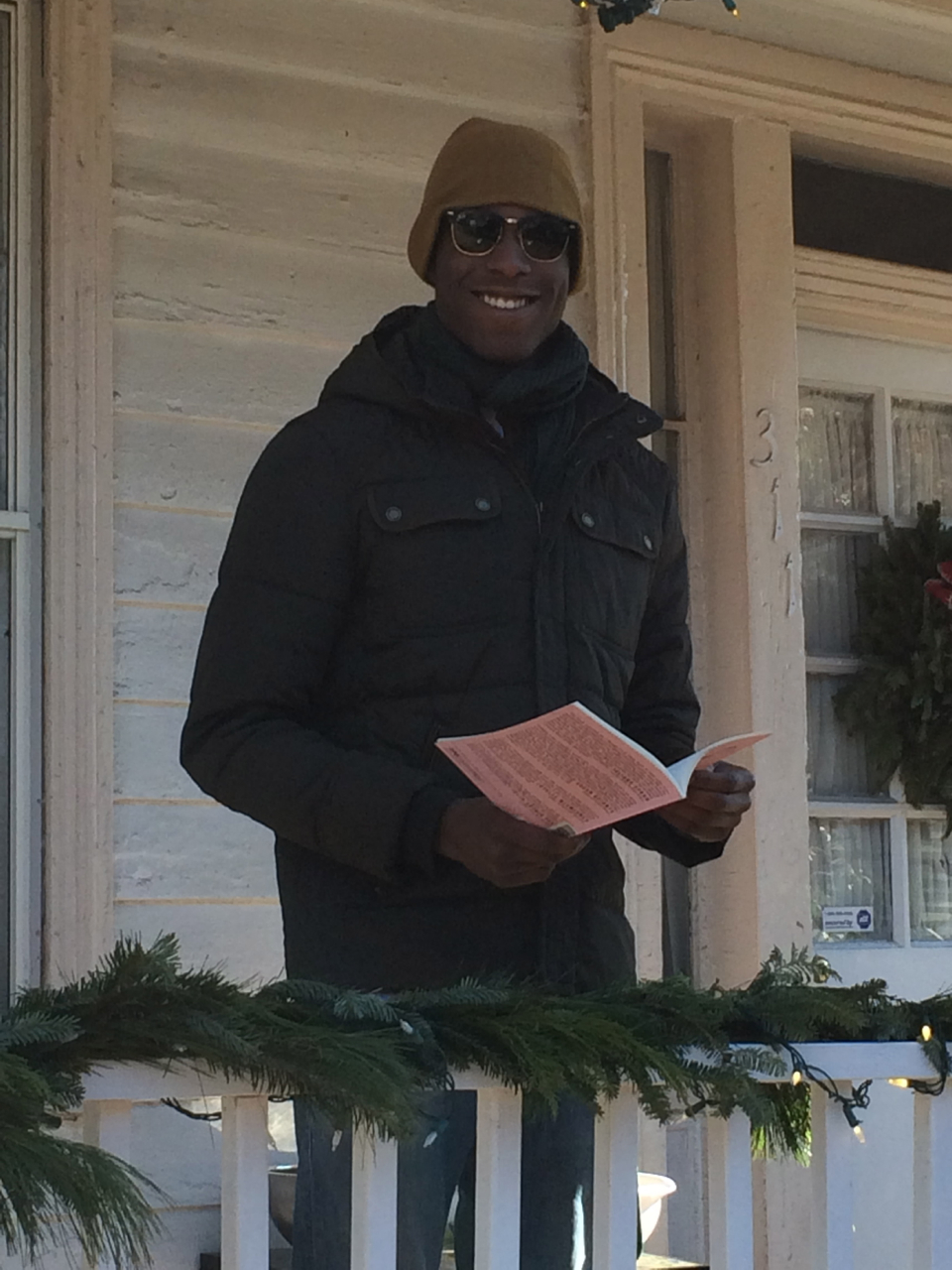
My fifteen students in ENGL 305: Writing Poetry gave a final reading on my front porch yesterday morning. They each read one of their own poems and then a poem that they loved from our required texts. We all stood down on the sidewalk for each reading. Additional audience members included the mailman, pizza guy, and several passersby in cars and on foot. My hope is to continue to have my students do public poetry projects. The following students gave me written permission to share their photos here.
Kierra Collins reading poetryNatalie Esch reading poetry on December 11, 2014 in Richmond, VirginiaGagan Kaur reading poetry on December 11, 2014 in Richmond, VirginiaColin McEligot reading poetry on December 11, 2014 in Richmond, VirginiaKelly-Jayne McGlynn reading poetry on December 11, 2014 in Richmond, VirginiaMariah Monk reading poetry on December 11, 2014 in Richmond, VirginiaAuverin Morrow reading poetry on December 11, 2014 in Richmond, VirginiaTchakalla Romeo reading poetry on December 11, 2014 in Richmond, VirginiaAlyssa Trop reading poetry on December 11, 2014 in Richmond, Virginia
A postcard (circa 1900–1920), found at a Richmond-area antique store
In addition to prison poetry workshops, let’s do police poetry workshops. I believe that poetry—all art—has the ability and responsibility to guide others into new perspectives. In “Tide of Voices: Why Poetry Matters Now,” Mark Doty says:
People who read imagine the lives of others. Literature makes other people more real to us. It invites us to notice differences but, even more so, points toward commonality.
Reading makes us more attuned to the needs, wants, and experiences of others and, therefore, has the potential of making us more conscientious citizens. I am the daughter of a former police officer and I was raised as the stepdaughter to another. Of course, there are good cops out there who genuinely strive to protect citizens. That being said, with the recent events in Ferguson—both the shooting of Michael Brown by Darren Wilson and the police response to the community’s riots—and in Staten Island—the chokehold death of Eric Garner—I’m concerned about the tendency toward violence and discrimination by our nation’s law enforcement.
As mentioned in my previous post, last year I encountered a cop who told me he had a book of poetry in his car. He asked me questions about poetry and what he should read. When I shared this story via social media, poet Staci R. Schoenfield led me to the idea of police poetry workshops when she said she suggested “arming police with poetry.”
Could poetry have a meaningful impact on police officers? What if we were to offer poetry workshops for law enforcement? While prison poetry workshops have been established in many communities across the nation, it strikes me that it also assumes that convicts are the only ones in need of these exercises in creativity, empathy, and imagination. While I’m certain that these prison or probation poetry workshops are doing vital and important work, why not also address the other side? Perhaps poetry workshops won’t alter systemic problems in the justice system, but they could have a meaningful impact on individual officers or groups of officers. In response to the recent deaths of black men at the hands of police, Claudia Rankine writes: “Because white men can’t police their imaginations, black men are dying.” Can we change this through poetry?
When I posted the idea for this program on social media, a friend posted a link to Art At Work’s “Thin Blue Lines” project and poetry calendar. Art At Work is “a national initiative to give municipal governments the powerful resource that comes from direct creative engagement.” They partnered with Portland, Maine’s police department and asked their officers to write poems that were then published as calendars. This is the only initiative that I know about right now that directly engages police officers in writing poetry, but if you have any information about similar programs in your area, please contact me using the form below.
I’m looking into the possibility of starting a police poetry workshop in my own community, and I encourage others to do the same. As I find out more information, I will post it here.
I want to get a group of poets and poetry readers together to go door-to-door reading poems in the community for the holidays. The poems should be about community, but that doesn’t mean that they should be easy, “rah-rah” poems. Rather, they should engage issues that the community faces—that our nation faces—that will also provide something to the listener, be it a new perspective, an idea, or even hope.
Although I’m going to try to launch this in my own neighborhood—Oregon Hill in Richmond, Virginia. My hope is that this could eventually happen in neighborhoods all over the United States. These groups could even ask their neighbors several questions like:
When was the last time you read a poem?
What was the greatest challenge you faced in reading poems?
Do you feel like the poems you had previous experience with appealed to your own life?
Do you know that poets are still writing today?
Did this poem address a concern that you have about your community?
Additionally, poetry educators could ask their students to be a part of the program, as a service learning endeavor.
Of course, not all neighbors would be receptive to this project, but some people would at least listen. Others might be engaged or inspired.
The seed for this project comes from an encounter I had with a police officer who was looking for the previous tenant at my house. When he asked me what I teach, he told me had a book of poetry in his cruiser. We talked for over thirty minutes about poetry and how he wanted to understand it better. This whole exchange happened on my front porch.
If you are interested in this project and would like to talk about collaborating on a door-to-door poetry caroling project in your neighborhood, please contact me through the form below.
Advertisement for “Nerve Food”. The headlines read “The Evidence of Toronto People – Dr. Chase’s Nerve Food” and the text of the ad contains testimonials about the product for six users from Toronto.
Purpose: To encourage students to be generous, curious, and discerning readers of poetry and to consider poetry’s impact on culture.
Readings:Poetry‘s July/August 2014 issue that includes poems by Dean Young, Philip Fried, D.A. Powell, Traci Brimhall, Devin Johnston, Rosanna Warren, Amanda Calderon, Thomas Sayers Ellis, Rickey Laurentiis, Timothy Donnelly, and Alice Fulton
Sharing “Why Is Poetry Relevant?” Assignment
Several volunteers will share their “Why Is Poetry Relevant?” assignment (500 words, completed outside of class) in order to start a discussion on the topic. Students should feel free to debate this question, supporting and/or countering one another’s arguments. Some students may take a more person approach, answering the question “Why is poetry relevant to me, my life?,” whereas other students might consider macro reasons as in, “Why is poetry relevant to society? Our culture? Politics?”
ON POETRY’S RELEVANCY
In a class in which the term “relatable” is banned, it may be difficult to understand why the “relevancy” of poetry is, well, relevant to our discussion. Aren’t these two concepts synonymous? Don’t they both suggest poetry’s ability to appeal to our emotional, cultural, or intellectual needs? Let’s break it down. “Relatability” as a concept, used in comments like “The poem’s subject matter of a child’s dog being run over by a car is so relatable because we’ve all lost something or someone that’s close to us,” has the expectation that, as Rebecca Mead writes in The New Yorker, “the work itself be somehow accommodating to, or reflective of, the experience of the reader or viewer.” “Relevancy,” however, suggests that the work has social or practical pertinence or applications, meaning you can use the poem as a means to access other points of view and to understand your own role in society. “Relatability” is a connection between what you’ve already done and what’s happening in the poem. “Relevancy” is a movement between who you are now and how you can understand what’s going on in the world. “Relatability” is predicated on the past, whereas “relevancy” is predicated on the present and, for some, what’s to come. One looks backward, one looks forward. “Relatability” is passive, and “relevancy” is active.
Patricia Smith’s poem “Skinhead” is in the persona of a white supremacist who says things like:
I’m just a white boy who loves his race,
fighting for a pure country.
Sometimes it’s just me. Sometimes three. Sometimes 30.
AIDS will take care of the faggots,
then it’s gon’ be white on black in the streets.
Scary, right? It may be helpful to know that Patricia Smith is a poet of African descent. So, ask yourselves, why has she chosen to write in the voice of a violent white supremacist? Perhaps it’s an act of empathy, of trying to understand this person, but I imagine it would be incredibly hard to have any sort of tenderness toward such a person. Or: she has chosen to draw our attention to this kind of voice in our country so that we can know about this sort of threat. Or: she has situated herself in direct with white supremacists and saying, “See, I know what you’re thinking.” In that way, it may make her appear stronger for having gone through the writing of this poem, and in some ways, she may have triumphed over this point of view by bearing witness to it. Whatever the reason, this poem is certainly not “relatable” to Patricia Smith or, I hope, to you. But is it relevant? Discuss.
In-Class Assignment
Break up into groups of two or three. I will assign each group one poem from the July/August 2014 issue of Poetry that you read over the weekend. Read the poem, and then compare your “Why Is Poetry Relevant?” essays. Now, do the following:
Write down how this poems moves. Is it narrative (it tells a story)? Associative, meaning it jumps around a lot? If it’s associative, consider how the poet jumps between each line? For instance, in “Romanticism 101” by Dean Young, what’s the train of thought that has “Then I realized I hadn’t secured the boat. / Then I realized my friend had lied to me. / Then I realized my dog was gone” all on the same tracks? (How do the boat/friend/dog relate?) Is it literal, meaning it sticks to “Just the facts” or does it employ figurative language like simile and metaphor (as Rosanna Warren does: “still she offered each song, / she said, like an Appalachian artifact.”)
Now compare your “Why Is Poetry Relevant?” essays. Does this poem exemplify any of the points in your essays? Why or why not? Be sure to address points made in each essay.
If you didn’t think the poem exemplified some of your points, think of why other readers might find the poem valuable. If the poem did appeal to your points, think about why other readers might not think the poem is valuable? Consider multiple points of view. Write this down and type it up later as an addendum to your essays. Post it to Blackboard before Thursday, August 28th.
Purpose: To encourage students to look for the relevancy of their studies to culture; to consider the effects that poetry has on readers; and to explore their own motivations for seeking out poetry instruction.
Readings:Poetry‘s July/August 2014 issue that includes poems by Dean Young, Philip Fried, D.A. Powell, Traci Brimhall, Devin Johnston, Rosanna Warren, Amanda Calderon, Thomas Sayers Ellis, Rickey Laurentiis, Timothy Donnelly, and Alice Fulton
I’ve asked my students to write at least 500 words on “Why Is Poetry Relevant?” after they read Poetry‘s July/August 2014 issue this weekend. On Thursday, we talked a little bit about our expectations for what poetry is, can be—that many people believe that poetry was something impenetrable and written a century or more ago. My hope is that they will investigate this question on their own and arrive at a diverse conclusions on why poetry is relevant. With that, I’ll point you back to the opening of my Writing Poetry course description as a clue for this assignment’s motivations:
American poet C.D. Wright once wrote: “If I wanted to understand a culture, my own for instance . . . I would turn to poetry first. For it is my confirmed bias that the poets remain the most ‘stunned by existence,’ the most determined to redeem the world in words.” In this course, we will hold poetry to this noble standard, as an amplifier for the voices in our culture and an invocatory rendering of our world.
With the fall semester starting at Virginia Commonwealth University this week, I have started to think about some new writing and reading exercises for my students. As these exercises will relate with our course goals and readings, I thought I would share my course descriptions and reading lists for my two classes, English 215: Textual Analysis and English 305: Writing Poetry.
ENGL 215: Textual Analysis
Course Description
“The Captive Body, The Body Captivating”—In order to investigate the means by which writers have control over textual bodies, we will examine a century’s worth of narratives about individuals’ control, or lack thereof, over their physical bodies. Beginning with Franz Kafka’s The Metamorphosis (1915) and working our way toward Leslie Jamison’s The Empathy Exams: Essays (2014), we will explore through class discussion and written assignments the relationships between identity, form, and point of view. In doing so, students will hone their abilities as close readers and critical thinkers, analyzing the writers’ choices in presenting these narratives and their effects on the reader, as well as the historical significance of each text and its consequence in today’s debates about individuals’ rights over their own bodies. In addition to the following primary texts, we will also read criticism that reflects a diverse approach to these issues, including new criticism, feminist and queer theory.
Required Texts
Atwood, Margaret. The Handmaid’s Tale. Knopf Doubleday, 1998. ISBN: 978-0385490818.
Carson, Anne. Autobiography of Red. Vintage, 1999. ISBN: 978-0375701290.
Huxley, Aldous. Brave New World. HarperCollins, 2006. ISBN: 978-0060850524.
Jamison, Leslie. The Empathy Exams: Exams. Graywolf, 2014. ISBN: 978-1555976712.
Kafka, Franz. The Metamorphosis, In The Penal Colony, and Other Stories. Touchstone, 2000. ISBN: 978-0684800707.
Nabokov, Vladimir. The Annotated Lolita: Revised and Updated. Vintage, 1991. ISBN: 978-0679727293.
Ward, Jesmyn. Salvage the Bones. Bloomsbury, 2012. ISBN: 978-1608196265.
ENGL 305 Writing Poetry
Course Description
American poet C.D. Wright once wrote: “If I wanted to understand a culture, my own for instance . . . I would turn to poetry first. For it is my confirmed bias that the poets remain the most ‘stunned by existence,’ the most determined to redeem the world in words.” In this course, we will hold poetry to this noble standard, as an amplifier for the voices in our culture and an invocatory rendering of our world. In doing so, I’ll ask you to not only read and write poetry but begin to look at your surroundings as a poet would. This requires close examination of images, scrutiny of your thoughts and feelings about subject matter, and consideration for other points of view. Additionally, you will be asked to think deeply about language, in terms of its meanings, its sounds, and its rhythms. You should bring to this class a hard work ethic supported by curiosity and generosity. As a means of introduction to the craft of poetry, students will submit original poems for workshop, a collaborative discussion about writing techniques and their effects on readers. In addition to workshop, you will be asked to engage with the writing of contemporary poets, to read like a writer would. I’ve chosen seven contemporary poetry collections and Poetry magazine so that you will have a lens through which to examine the current landscape of American poetry and to see that even today poets are still trying to “redeem the world in words.”
Required Texts
Bendorf, Oliver. The Spectral Wilderness. Kent State University Press, 2014. ISBN: 978-1606352113.
Diaz, Natalie. When My Brother Was an Aztec. Copper Canyon Press, 2012. ISBN: 978-1556593833.
Emerson, Claudia. Secure the Shadow. Louisiana State University Press, 2012. ISBN: 978-0807143032.
Faizullah, Tarfia. Seam. Southern Illinois University Press, 2014. ISBN: 978-0809333257.
Reeves, Roger. King Me. Copper Canyon Press, 2013. ISBN: 978-1556594489.
Smith, Carmen Giménez. Milk and Filth. University of Arizona Press, 2013. ISBN: 978-0816521166.
Each class member should respond to a poem written by the person seated on their right. They can argue or interrogate an idea, provide an anecdotal narrative that relates to the first person, or work associatively away from the original kernel to access something new. Participants should remember their addressee’s personality, concerns, and
The next step has two variations. Students should then write a response to:
the response to their own poem so as to create a dialogue between the two poets, or
the response written by their original addressee so as to create a chain of communication.
Ask that the students bring in one of their favorite poems. (My students brought in “Meditation at Lagunitas” by Robert Hass, “Fever 103°” by Sylvia Plath, and “[Carrion Comfort]” by Gerard Manley Hopkins.) Have each student read the selection to the class and lead a discussion on the poem’s features, movement, and form.
Consider some of the ways one can write imitations:
Imitate all or many of the strategies of that specific poem.
Imitate general features of the poet’s style.
Write a poem in the persona of the poet. (His/her general voice, not just the voice on the page.)
Do a loose imitation using one element of the original poem. This could even include response poems, poems with lines of that poet, etcetera.
Then have them do the following exercise:
Write an imitation of the poem you brought in. (15 min.)
Write an imitation of one of the other poems. (15 min.)
Discuss. What imitation strategy did you choose? Why? Did you find yourself more able to imitate your selection or another’s? Why? Which imitation was hardest? Can you more easily discern some of your own fundamental orientation to language, ticks, go-to strategies, etcetera through the imitation process?
Think about a poem that you’ve been wanting to write for a long time but haven’t been able to successfully accomplish. It works best if this is a personal memory or other narrative.
Discuss each of the following approaches and the read their respective suggested poems:
Anecdotal: A simple story in one setting, usually in plain speech. See “Black” by Alan Shapiro.
Imperative: A second person address with instructions, based on an extended metaphor or literal. See “How to Live in a Trap” by Eleanor Ross Taylor.
Meta: A response to an event that takes into account writing’s inability to fully capture the event. See “Photograph of September 11th” by Wislawa Szymborska and “The streetlamp above me darkens” by Tarfia Faizullah.
Figurative: A characterization of an event or action through metaphor. See “Boy Breaking Glass” by Gwendolyn Brooks.
Collage: A poem that uses multiple of these approaches and usually isn’t afraid to associate away from and back again to the original motivation. See “My Story In a Late Style of Fire” by Larry Levis of “Across the Sea” by Dana Levin.
After discussing each approach, take ten minutes to write your narrative using only that approach. Move on to the next one and repeat.
At the end, ask yourself: How did the poem change? Did the poem become more or less imaginative? Which one do I like the most? Why? Share.
Belauscht (1874) by Carl Wilhelm Hübner Class: Intro to Creative Writing Genre: Drama Readings: Edward Albee’s Who’s Afraid of Virginia Woolf? Time: 45+ minutes
1. Have students pair off. One person per group should be in charge of transcription.
2. Leave the classroom. Take the students to a common area on campus like the student union, cafeteria, or the quad. Once you are there, have the groups split up and walk through the crowd. Encourage them not to linger in any one place. They should write down the most compelling and/or bizarre sentence they hear someone say. Examples: “I ate a whole pound of Swedish Fish and it cost me like 35 dollars!” “How old are you?” (10 minutes.)
3. Return to the classroom. Have each group pass their transcribed line to the group on their right.
4. On the board, write down a pair of character roles in a specific setting for each group. I gave my classes the following character/setting sets:
a. Two waste disposal workers on the back of a garbage truck.
b. A veterinarian and the owner of a pet in the exam room.
c. The host and a contestant on the game show.
d. A teenager with driver’s ed instructor in the car.
e. A police officer and an arrested person in cruiser.
f. A priest and a congregant in confession booth.
g. Two single people on a speed date at a bar.
5. Each group should read aloud the line passed to them. Assign character/setting sets to the groups based on these lines. Play it safe and assign the characters/setting to lines that seem natural, or see what happens if you make unexpected pairings. (Hint: Students often have more fun with unexpected pairings.)
6. The line provided will serve as the first line of the scene involving their assigned character/setting sets. Each student should assume the role of one of the characters. Each will respond to their partner’s line by passing the paper back and forth. (30 min.)
7. Share.
This exercise allows students to work collaboratively to create a narrative through dialogue, a skill that many of my students cite as the hardest thing to accomplish in their first plays. Additionally, their time in the crowd locates them in conversational rhythm and dynamics so that the information about the plot doesn’t seem unnatural to the conversation. The assigned lines provide them with an inciting action as well as a clue toward their new character’s personality. The hope is that once they are writing on their own, they will be able to recreate these investigative processes on characters of their own.






 Emilia Phillips