Class: Introduction to Creative Writing (The College of William & Mary) Genre: Nonfiction Purpose: To explore the self as a character and subject Readings: Chapters 8 (“Creative Nonfiction”) in Janet Burroway’s Imaginative Writing and “Nobody Knows Your Name” of Eula Biss’s Notes from No Man’s Land
Do you know the story of your name? Its meaning and its history? Do you know why your parents named you what they named you? Are there other famous people with your name? Is your name particularly popular or obscure? What does your last name say about your ancestry, if anything? What are misconceptions about your name? Is your name easily mispronounced or misspelled; if so, give us a narrative about someone getting your name wrong. Are their misconceptions about you based on your name? How would address those who make judgments on a person based on their name? If you don’t know what your name means, speculate and/or invent your own personal meaning for your name based on your experiences, the sounds in your name, etc.. Do you define your name or does your name define you? Write for 10 minutes.
My Textual Analysis class is discussing two essays titled “Goodbye To All That,” the first, of course, by Joan Didion and the second, a response by Eula Biss. We’ll be considering literary influence and response.
For my intro to creative writing class at William & Mary this semester, I’m asking students to write one hybrid work as their final workshop piece. Often I feel like these introductory classes set up limits for students, but I wonder if allowing them to see genre as something that’s a little more fluid will encourage continued reading across the genres, an understanding that writing techniques can be used across genres, and creativity with the execution of their ideas. They will be reading a few hybrid texts at the end of the semester, too. The hybrid assignment will also give us a chance to review what we’ve gone over about the three genres by forcing us to consider their respective challenges. I think it will also give students the opportunity to tackle issues they faced across multiple assignments. Say they struggled with point of view in their poetry and concrete details in their nonfiction, but the poems presented strong images and their nonfiction offered an unwavering first-person. Perhaps they’ll be able to double up on their strengths through a hybrid work.
Regardless of the success of their pieces, I hope that we can have a great discussion that will prepare them for debates about form and theory in upper-level, genre-specific courses. Additionally, I don’t want to have a situation where I say, “You’ll discuss these forms if you choose to continue taking creative writing courses.” I want to be able to answer these inevitable questions thoroughly, not offhandedly in a minute or so in the middle of a workshop. Besides, you never know which discussion might excite a student about writing. Maybe those slippery hybrid genres are what really interest some students and they might not know it until you offer it to them!
I taught a class titled “No River, No Bridge: Writing Poetry, Writing Nonfiction” at Appomattox Regional Governor’s School’s Writers’ Fest yesterday. We discussed hybridity of poetry and nonfiction, as well as the ways in which poetry can take on and explore “truth” using essayistic strategies without the requirement of “fact.” Several students came up afterward to show me their exercises, and one told me that she felt like it was one of the best things she’s written. The class ranged from high school students to adults.
In this course we will examine works of poetry and creative nonfiction in order to open up these genres to hybrid works. We will discuss features that are shared by the genres, how to bend the rules, and look at some examples before doing an exercise.
With over forty students in a one-hour class, we had these objectives:
Examine definitions of genre and the elements therein.
Think about the function and aims of each genre.
Read excerpts of texts that bridge the gap between poetry and nonfiction.
Write some assays—yes, some attempts—that use both poetry and essay strategies.
Examine definitions of genre and the elements therein. We looked at definitions of essays and lyric essays and Edward Hirsch’s definitions of line, lineation, lyric, prose poem, and stanza from A Poet’s Glossary. We looked at these definitions because they seek to define and, therefore, draw boundaries. We needed to know these definitions in order to explode these boundaries. In particular, we looked at Hirsch’s definition of line, in which he quotes Longenbach:
“Poetry is the sound of language organized in lines,” James Longenbach asserts in The Art of the Poetic Line (2008). “More than meter, more than rhyme, more than images or alliteration or figurative language, line is what distinguishes our experience of poetry as poetry, rather than some other kind of writing.”
And compared it to the prose poem definition:
A composition printed as prose that names itself poetry. The prose poem takes advantage of its hybrid nature—it avails itself of the elements of prose (what Dryden called “the other harmony of prose”) while foregrounding the devices of poetry. . . . Baudelaire used prose poems to rebel against the straitjacket of classical French versification. He dreamed of creating “a poetic prose, musical without rhyme or rhythm, supple and jerky enough to adapt to the lyric movements of the soul, to the undulations of reverie, to the somersaults of conscience.” Baudelaire’s prose poems—along with Rimbaud’s Les Illuminations (1886) and Malarmé’s Divagations (1897)—created a mixed musical form (part social, part transcendental) that has been widely and internationally practiced in the twentieth century. “There is no such thing as prose,” Malarmé insisted in 1891. “There is the alphabet, and then there are verses which are more or less closely knit, more or less diffused. So long as there is a straining toward style, there is versification.”
We thought about these paradoxes, discussed why lineation makes a poem a poem, as well as considered some alternative definitions. We then examined Hirsch’s definition of “lyric”—
The lyric poem immerses us in the original waters of consciousness, in the awareness, the aboriginal nature, of being itself. . . . The lyric, which offers us a supposed speaker, a person to whom we often assign the name of the author, shades off into the dramatic utterance
—in juxtaposition with a discussion of point of view in essay. Think about the function and aims of each genre. When I think about the intersections and differences of poetry and nonfiction, it’s helpful for me to illustrate the two genres with metaphors.
Poem as a river. With all of their musical elements, I think of poems as a river—something fluid, flowing, that rushes and eddies, deltas, and empties out to sea. Poems are one of our oldest forms of literature and therefore seem natural to our landscape of language.
Essay as a bridge. The essay, an analytical form, builds upon its subject piece by piece, element by element, fact by fact, experience by experience. We might think about this strategy as similar to building pillars with blocks, hammering planks together, supporting and trussing.
We might use these metaphors to understand hybrid works—nonfiction prose poems, lyric essays—better. Sometimes a poem is a river we want to cross; we see and hear the rushing water, but we want to examine it from a sturdy vantage point where we stay safe and dry. Some music comes into the poem, but we rely on the exposition that essays provide. Adversely, we could be in the water, prone to the rapids, splashed in the face, paddling fiercely. Just trying to stay afloat in the overflow of language, of experience. There are times, however, where we might pass under the shadow of a bridge, have insights into reason, into conquering this flow, bridging one experience to another. Read excerpts of texts that bridge the gap between poetry and nonfiction.
“Say It, Say It Anyway You Can” by Vievee Francis (two versions—the prose poem version from Rattle and the lineated version that appeared in her collection Horse in the Dark). Let’s take a look at this poem, which started off as a prose poem and then became a lineated poem. Discuss the poet’s possible reasoning for lineating the poem. What are the effects of the two forms?
An excerpt from Citizen by Claudia Rankine and an excerpt from Bluets by Maggie Nelson. Talk to me a little bit about what these prose forms borrow from poetry. Are they poetry? (How were they marketed? How were they identified?) Is it enough to say something is poetry? Nonfiction? Are these true hybrids? How would you categorize it? Does it need to be categorized?
Write someassays—yes, some attempts—that use both poetry and essay strategies.
“No River, No Bridge” Exercise
Select an everyday object that’s in your house. Ex. a television, a pair of jeans, a can of kidney beans. (1 min.)
Now describe the object using all of your senses, with only concrete details. Do not use any metaphors or other figurative language. (2 min.)
Imagine how the object was made. Write a step-by-step description of its fabrication. (3 min.)
Imagine the harvesting, mining, or creation of the raw materials that went into making this object. (i.e. the shearing of sheep for your wool sweater or the mining of silicone to make your iPhone). Describe. (2 min.)
Now talk a little bit about how you came to own this object (and talk about not remembering how you got it, if that’s true.) Tell us the backstory. Or, what connotations does the object have? Do you have specific memories associated with it? (2 min.)
Now describe the object using only metaphors. (“My pair of jeans is muddy water reflecting sky, a bird with clipped wings . . . ”) (2 min.)
Share and discuss: How has the object changed in each iteration (concrete description, origin story, deconstruction, entrance, emotional connection, metaphorical naming)? Which form (poetry or essay) better conveys these approaches? Why? How can we combine these strategies?
“Dead City III (City on the Blue River III)” (1911) by Egon Schiele Class: Writing Out of the Ordinary Genre: Poetry/Nonfiction Readings: Maggie Nelson’s Bluets Time: 30 minutes
Identify one thing you have been obsessed with for quite some time.
Detail a direct encounter with that thing. Be as descriptive as possible.
Name the first person you can think of who is missing from your life.
Write down something you never told them. (A confession, an idea, a story, etcetera.)
Remind that person of something you did together. Tell the narrative.
Is there a connection between the thing and the person? Explain.
Write down the first thing and then write the next five words that come to your mind in an associative chain from one word to the next.
Now pick one of those things on the list and write about an encounter you had with that thing.
from People’s Cyclopedia of Universal Knowledge (1883)
A student wrote to me over the weekend to request a prompt for my Intro to Creative Writing‘s 5–7 page creative nonfiction assignment. Although I usually encourage students to locate their own subject matter as it’s a critical skill and they’ll likely care more about their handpicked subjects, I came up with several prompts that I’ll hold onto for future students who need a place to start.
The Conversationalist
Is there a story or several stories that you like to tell friends or new people you meet? Is the subject matter related or disparate? Write the story/stories that you tell, and the narrative of telling these stories. How have people reacted? Reflect. Why do you tell these stories? Do you find yourself wanting to create a certain impression on listeners? This piece, as it has three narrative components, has a lot of promise for fulfilling the page requirement.
Just a Phase
Was there a time that you tried to “be someone else,” to adopt a different personality? Describe in detail. Did you change your clothes? Your hair? Your interests? Your speech or accent? Many of us go through identity crises especially as adolescents. What did you do while you tried this out? Did you go somewhere? Did you make a fool of yourself or pull it off? When did you realize it wasn’t right for you? Why change? Do you feel nostalgic now? Show this.
Witness
Have you ever witnessed something violent, unsettling, or scary? Write about this and your reaction after. How long did it affect you? How did it change you? Did you intervene? Why or why not? Do you regret your decision to become involved or not involved? (See “Accident, June 1948” by Seamus Deane for an example.)
Garage met Chauffeurswoning te Zandvoort (1916) by Guillaume Frédéric la CroixClass: Intro to Creative Writing Genre: Creative nonfiction Readings: “Notes from a Native Daughter,” “Los Angeles Notebook,” and “Goodbye to All That” by Joan Didion; “Bread” by Jane Brox Time: 24 minutes
1. Describe the home you spent the most time in as a child including its location, distinctive features, the people, the food, the weather, etc. Be as thorough as possible. (7 min.)
2. Is there something that people often assume about the place that isn’t true? Write an anecdote about a time that someone made a presumption about where you were from. (i.e. Every evening while I had bronchitis I stopped at a pub in Mayfair to have a shot of Jack Daniel’s to ease my coughing before bed. The first night, the bartender asked to see my ID. When I handed him my Tennessee driver’s license, he said, “A Tennessee girls drinks Tennessee whiskey,” and, laughing, “Do you like your country music too?”) (5 min.)
3. Why do you think that outsiders often assume these things about your home? Speculate about why that is, how long that’s been true, and if it will continue to be true. Why or why not? Use this as a means to tell us a little bit of history about the place you grew up. You can use historical facts, family stories, gossip, rumors, etc. (7 min.)
4. If you weren’t from the area, how would you view your hometown? Would you visit or move there? Consider several possibilities. (5 min.)
This exercise allows students to look at a subject from different angles as well as helps them access something personal through exterior descriptions. In much the same way that they saw Didion revealed through the places she talks about (California’s Central Valley, Los Angeles, and New York), students should realize that, by the details they choose to talk about and the perceptions they reject or defend, they do some work to define themselves as well as the place, subject, and—perhaps most importantly—a conflict.
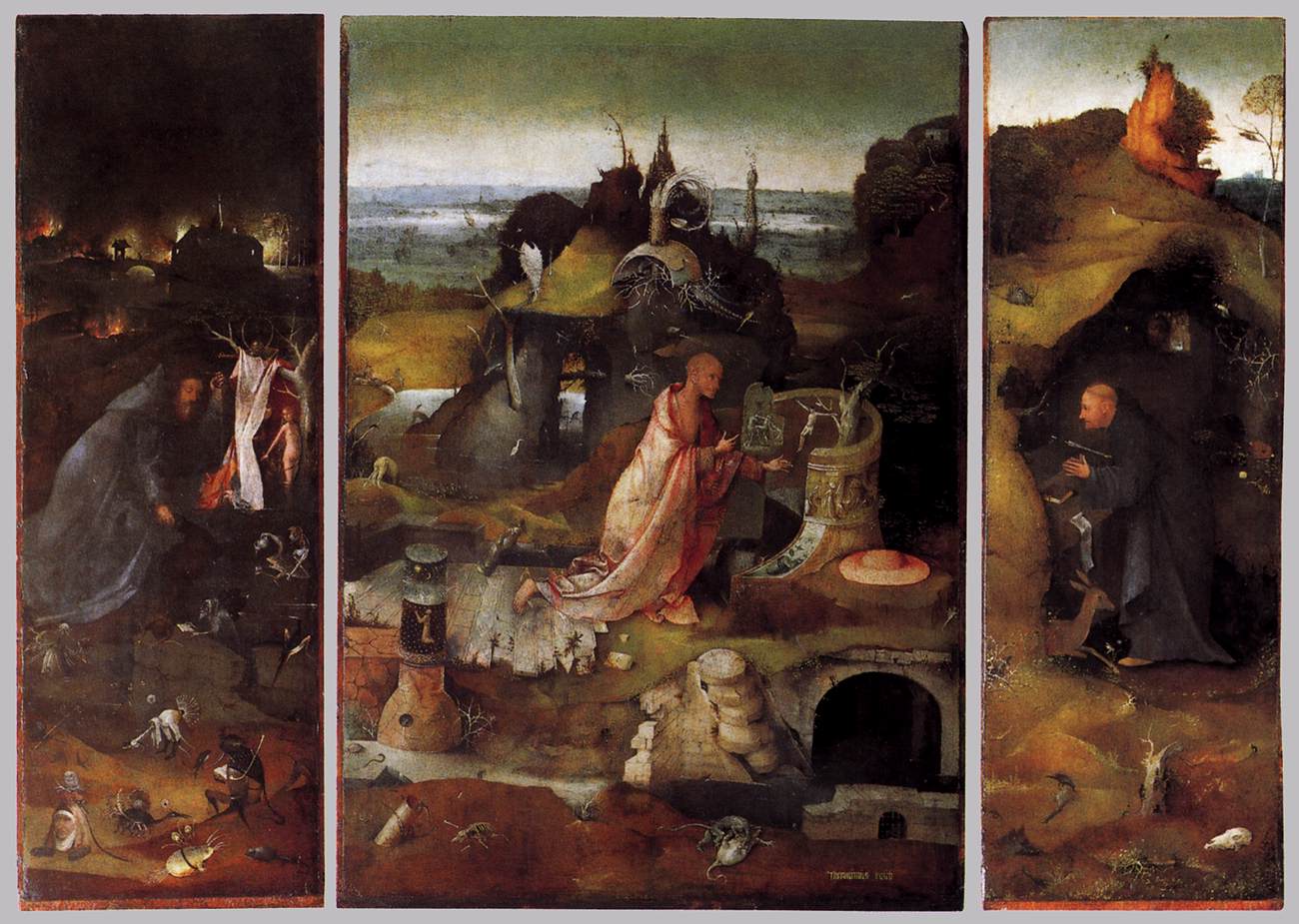
The Hermit Saints Triptych (1490s) by Hieronymus BoschMy Intro to Creative Writing class discussed Joan Didion’s “Slouching Towards Bethlehem,” “On Morality,” and “On Going Home” with regard to what they learned from the “Creative Nonfiction” and “Setting” chapters in Janet Burroway’s Imaginative Writing. After, they jumped into this exercise about place and how external details reveal internal information.
1. Write about entering a place that’s incredibly familiar to you (your dorm room, your car, etc., but not this classroom.) What do you notice? Use only concrete descriptions. Avoid emotional responses and abstractions. (5 min.)
2. Think of a time in which you returned to a place that was once familiar to you but to which you hadn’t been in a long time. (A childhood home, your old school, etc.) Write a scene in which you describe only your physical surroundings as you enter that place. What’s changed? What’s different? Compare and contrast your memory of the place with its current state. (5 min.)
3. Now write a similar sort of description about a time in which you entered a new place, particularly one in which you weren’t comfortable or one that has a culture that is unfamiliar to you (like Didion going into the Haight). Again, focus only on concrete details. (5 min.)
4. Read aloud your three entries. The class will then vote on which one was more immersive, compelling, and detailed.
5. Reflect: Why did the class choose that one? Did you write more about one than the others? If so, why do you think that is? As a reader, which one of these is more interesting to you? Why? Which one was the hardest to write? Why?
Overwhelmingly, the class chose either the second or third description as both seemed to reveal an internal conflict—the sense of something lost/irreparable or alienation. The best part is that the students didn’t write about these internal conflicts at all; rather, it was entirely implicit in the concrete details.
Codex Manesse, fol. 383r, Meister Konrad von WürzburgSometimes discussions with my students lead me to articulate things about writing that I’ve fathomed but haven’t been able to put into words. For instance, in Intro to Creative Writing this morning, my students were discussing Joan Didion’s “On Keeping a Notebook” and how they could use journaling as a foundation for their creative writing. Because of the students’ provocative questions and Didion’s exegesis on the practice—”I imagine . . . that the notebook is about other people. But of course it is not. . . . our notebooks give us away, for however dutifully we record what we see around us, the common denominator of all we see is always, transparently, shamelessly, the implacable ‘I.'”—I was able to finally say what I’ve often felt in keeping my writing journal:
Journaling is an exercise in being a character.
In keeping a journal, I distance myself from the self that appears in my writing. (Think Dante the writer vs. Dante the character.) This not only allows me to receive critical input without feeling as if I’m under attack but it also, and perhaps more importantly, gives me the opportunity to view my own writing as a reader would.
Maybe other writers out there have come to this realization, but the idea, and the way I was able to say it, surprised me in its clarity. Maybe this too is a product of journaling: I have distanced myself enough so that I am allowed to be surprised by myself, a moxie I find quite germane to the writing of the lyric.



 Emilia Phillips