In this exercise, I ask my Craft of Prose students to think about the ways in which one element of their worlds—sports—can reveal a great deal about cultural values in addition to demonstrating some of what’s possible. With the class having just read about the Quidditch World Cup in Harry Potter and the Goblet of Fire and been introduced briefly to other examples of games popular fiction, they will create their own sport, have a partner demonstrate, in a charades-like fashion, how that sport works, so that the writer m then ask themselves if they effectively described the sport in “All in Good Sport.”
Writing Exercise: “Of Violins and Violence” for Poetry Workshop
With a subscription to Poetry magazine as one of the required texts for my Poetry Workshop class, students will have read “Violins” by Rowan Ricardo Phillips prior to completing this exercise, “Of Violins and Violence,” based around the tension between similar sounding words.
“How to Become a Writer” Exercise
For the second day of class in ENG 2031: Craft of Prose, students will begin the day by reading an excerpt from Lorrie Moore’s piece “How to Become a Writer” and then write directions for themselves about becoming a writer in this “How to Become a Writer” Exercise on Google Drive.
Introductions and the Alias of Imagination for First Day of Craft of Prose
Note: In an effort to keep this blog updated regularly, I’m going to be storing my writing exercises and handouts in my Google Drive. I will post these exercises as a link here.
This single document includes two components:
- An introduction questionnaire, allowing students to tell me a little about them, their needs, and their preferences.
- A Writing Exercise in which students introduce themselves by creating a fake or exaggerated writer’s bio or acknowledgments page, titled “Alias of Imagination.”
Students will read two of Michael Martone’s flash CNF pieces titled “Contributor’s Notes” and “Acknowledgments” by Paul Theroux. This should be a fun way for students to tell one another about themselves while exercising their skills on the page.
“Rivers Into Seas”: Line Into Meaning
Genre: Poetry
Purpose: To push the boundaries of the line, sentence, and punctuation to add subtext and texture to poems
Readings: Lynda Hull, Claudia Emerson, Ocean Vuong, Tarfia Faizullah, Jamaal May, Ross Gay
*This prompt was given to Mary Szybist’s workshop at the 2015 Kenyon Review Writers’ Workshop
In this prompt, I’d like for you to explore the ways in which you can complicate your poems with subtext and refine them with dramatic, imagistic, and rhythmic textures through the relationship between the line/form and the sentence.
- Write a heavily enjambed poem about deceit, doublespeak, a fallible memory, or letting someone down easy. Each line of this poem must make its own kind of sense separate from the sentence(s) to which it belongs. Each line may support, nuance, or buck against its parent syntactical meaning(s). Take a look at Lynda Hull’s “Rivers Into Seas.” In order to examine this phenomenon, it might be helpful to read the poem for its sentences initially, and then reread it line-by-line with an exaggerated pause at each break. What lines assert themselves as a complete thought, sentence, or image? How does that relate to the syntax?
- Write a poem that takes the first prompt further by including little or no punctuation. Choose whether or not you’d like to introduce alternatives to traditional punctuation, through in-line white space (also called visual caesuras) as found in Claudia Emerson’s “Midwife”; line breaks, like those in Ocean Vuong’s “Ode to Masturbation”; capitalization at the start of sentences; or some combination. (Keep in mind that in-line white space also can be used as a means to emphasize certain images or phrases; to modulate the reader’s pace; or to imitate an action taking place in the poem.)
- Write a poem in two columns. The columns must make (a certain) sense if read together and apart. See “Aubade Ending with the Death of a Mosquito” by Tarfia Faizullah and “I Do Have a Seam” by Jamaal May.
- Write a poem in one sentence or run-on sentence that uses the line as a break for breath that befits the action of the poem or the way in which the speaker might tell the story. See Ross Gay’s “For Some Slight I Can’t Quite Recall.”
“Ornithology” Poetry Analysis and Imitation Exercise
Class: Introduction to Creative Writing (The College of William & Mary)
Genre: Poetry
Purpose: To become more scrupulous readers of poetry
In order to prepare my Intro to Creative Writing students for talking more about poetry with regard to the author’s intentionality before their poetry workshop, I’m asking them to read and examine the poem “Ornithology” by Lynda Hull. They then have to answer questions about specifics in the poem. I’ve provided these questions via track changes in Microsoft Word:

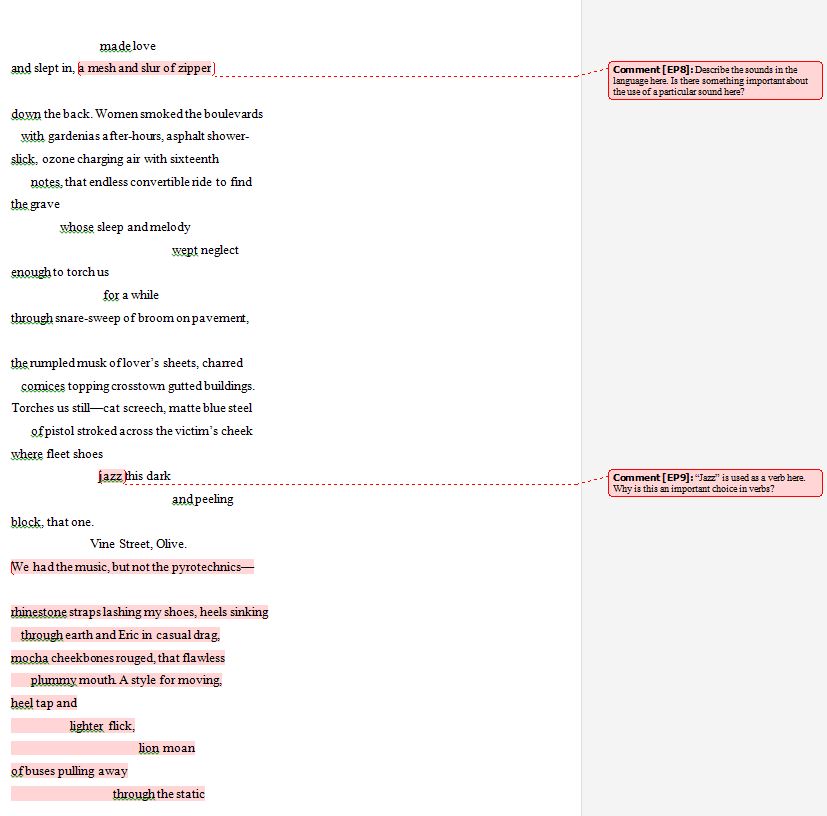
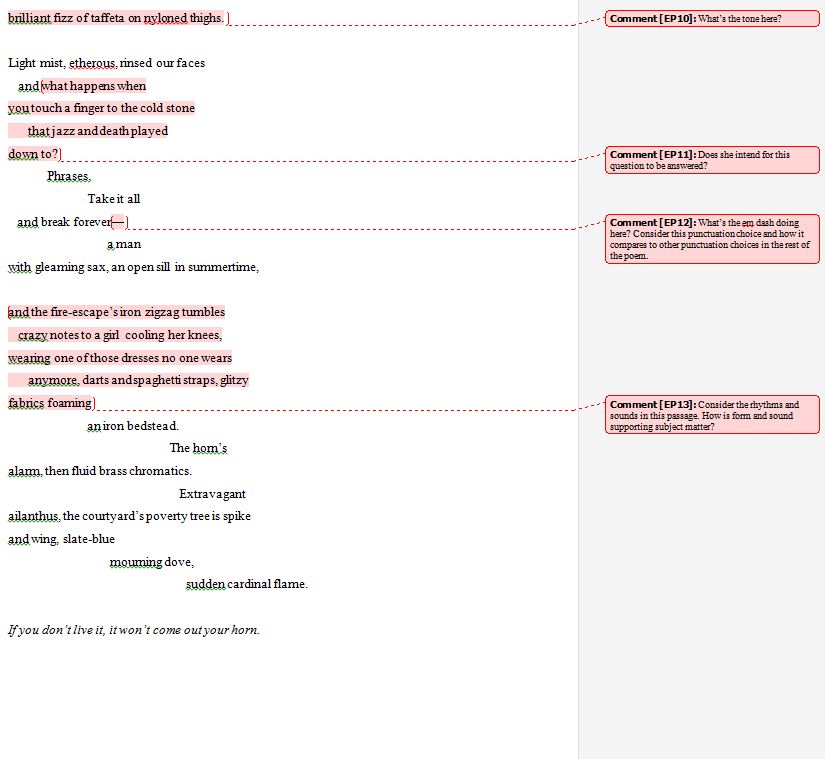
Once they respond to these questions on their own, we will then discuss the possibilities. My hope is that they will see the value in discussing the possibilities rather than strive to make proclamations about what the poem is or what it’s doing.
After they complete the analysis, I’m going to ask them to try to write an imitation of at least ten lines (the formal unit that’s repeated throughout the poem) with special attention to sound and rhythm.
“Think Lagunitas business” Exercise
Class: Introduction to Creative Writing (The College of William & Mary)
Genre: Poetry
Purpose: To consider how language is the raw material with which all writers work and to consider the unique challenges that poetry in translation offers
Readings: A packet of poetry in translation
A native speaker of a foreign language that you do not speak has given you a literal translation (that is, a word-for-word rendering) of a poem written by a poet who writes in her language. The native speaker has asked you to further translate the poem so that it makes sense and is a good poem.
The poem’s original language is from a unique language family and shares no roots with English. Because of this, there are some words that are almost untranslatable in English; the native speaker has done her best to provide you with some sense of those words, sometimes substituting phrases or even metaphors for individual objects. Additionally, because the grammar of the original language is so unique, the sentence structure often doesn’t work in English. Not only will you have to find translations for individual words, you’ll have to make sense of those words in foreign syntax.
You read the translation*…
Think Lagunitas business
Loss innovation. It seems that the old way of thinking. The idea, for example, eliminates the sense that the general idea of light. The resurrection of the dead birch, black, the face of the first month, or any other theory of the world tribal carved sad because the skills to deal with the clown Beck, anything associated with Blackberry Blackberry word complaint if it does in this world, it is. We talked last night, my friend, marina trouble hearing sound thin. After that, I knew it from the start, and judges, and chin, hair, and the woman, and you, and I am his wife, and I remember that I love you still, it was several times small shoulders in his hands, and was surprised to see the face of violence, such as the drought and salt and the river of my childhood and Willow Iceland, sad songs levels, such as mud fish, we have a little money should pumpkin orange. It is difficult to deal with. It is necessary if we want to get an external desire eternal. And did the same to him. Reminds me a lot, and his hands and the length of the bread and said that his father hated him because he was asleep. Time was the word supernatural, flesh and body. Love, lunch and dinner, and BlackBerry.
*In order to produce this text, I ran Robert Hass’s “Meditation at Lagunitas” through several different languages (Maori, Chinese Traditional, German, French, Arabic, Finnish, Irish, and Icelandic) in Google Translate before translating it back into English.
The native speaker has also noted that the original poem was in one stanza and contained thirty-one lines. The literal translation, however, is in prose. She has converted the original poem into prose in order to preserve some semblance of the original syntax, and she hints that most of the lines contained between seven and ten words, except the last line, which only contained four.
You get to work and set about your translation systematically:
- You assess the overall tone of the poem, considering if it’s joyful, melancholic, bittersweet, or meditative.
- You then summarize the poem, identifying its:
- setting;
- speaker;
- addressee (if there is one) and/or audience;
- primary themes;
- and motivations and/or stakes.
- You now notate those places in the poem in which there seems to be some kind of shift in setting, direction, and/or tone. (This could also include an associative leap between images or thoughts. If you notice one of these leaps, briefly summarize the connection.)
- You then start the hard work of translating the poem, sentence-by-sentence, for clarity. At this point, you might begin to take some liberties with the text. As you’re revising the sentence, decide if you want to:
- change any words or phrases so that the poem will seem more accessible to North American readers (i.e. an American might write “truck” when an English translator would write “lorry”)
- or change any language that doesn’t seem essential to the overall meaning of the poem but that might make the poem sound more musical.
- Now begin to format the poem for line length, breaks, and stanza structure. Decide whether or not you want to try to mimic the poem’s original format. (If not, make a case for it.)
- Share your translation.
“One Story, Three Genres” Exercise
Class: Introduction to Creative Writing (The College of William & Mary)
Genre: Fiction, Nonfiction, and Poetry
Purpose: To consider how writers of three genres go about approaching similar subject matter; to introduce distinctions between the genres; and to introduce key drafting and revision considerations based on reading from Janet Burroway’s Imaginative Writing
Readings: Chapters 1 (“Invitation to the Writer”) and 7 (“Development and Revision”) in Janet Burroway’s Imaginative Writing

- Pick a favorite nursery rhyme, myth, or religious tale that you know by heart. Write a brief summary of the story in 2 to 5 sentences.
- If you were writing this narrative as a short story, how would you change it? What elements would you include? How would the style change?
- If you were writing this narrative as a poem, how would you change it? What would be your first steps to writing the poem? What would you leave out? What would you add in?
- If you were using this narrative as a basis for nonfiction, how would you frame it? How can you approach this subject matter in that way?
- Free write for ten minutes and begin to convert your summary into either a short story, a poem, or personal essay.
“No River, No Bridge: Writing Poetry, Writing Nonfiction” Handout and Exercise

I taught a class titled “No River, No Bridge: Writing Poetry, Writing Nonfiction” at Appomattox Regional Governor’s School’s Writers’ Fest yesterday. We discussed hybridity of poetry and nonfiction, as well as the ways in which poetry can take on and explore “truth” using essayistic strategies without the requirement of “fact.” Several students came up afterward to show me their exercises, and one told me that she felt like it was one of the best things she’s written. The class ranged from high school students to adults.
In this course we will examine works of poetry and creative nonfiction in order to open up these genres to hybrid works. We will discuss features that are shared by the genres, how to bend the rules, and look at some examples before doing an exercise.
With over forty students in a one-hour class, we had these objectives:
- Examine definitions of genre and the elements therein.
- Think about the function and aims of each genre.
- Read excerpts of texts that bridge the gap between poetry and nonfiction.
- Write some assays—yes, some attempts—that use both poetry and essay strategies.
Examine definitions of genre and the elements therein. We looked at definitions of essays and lyric essays and Edward Hirsch’s definitions of line, lineation, lyric, prose poem, and stanza from A Poet’s Glossary. We looked at these definitions because they seek to define and, therefore, draw boundaries. We needed to know these definitions in order to explode these boundaries. In particular, we looked at Hirsch’s definition of line, in which he quotes Longenbach:
“Poetry is the sound of language organized in lines,” James Longenbach asserts in The Art of the Poetic Line (2008). “More than meter, more than rhyme, more than images or alliteration or figurative language, line is what distinguishes our experience of poetry as poetry, rather than some other kind of writing.”
And compared it to the prose poem definition:
A composition printed as prose that names itself poetry. The prose poem takes advantage of its hybrid nature—it avails itself of the elements of prose (what Dryden called “the other harmony of prose”) while foregrounding the devices of poetry. . . . Baudelaire used prose poems to rebel against the straitjacket of classical French versification. He dreamed of creating “a poetic prose, musical without rhyme or rhythm, supple and jerky enough to adapt to the lyric movements of the soul, to the undulations of reverie, to the somersaults of conscience.” Baudelaire’s prose poems—along with Rimbaud’s Les Illuminations (1886) and Malarmé’s Divagations (1897)—created a mixed musical form (part social, part transcendental) that has been widely and internationally practiced in the twentieth century. “There is no such thing as prose,” Malarmé insisted in 1891. “There is the alphabet, and then there are verses which are more or less closely knit, more or less diffused. So long as there is a straining toward style, there is versification.”
We thought about these paradoxes, discussed why lineation makes a poem a poem, as well as considered some alternative definitions. We then examined Hirsch’s definition of “lyric”—
The lyric poem immerses us in the original waters of consciousness, in the awareness, the aboriginal nature, of being itself. . . . The lyric, which offers us a supposed speaker, a person to whom we often assign the name of the author, shades off into the dramatic utterance
—in juxtaposition with a discussion of point of view in essay. Think about the function and aims of each genre. When I think about the intersections and differences of poetry and nonfiction, it’s helpful for me to illustrate the two genres with metaphors.
- Poem as a river. With all of their musical elements, I think of poems as a river—something fluid, flowing, that rushes and eddies, deltas, and empties out to sea. Poems are one of our oldest forms of literature and therefore seem natural to our landscape of language.
- Essay as a bridge. The essay, an analytical form, builds upon its subject piece by piece, element by element, fact by fact, experience by experience. We might think about this strategy as similar to building pillars with blocks, hammering planks together, supporting and trussing.
We might use these metaphors to understand hybrid works—nonfiction prose poems, lyric essays—better. Sometimes a poem is a river we want to cross; we see and hear the rushing water, but we want to examine it from a sturdy vantage point where we stay safe and dry. Some music comes into the poem, but we rely on the exposition that essays provide. Adversely, we could be in the water, prone to the rapids, splashed in the face, paddling fiercely. Just trying to stay afloat in the overflow of language, of experience. There are times, however, where we might pass under the shadow of a bridge, have insights into reason, into conquering this flow, bridging one experience to another. Read excerpts of texts that bridge the gap between poetry and nonfiction.
- “Say It, Say It Anyway You Can” by Vievee Francis (two versions—the prose poem version from Rattle and the lineated version that appeared in her collection Horse in the Dark). Let’s take a look at this poem, which started off as a prose poem and then became a lineated poem. Discuss the poet’s possible reasoning for lineating the poem. What are the effects of the two forms?
- An excerpt from Citizen by Claudia Rankine and an excerpt from Bluets by Maggie Nelson. Talk to me a little bit about what these prose forms borrow from poetry. Are they poetry? (How were they marketed? How were they identified?) Is it enough to say something is poetry? Nonfiction? Are these true hybrids? How would you categorize it? Does it need to be categorized?
Write some assays—yes, some attempts—that use both poetry and essay strategies.
“No River, No Bridge” Exercise
- Select an everyday object that’s in your house. Ex. a television, a pair of jeans, a can of kidney beans. (1 min.)
- Now describe the object using all of your senses, with only concrete details. Do not use any metaphors or other figurative language. (2 min.)
- Imagine how the object was made. Write a step-by-step description of its fabrication. (3 min.)
- Imagine the harvesting, mining, or creation of the raw materials that went into making this object. (i.e. the shearing of sheep for your wool sweater or the mining of silicone to make your iPhone). Describe. (2 min.)
- Now talk a little bit about how you came to own this object (and talk about not remembering how you got it, if that’s true.) Tell us the backstory. Or, what connotations does the object have? Do you have specific memories associated with it? (2 min.)
- Now describe the object using only metaphors. (“My pair of jeans is muddy water reflecting sky, a bird with clipped wings . . . ”) (2 min.)
Share and discuss: How has the object changed in each iteration (concrete description, origin story, deconstruction, entrance, emotional connection, metaphorical naming)? Which form (poetry or essay) better conveys these approaches? Why? How can we combine these strategies?
“Cadenza” Exercise
 I haven’t had a chance yet to give this exercise to my Writing Poetry students, but I hope to give this to them by the end of the semester. A “cadenza” is a soloist’s improvisation that later gets written into a piece of music. It’s my hope that this exercise will produce in-class improvisation that later becomes a revised poem.
Class: Writing Poetry (Virginia Commonwealth University)
Genre: Poetry
Purpose: To consider how pace and sound relates to emotion, tone, and intensity.
Readings: One might provide the students with musical examples in lieu of readings.
- Provide students with a glossary of musical terms, such as http://www.classicalworks.com/html/glossary.html, or a selected list. (Italianate terms preferable.)
- Each student should select a term, study its definition, and then conceive of a poem that demonstrates the qualities of the term. The poem could embody these qualities with form, syntax, diction, sound, prosody, or any combination thereof. This term must serve as the title of the poem. For instance, “Sonata” might produce a poem in four parts that each differ in tone and pace. (30+ minutes)
- Students should share their results with the class for feedback on whether or not they embodied the musical terms in their poems. Open up a discussion about how line breaks, forms, and syntax/diction create a kind of music in poems and how these can be manipulated to produce certain tonal/emotional effects in addition to those implicit in dramatic situations. (10–15 minutes)
- The students will then take home the poem and revise it. Share again at a later date.
 Emilia Phillips