Prompts: “The Conversationalist,” “Just a Phase,” and “Witness” for Creative Nonfiction Writing

Phrenology diagram. From People's Cyclopedia of Universal Knowledge (1883).
from People’s Cyclopedia of Universal Knowledge (1883)

A student wrote to me over the weekend to request a prompt for my Intro to Creative Writing‘s 5–7 page creative nonfiction assignment. Although I usually encourage students to locate their own subject matter as it’s a critical skill and they’ll likely care more about their handpicked subjects, I came up with several prompts that I’ll hold onto for future students who need a place to start.

The Conversationalist
Is there a story or several stories that you like to tell friends or new people you meet? Is the subject matter related or disparate? Write the story/stories that you tell, and the narrative of telling these stories. How have people reacted? Reflect. Why do you tell these stories? Do you find yourself wanting to create a certain impression on listeners? This piece, as it has three narrative components, has a lot of promise for fulfilling the page requirement.

Just a Phase
Was there a time that you tried to “be someone else,” to adopt a different personality? Describe in detail. Did you change your clothes? Your hair? Your interests? Your speech or accent? Many of us go through identity crises especially as adolescents. What did you do while you tried this out? Did you go somewhere? Did you make a fool of yourself or pull it off? When did you realize it wasn’t right for you? Why change? Do you feel nostalgic now? Show this.

Witness
Have you ever witnessed something violent, unsettling, or scary? Write about this and your reaction after. How long did it affect you? How did it change you? Did you intervene? Why or why not? Do you regret your decision to become involved or not involved? (See “Accident, June 1948” by Seamus Deane for an example.)

Homing In On Home Exercise

Garage met Chauffeurswoning te Zandvoort (1916) by Guillaume Frédéric la Croix
Class: Intro to Creative Writing
Genre: Creative nonfiction
Readings: “Notes from a Native Daughter,” “Los Angeles Notebook,” and “Goodbye to All That” by Joan Didion; “Bread” by Jane Brox
Time: 24 minutes

1. Describe the home you spent the most time in as a child including its location, distinctive features, the people, the food, the weather, etc. Be as thorough as possible. (7 min.)
2. Is there something that people often assume about the place that isn’t true? Write an anecdote about a time that someone made a presumption about where you were from. (i.e. Every evening while I had bronchitis I stopped at a pub in Mayfair to have a shot of Jack Daniel’s to ease my coughing before bed. The first night, the bartender asked to see my ID. When I handed him my Tennessee driver’s license, he said, “A Tennessee girls drinks Tennessee whiskey,” and, laughing, “Do you like your country music too?”) (5 min.)
3. Why do you think that outsiders often assume these things about your home? Speculate about why that is, how long that’s been true, and if it will continue to be true. Why or why not? Use this as a means to tell us a little bit of history about the place you grew up. You can use historical facts, family stories, gossip, rumors, etc. (7 min.)
4. If you weren’t from the area, how would you view your hometown? Would you visit or move there? Consider several possibilities. (5 min.)

This exercise allows students to look at a subject from different angles as well as helps them access something personal through exterior descriptions. In much the same way that they saw Didion revealed through the places she talks about (California’s Central Valley, Los Angeles, and New York), students should realize that, by the details they choose to talk about and the perceptions they reject or defend, they do some work to define themselves as well as the place, subject, and—perhaps most importantly—a conflict.

Three Places Exercise

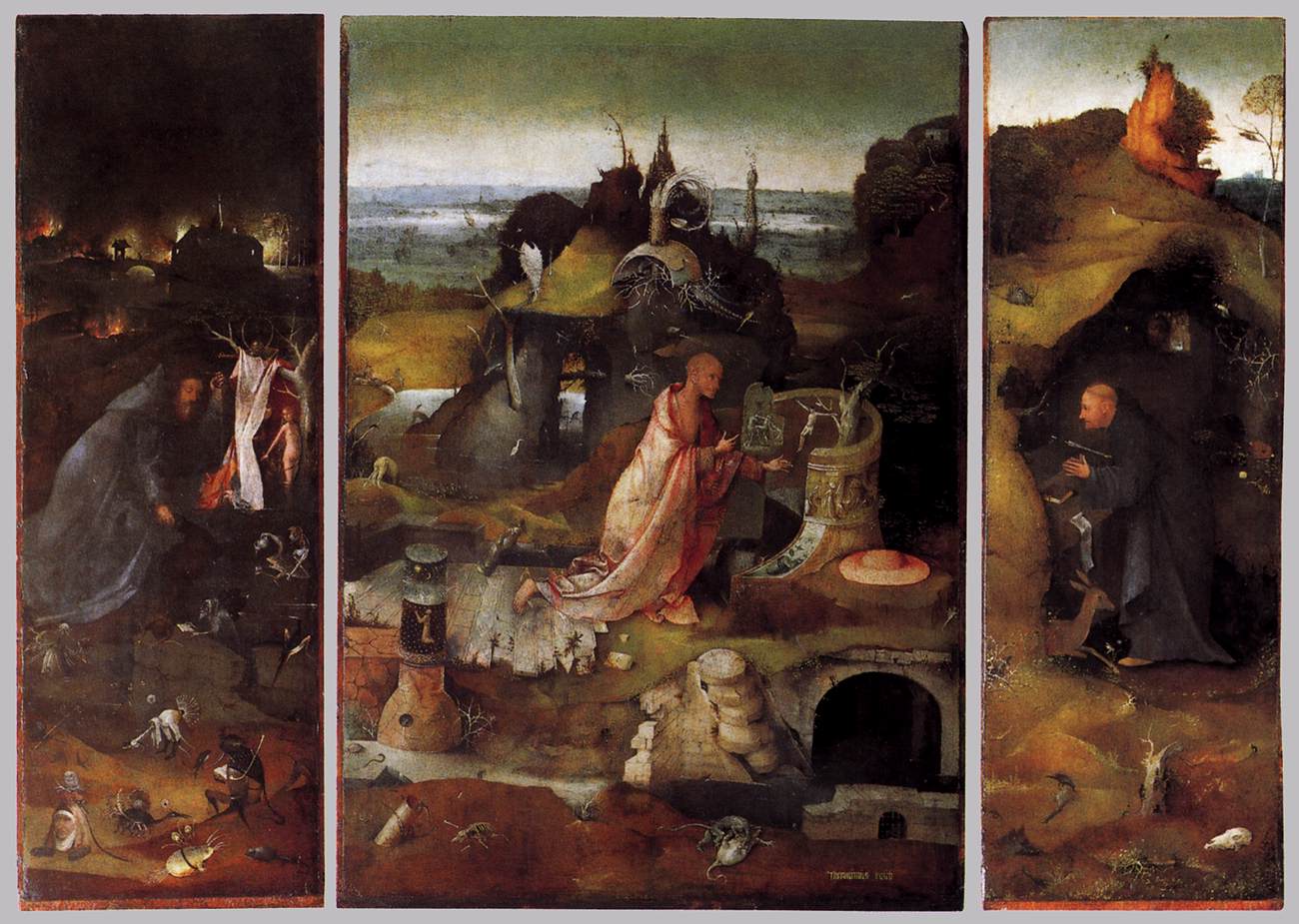
    The Hermit Saints Triptych (1490s) by Hieronymus Bosch
    The Hermit Saints Triptych (1490s) by Hieronymus Bosch
    My Intro to Creative Writing class discussed Joan Didion’s “Slouching Towards Bethlehem,” “On Morality,” and “On Going Home” with regard to what they learned from the “Creative Nonfiction” and “Setting” chapters in Janet Burroway’s Imaginative Writing. After, they jumped into this exercise about place and how external details reveal internal information.

    1. Write about entering a place that’s incredibly familiar to you (your dorm room, your car, etc., but not this classroom.) What do you notice? Use only concrete descriptions. Avoid emotional responses and abstractions. (5 min.)
    2. Think of a time in which you returned to a place that was once familiar to you but to which you hadn’t been in a long time. (A childhood home, your old school, etc.) Write a scene in which you describe only your physical surroundings as you enter that place. What’s changed? What’s different? Compare and contrast your memory of the place with its current state. (5 min.)
    3. Now write a similar sort of description about a time in which you entered a new place, particularly one in which you weren’t comfortable or one that has a culture that is unfamiliar to you (like Didion going into the Haight). Again, focus only on concrete details. (5 min.)
    4. Read aloud your three entries. The class will then vote on which one was more immersive, compelling, and detailed.
    5. Reflect: Why did the class choose that one? Did you write more about one than the others? If so, why do you think that is? As a reader, which one of these is more interesting to you? Why? Which one was the hardest to write? Why?

    Overwhelmingly, the class chose either the second or third description as both seemed to reveal an internal conflict—the sense of something lost/irreparable or alienation. The best part is that the students didn’t write about these internal conflicts at all; rather, it was entirely implicit in the concrete details.

Metamorphosis Exercise

Bottom part of plate LXXI. from Veranderingen der surinaemsche insekten, Amsterdam, Joannes Oosterwyk, 1719

Today in Writing Out of the Ordinary the class animatedly discussed Kafka’s “The Metamorphosis” and Márquez’s “A Very Old Man with Enormous Wings.” During the last twenty minutes of class, they participated in the following exercise that asks them to transform a character into another creature in the spirit of Gregor Samsa’s overnight transformation or à la the “fearful thunderclap” that “rent the sky in two and changed her into a spider”:

1. Outline the narrative of an extraordinary—think of “extraordinary” in terms of its literal meaning, “outside the normal course of events”— event (the time when . . . i.e. you broke your arm skiing, you shared an airport shuttle with the mayor, the woman sitting next to you in 16A threw up on the plane window during takeoff, etc.).
2. Now, pick a character that you’re willing to change.
3. Turn that character into another creature (ghost, sheep, centaur etc.) but allow the world to stay familiar. Rewrite it with that in mind. What changes? What can stay the same?
4. Now, reflect. Is there a way to get to something you couldn’t by making this change? Does it change what’s at stake in the piece? How did you attempt to keep the world realistic even when there was a fantastical creature in the scene?

I also emphasized that the realism in magical realism isn’t simply that the context of magical creature is realistic but that the magical creature is also depicted in a way that seems real to that world of the story. What’s realistic in a fictional space can be different than what’s realistic in our lives. Other thoughts I encouraged: How does one keep the narrative squarely in the world of magical realism and not drift into fantasy? How does one prevent the fantastical creature from being thought of as only allegory? We’ll continue to think about these things as the magical realism unit progresses.

2 Lies + 1 Truth = 1 Truth Exercise

La Vérité by Jules Joseph Lefebvre (1870)

On the first day of my Intro to Creative Writing class, I ask my students to do the following exercise as a means of introduction.

1. Write down two lies and one truth about yourself. It’s ideal if students write about specific and concrete events. Avoid the mundane like “I like cheese” and small factual discrepancies like “I have six brothers” when really you have seven.
2. Share. The class will try to pick out the truth.
3. After everyone shares, students will pick one of their lies and write a narrative based on that lie. What’s the character like? How would they react in the situation?
4. Now, consider the true statement. What if the character also had had that experience? Rewrite the narrative of the experience knowing the character has the “true” statement as a backstory.
5. Questions to ask yourself during and after the rewrite: How has the character changed in your mind? Did the two experiences make sense for the character? What is “true” in this new narrative? What’s the difference between “truth” and believability? Can something be “true” in a piece of writing that’s not necessarily “true” in real life?

These questions should illustrate what sorts of inferences students might make during this exercise. Plus, they get to open up and introduce themselves to the class. I should thank Tom Balázs, my undergrad fiction professor, who used to do Two Lies and a Truth at the beginning of the semester. I hope the additions to the exercise encourage students to think about context and to create believable characters.

Fantastic Creature Telephone Exercise

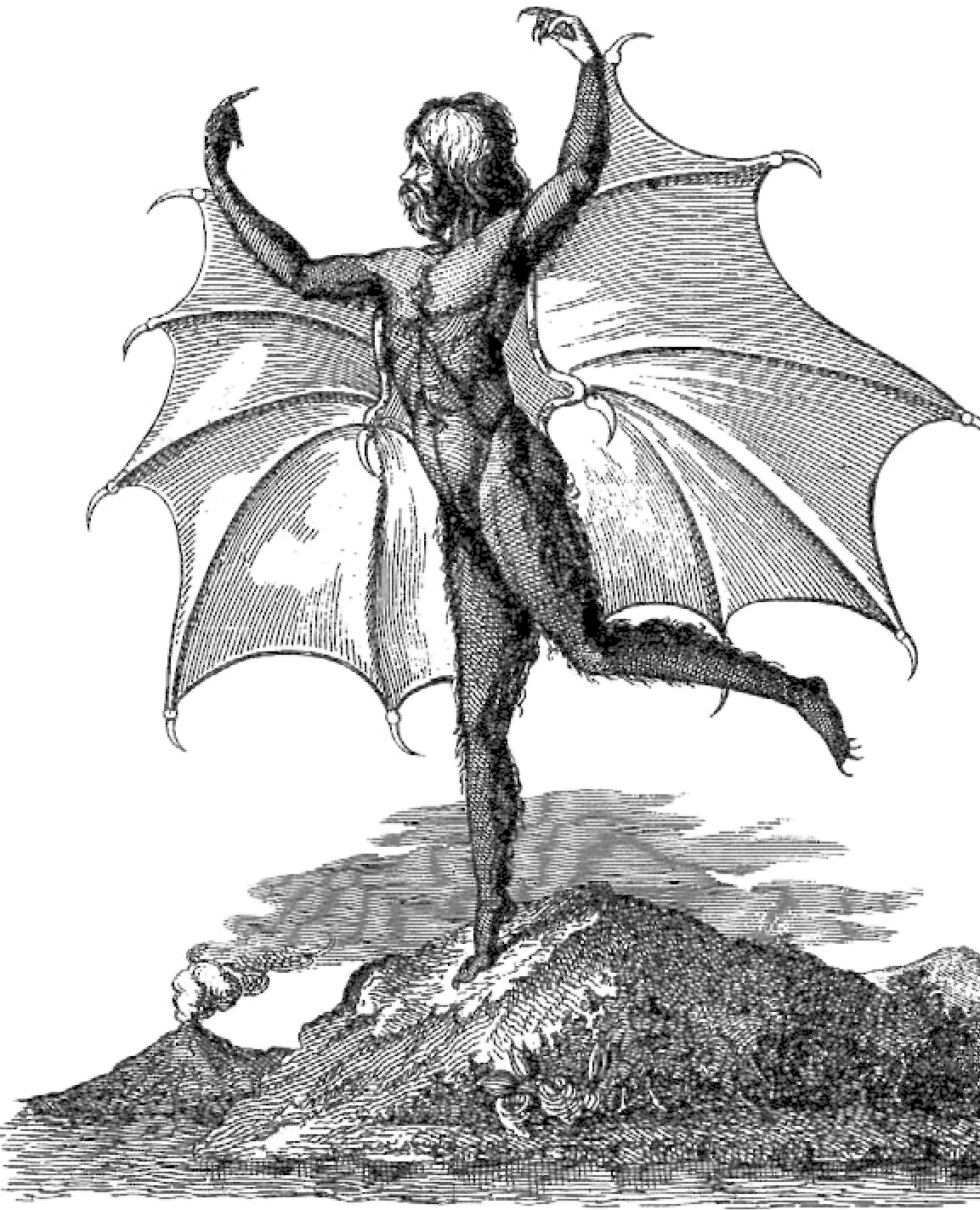
Portrait of a man-bat (Vespertilio-homo), from an edition of the moon series published in Naples. (Courtesy of the New York Public Library.) (1836)
Portrait of a man-bat from The Sun and the Moon: The Remarkable True Account of Hoaxers, Showmen, Dueling Journalists, and Lunar Man-Bats (1836), published in the US before 1923 and public domain in the US.

To jumpstart my Writing Out of the Ordinary students thinking about the weird and wild, I created the following exercise for the first day of class.

1. The class breaks up into groups of at least five. Each group designates a leader and forms a line.
2. Each leader reads an entry in Borges’s Book of Imaginary Beings for two minutes. (I used “The Bird That Makes the Rain,” “A Crossbreed by Kafka,” and the “Hare in the Moon” as they’re among the shortest entries in the book.)
3. The leader then returns to the group and whispers details about the creature to the next group member; each member then whispers it to the next until everyone has heard about the creature.
4. The last group member must write, from memory, a summary of the creature as it was last described.
5. Each group then hands the summary to the leader of an adjacent group.
6. The groups then brainstorm and write a narrative (daily routine, an encounter, origin story, etc.) for the new creature.

There’s several “translations” here that I asked my students to consider:

1. text to memory,
2. speech to hearing (multiplied by however many students are in a group),
3. intention of the writer (the last group member) to readers (the next group),
4. and information (transcription) to imagination (the narrative).

This exercise introduces students to a practice of imaginative thinking, asks them to consider readers’ relationship to text, locates significant and memorable details, and provides them with a chance to interact and thus establish a good rapport with one another—a boon to future workshops!