With all the driving I’ve done the last couple weeks, I’ve been drafting poems aloud again & recording them on voice memo. I haven’t yet typed them up but I have transcribed them in my notebook. I’m waiting for the page, at least for a little bit. I will be writing about composing aloud for my next Ploughshares post, and I hope to draw on the experiences of other writers and make connections between craft choices and the method of composition.
Centenary Students at Dodge Poetry Festival

Birch bark for a poem
I picked up this birch bark today & I’m determined to draft a poem on it this weekend. I’ve often found that I can shake up my poems by finding new mediums for writing. 
“Imitation” Exercise for Poetry Workshop
In this exercise, my Poetry Workshop students are introduced to poetic imitations by imitating the poems from the October 2016 issue of Poetry they chose to present in class.
Class at Hudson Valley Writers’ Center Tomorrow!
Tomorrow, I’m teaching a one-day course called “Walk the Line: The Tension Between Line & Syntax” at the Hudson Valley Writers’ Center in Sleepy Hollow, New York. We will consider the relationship between poetry’s vehicles of meaning: the line and the sentence. In doing so, we’ll investigate the ways in which these structures support, nuance, and deny one another to achieve resonance, depth, and subtext within a poem. This course will be generative, with exercises that rely on close reading and formal manipulation of texts, as well as the drafting of new pieces. Whether you want to learn more about what your favorite poets are doing with their poems or discover how to break lines in your own, this course will insist that poetry is a craft, honed by exercises and study.
When I finalize the course packet, I will share it here on Ears Roaring with Many Things. If you’re still interested in signing up, register through the HVWC website.
Poetry Reading Calibration and a Writing Exercise for the First Day of Poetry Workshop
Note: In an effort to keep this blog updated regularly, I’m going to be storing my writing exercises and handouts in my Google Drive. I will post these exercises as a link here.
This single document includes three different components:
- An introduction questionnaire, allowing students to tell me a little about them, their needs, and their preferences.
- A Poetry Reading Calibration Exercise, featuring Ari Banias’s poem “A Sunset.”
- A Writing Exercise titled “Home” after the Safiya Sinclair poem by the same name.
I’m giving these exercises on the first day of class in order to get a better sense of where the students are in terms of their poetry knowledge and reading ability. Additionally, I wanted to introduce them to some terminology (e.g. line breaks, tone, concrete details, etc.) that will make it easier for them to talk about poetry throughout the course.
Course Descriptions & Reading Lists for ENG 2015: Poetry Workshop & ENG 2016: Prose Workshop
ENG 2015: POETRY WORKSHOP
Instructor’s Course Description
American poet C.D. Wright once wrote: “If I wanted to understand a culture, my own for instance . . . I would turn to poetry first. For it is my confirmed bias that the poets remain the most ‘stunned by existence,’ the most determined to redeem the world in words.” In this course, we will hold poetry to this noble standard, as an amplifier for the voices in our culture and an invocatory rendering of our world. In doing so, I’ll ask you to not only read and write poetry but also begin to look at your surroundings as a poet would. This requires close examination of images, scrutiny of your thoughts and feelings about subject matter, and consideration for other points of view. Additionally, you will be asked to think deeply about language, in terms of its meanings, its sounds, its rhythms, and its forms. You should bring to this class a hard work ethic supported by curiosity and generosity. As a means of introduction to the craft of poetry, students will submit original poems for workshop, a collaborative discussion about writing techniques and their effects on readers. In addition to workshop, you will be asked to engage with the writing of contemporary poets, to read like a writer would. I’ve chosen a couple of poetry collections and The Best American Poetry 2015 so that you will have a lens through which to examine the current landscape of American poetry and to see that even today poets are still trying to “redeem the world in words.”
Required Texts
- The Best American Poetry 2015, ed. Sherman Alexie. Scribner, 2015. ISBN: 978-1476708195
- Charms Against Lightning by James Arthur. Copper Canyon, 2012. ISBN: 978-1556593871*
- Poems by Elizabeth Bishop. FSG, 2011. ISBN: 978-0374532369
- A Larger Country by Tomás Q. Morín. Copper Canyon, 2012. ISBN: 978-0966339598*
- Miscellaneous poems/packets on Moodle
*Arthur and Morín will be reading at Centenary College on September 23, 2015.
ENG 2016: PROSE WORKSHOP (ONLINE)
Instructor’s Course Description
This online course will introduce students to a variety of prose forms: flash fiction, the short story, personal essay, and memoir. Using Janet Burroway’s Imaginative Writing as a technique and terminology guide, students will analyze published prose and write their own pieces for workshop, a collaborative discussion about the effects of writers’ choices on readers. You should bring to this class a hard work ethic supported by curiosity and generosity. We will base our discussions on how texts work rather than what they mean, after Francine Prose’s ideal of “reading like a writer.” My approach to teaching writing is founded on the belief that our writing skills must be practiced and cultivated, and that one must continually challenge one’s aesthetics, habits, and concerns throughout one’s writing life in order to write anything of consequence to one’s readers and, perhaps more importantly, one’s self.
Required Texts
- Imaginative Writing: The Elements of Craft by Janet Burroway. Longman, 2014. ISBN: 978-0134053240
- The Best American Short Stories 2014, ed. Jennifer Egan. Mariner, 2014. ISBN: 978-0547868868
- The Best American Essays 2014, ed. John Jeremiah Sullivan. Mariner, 2014. ISBN: 978-0544309906
- Miscellaneous readings on Moodle
The Third Manuscript Has a New Title
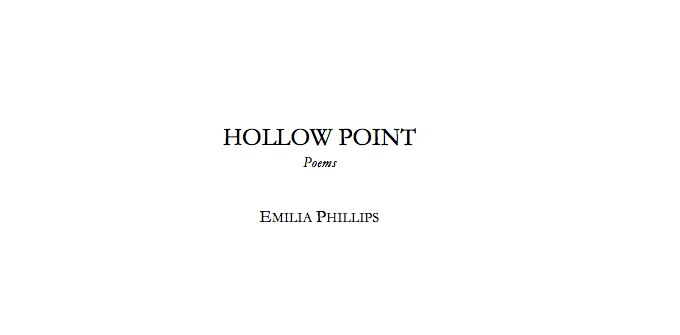
My third manuscript, previously called Bluff, has a new title: Hollow Point. At 74 pages, it’s all ready except for a few revisions and the addition of some more poems in the person of Othello‘s Emilia.
Proposal for a New Form: the “Boulder”
Proposal for a new form, because I’m writing in it . . .
A “Boulder” is wedged somewhere between a prose poem and a micro-essay, as if between a rock and a hard place, but gestures toward fiction through its willingness to engage in absurd scenarios instigated by the true occasions or circumstances introduced in the title. At under 500 words, it is a rhetorical form that posits itself as another form (i.e. a disclaimer, parable, alternate history, etc.) and it must respond in some way to STUPID SHIT (i.e. sexist, discriminatory, or otherwise dumb-dumb things) said to the speaker. Figuratively, the “Boulder” can be seen as a roadblock, avalanche, or agent of Wile. E. Coyote-style injury.
I have written three so far and I’ve started several more. An example of one of the titles: “An Alternate History In Response to the Man Who Told Me Canned Biscuits Ruined America.”
“Rivers Into Seas”: Line Into Meaning
Genre: Poetry
Purpose: To push the boundaries of the line, sentence, and punctuation to add subtext and texture to poems
Readings: Lynda Hull, Claudia Emerson, Ocean Vuong, Tarfia Faizullah, Jamaal May, Ross Gay
*This prompt was given to Mary Szybist’s workshop at the 2015 Kenyon Review Writers’ Workshop
In this prompt, I’d like for you to explore the ways in which you can complicate your poems with subtext and refine them with dramatic, imagistic, and rhythmic textures through the relationship between the line/form and the sentence.
- Write a heavily enjambed poem about deceit, doublespeak, a fallible memory, or letting someone down easy. Each line of this poem must make its own kind of sense separate from the sentence(s) to which it belongs. Each line may support, nuance, or buck against its parent syntactical meaning(s). Take a look at Lynda Hull’s “Rivers Into Seas.” In order to examine this phenomenon, it might be helpful to read the poem for its sentences initially, and then reread it line-by-line with an exaggerated pause at each break. What lines assert themselves as a complete thought, sentence, or image? How does that relate to the syntax?
- Write a poem that takes the first prompt further by including little or no punctuation. Choose whether or not you’d like to introduce alternatives to traditional punctuation, through in-line white space (also called visual caesuras) as found in Claudia Emerson’s “Midwife”; line breaks, like those in Ocean Vuong’s “Ode to Masturbation”; capitalization at the start of sentences; or some combination. (Keep in mind that in-line white space also can be used as a means to emphasize certain images or phrases; to modulate the reader’s pace; or to imitate an action taking place in the poem.)
- Write a poem in two columns. The columns must make (a certain) sense if read together and apart. See “Aubade Ending with the Death of a Mosquito” by Tarfia Faizullah and “I Do Have a Seam” by Jamaal May.
- Write a poem in one sentence or run-on sentence that uses the line as a break for breath that befits the action of the poem or the way in which the speaker might tell the story. See Ross Gay’s “For Some Slight I Can’t Quite Recall.”
 Emilia Phillips