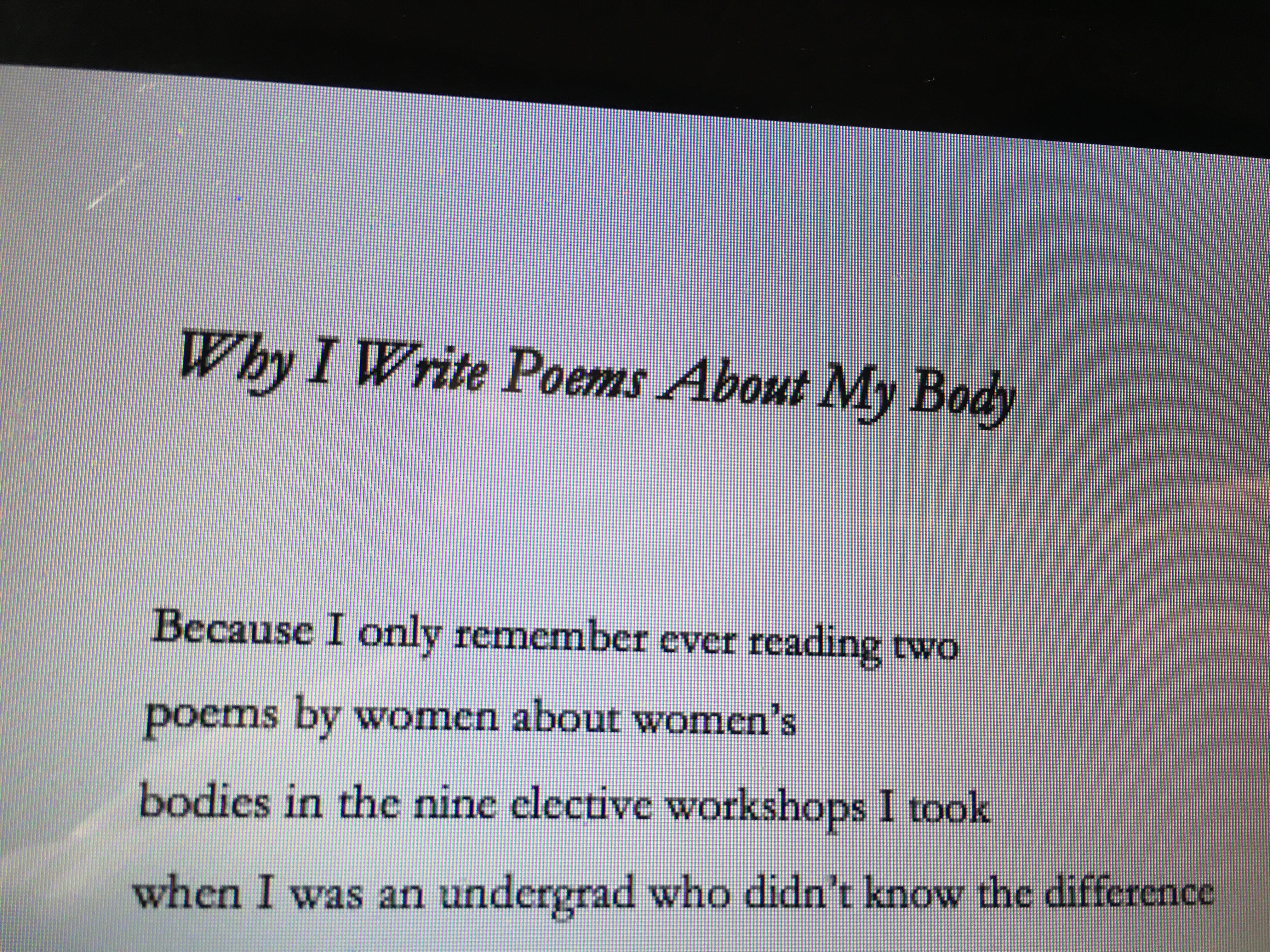
Yesterday I drafted a poem titled “Why I Write Poems About My Body.” As an undergrad professor, I’ve been thinking a lot about what writing I was exposed to when I was an undergraduate, what that offered me, and how it limited me. One part ars poetica, one part invective, the poem needed me to write it, even if only for myself.
Good way to start any draft
Fall 2016 Required Texts & Course Descriptions
ENG 2015: Poetry Workshop
American poet C.D. Wright once wrote: “If I wanted to understand a culture, my own for instance . . . I would turn to poetry first. For it is my confirmed bias that the poets remain the most ‘stunned by existence,’ the most determined to redeem the world in words.” In this course, we will hold poetry to this noble standard, as an amplifier for the voices in our culture and an invocatory rendering of our world. In doing so, I’ll ask you to not only read and write poetry but also begin to look at your surroundings as a poet would. This requires close examination of images, scrutiny of your thoughts and feelings about subject matter, and consideration for other points of view. Additionally, you will be asked to think deeply about language, in terms of its meanings, its sounds, its rhythms, and its forms. You should bring to this class a hard work ethic supported by curiosity and generosity. As a means of introduction to the craft of poetry, students will submit original poems for workshop, a collaborative discussion about writing techniques and their effects on readers. In addition to workshop, you will be asked to engage with the writing of contemporary poets, to read like a writer would. I’ve chosen Poetry magazine as our required text so that you will have a lens through which to examine the current landscape of American poetry and to see that even today poets are still trying to “redeem the world in words.”
Required Texts
- Hirsch, Edward. A Poet’s Glossary. Houghton Mifflin Harcourt, 2014. ISBN: 978-0151011957.
- Poetry magazine student subscription, available at https://www.poetryfoundation.org/poetrymagazine/subscribe
ENG 2016OL: Online Prose Workshop
This course will focus on the prose forms of the short story and personal essay, and emphasize drafting and revision. Students will respond to published prose and write their own pieces for workshop, a collaborative discussion about the effects of a writer’s choices on readers. You should bring to this class a hard work ethic supported by curiosity and generosity. We will base our discussions on how texts work rather than what they mean, after Francine Prose’s ideal of “reading like a writer.” We will use Megan Mayhew Bergman’s collection of short stories, Almost Famous Women, and Zadie Smith’s collection of essays, Changing My Mind, as a touchstone for learning writing skills and discovering genre conventions. My approach to teaching writing is founded on the belief that our writing skills must be practiced and cultivated, and that one must continually challenge one’s aesthetics, habits, and concerns throughout one’s writing life in order to write anything of consequence to one’s readers and, perhaps more importantly, one’s self.
Required Texts
- Bergman, Megan Mayhew. Almost Famous Women. Scribner, 2015. 256 pages. ISBN: 978-1476788814.
- Smith, Zadie. Changing My Mind: Occasional Essays. Penguin, 2010. 320 pages. ISBN: 978-0143117957.
ENG 2031: Craft of Prose
In Italo Calvino’s Invisible Cities, Marco Polo tells Kublai Khan that “the city must never be confused with the words that describe it.” In this course, we will shoot high and aim to write so richly and uniquely about our fictional worlds that they will be rendered in our readers’ imaginations as palpable, the words and places indistinguishable, symbiotic, “real.” We will take as our lodestars a number of texts, including Calvino’s Invisible Cities, a short story collection by Centenary’s fall 2016 visiting author Megan Mayhew Bergman, and one of the Harry Potter novels. We will translate these immersive reading experiences into writing skills through discussion, exercises, and workshop. Several times throughout the semester, students will turn in original writing for workshop, a collaborative discussion about writing techniques and their effects on readers, and later revise one of the pieces using the comments received in workshop. Additionally, we will play host to Centenary’s Fall 2016 visiting writer, Megan Mayhew Bergman, and prepare accordingly. You should bring to this class a hard work ethic supported by curiosity and generosity. We will base our discussions on how texts work rather than what they mean, after Francine Prose’s ideal of “reading like a writer.” My approach to teaching writing is founded on the belief that our writing skills must be practiced and cultivated, and that one must continually challenge one’s aesthetics, habits, and concerns throughout one’s writing life in order to write anything of consequence to one’s readers and, perhaps more importantly, one’s self.
Texts and Supplies
- Bergman, Megan Mayhew. Almost Famous Women. Scribner, 2015. 256 pages. ISBN: 978-1476788814.*
- Calvino, Italo. Invisible Cities. Harcourt, 1978. 165 pages. ISBN: 978-0156453806. +
- Everett, Percival. I Am Not Sidney Poitier. Graywolf Press, 2009. 234 pages. ISBN: 978-1555975272. +
- Rowling, J.K. Harry Potter and the Goblet of Fire. Scholastic Paperbacks, 2002. 752 pages. ISBN: 978-0439139601.*
- Russell, Karen. Vampires in the Lemon Grove: And Other Stories. Vintage, 2014. +
- Writing Journal
ENG 3099: Special Topics: Literary Editing & Publishing
“Editing, like writing, is fundamentally about composing a world,” Peter Gizzi writes in his essay “On the Conjunction of Editing and Composition.” In this course, students will learn how this act of composition takes place, from submissions to printing, by reading first-hand accounts of editors in the profession and through practical application. This reading intensive course will challenge you to read like an editor rather than a reader, writer, or critic, and ask you to consider how literary magazines contribute to literary culture. You will be exposed to many different types of editing styles, and you will be asked to begin to cultivate your own approach to editing a literary magazine or journal while being introduced to all the skillsets needed to create a publication. We will use literary magazines as a case study for all of our publishing inquiries, but we will likewise touch upon the book-publishing process and market. The class will include an investigation into the history of literary magazines; editorial meetings in which students will evaluate and debate sample pieces; papers that analyze literary magazines, editorial roles, and the state of contemporary publishing; and a final editorial project in which student groups will “compose a world” through a mock literary magazine by developing its mission, design, and content. In many ways, this course acts as a kind of introductory practicum for students interested in pursuing future publishing opportunities as editors, production editors, and as writers.
Texts and Supplies
- Lupton, Ellen. Thinking with Type, 2nd edition. Princeton Architectural Press, 2010.
- Kurowski, Travis. Paper Dreams: Writers and Editors on the American Literary Magazine. Atticus Books, 2013.
- Art supplies, paper, etc. and whatever else you may need to create your final editorial project.
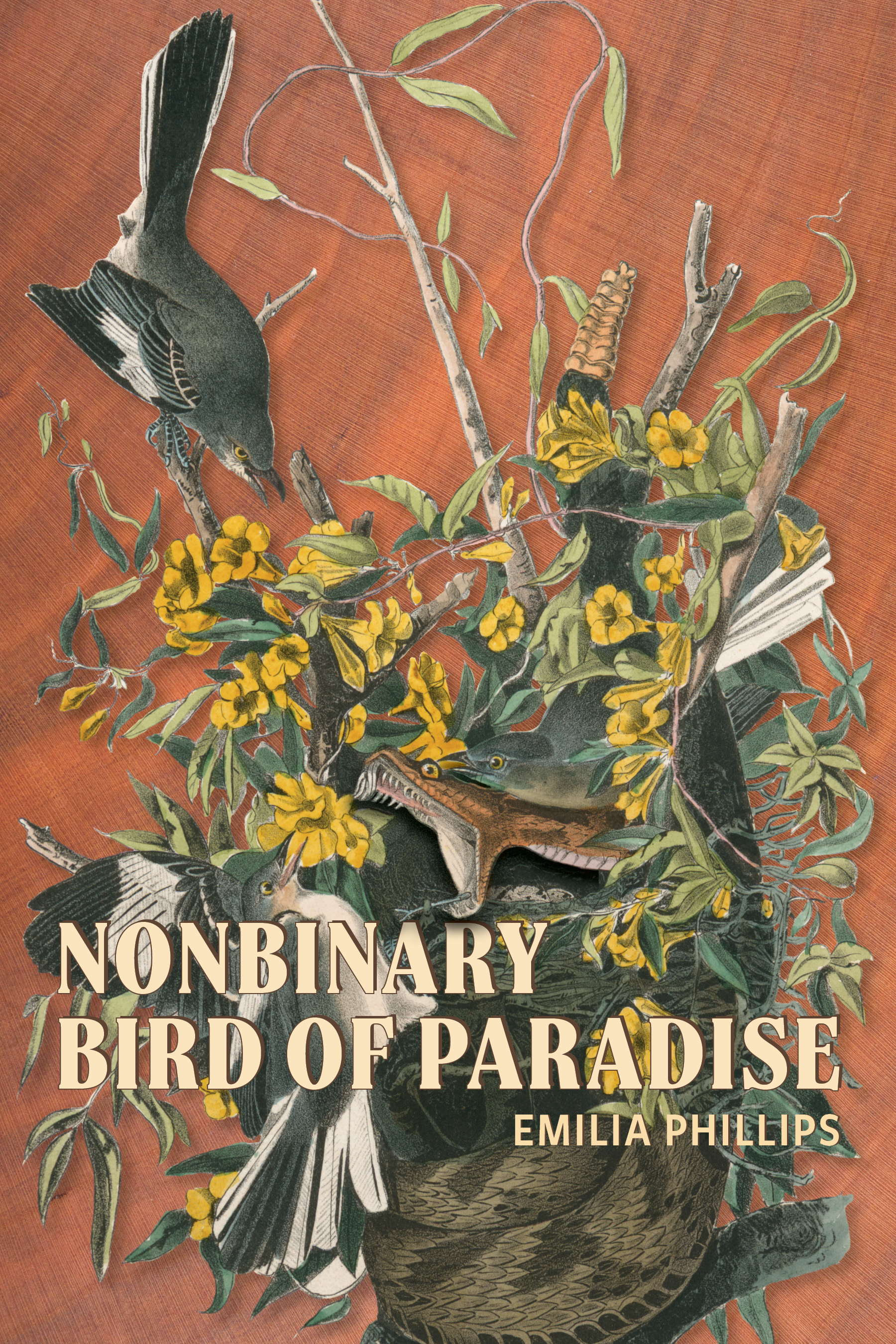
Writing Exercise: “Of Violins and Violence” for Poetry Workshop
With a subscription to Poetry magazine as one of the required texts for my Poetry Workshop class, students will have read “Violins” by Rowan Ricardo Phillips prior to completing this exercise, “Of Violins and Violence,” based around the tension between similar sounding words.
#FridayWritingDay
Now that the semester is here again, I have to make sure to protect my writing and research time so that I stay focused and productive on my own creative and scholarly projects while also staying focused and productive on my teaching. For that reason, I try to reserve Fridays for my writing day. Because I don’t teach on Fridays, it’s the perfect time for me to assess all of the energy and ideas I’ve had throughout the week, throughout my class discussions, and empty myself before the weekend, during which I try to have at least one day of self-care, time for myself, away from grading, away from writing, away from any kind of work. I find that I’m more productive in all of my endeavors if I protect my writing and self-care time, and I find that I’m happier, healthier, and more energetic when I return to work on Monday. Additionally, I like to think of my #FridayWritingDay as one kind of self-care I practice throughout the semester, and it also serves to keep my Professional Development & Scholarship, a component of my faculty assessment, current and relevant.
Some writers who teach protect their writing time by getting up really early in the morning and writing every day. Others I know only write during winter and summer breaks. How do you protect your writing time? I’d love to hear your strategies, so feel free to comment below!
Poetry Reading Calibration and a Writing Exercise for the First Day of Poetry Workshop
Note: In an effort to keep this blog updated regularly, I’m going to be storing my writing exercises and handouts in my Google Drive. I will post these exercises as a link here.
This single document includes three different components:
- An introduction questionnaire, allowing students to tell me a little about them, their needs, and their preferences.
- A Poetry Reading Calibration Exercise, featuring Ari Banias’s poem “A Sunset.”
- A Writing Exercise titled “Home” after the Safiya Sinclair poem by the same name.
I’m giving these exercises on the first day of class in order to get a better sense of where the students are in terms of their poetry knowledge and reading ability. Additionally, I wanted to introduce them to some terminology (e.g. line breaks, tone, concrete details, etc.) that will make it easier for them to talk about poetry throughout the course.
Lines from “Staying”
—Pierluigi Cappello, “Staying” (trans. Portnowitz) in new Poetry
Course Descriptions & Reading Lists for ENG 2015: Poetry Workshop & ENG 2016: Prose Workshop
ENG 2015: POETRY WORKSHOP
Instructor’s Course Description
American poet C.D. Wright once wrote: “If I wanted to understand a culture, my own for instance . . . I would turn to poetry first. For it is my confirmed bias that the poets remain the most ‘stunned by existence,’ the most determined to redeem the world in words.” In this course, we will hold poetry to this noble standard, as an amplifier for the voices in our culture and an invocatory rendering of our world. In doing so, I’ll ask you to not only read and write poetry but also begin to look at your surroundings as a poet would. This requires close examination of images, scrutiny of your thoughts and feelings about subject matter, and consideration for other points of view. Additionally, you will be asked to think deeply about language, in terms of its meanings, its sounds, its rhythms, and its forms. You should bring to this class a hard work ethic supported by curiosity and generosity. As a means of introduction to the craft of poetry, students will submit original poems for workshop, a collaborative discussion about writing techniques and their effects on readers. In addition to workshop, you will be asked to engage with the writing of contemporary poets, to read like a writer would. I’ve chosen a couple of poetry collections and The Best American Poetry 2015 so that you will have a lens through which to examine the current landscape of American poetry and to see that even today poets are still trying to “redeem the world in words.”
Required Texts
- The Best American Poetry 2015, ed. Sherman Alexie. Scribner, 2015. ISBN: 978-1476708195
- Charms Against Lightning by James Arthur. Copper Canyon, 2012. ISBN: 978-1556593871*
- Poems by Elizabeth Bishop. FSG, 2011. ISBN: 978-0374532369
- A Larger Country by Tomás Q. Morín. Copper Canyon, 2012. ISBN: 978-0966339598*
- Miscellaneous poems/packets on Moodle
*Arthur and Morín will be reading at Centenary College on September 23, 2015.
ENG 2016: PROSE WORKSHOP (ONLINE)
Instructor’s Course Description
This online course will introduce students to a variety of prose forms: flash fiction, the short story, personal essay, and memoir. Using Janet Burroway’s Imaginative Writing as a technique and terminology guide, students will analyze published prose and write their own pieces for workshop, a collaborative discussion about the effects of writers’ choices on readers. You should bring to this class a hard work ethic supported by curiosity and generosity. We will base our discussions on how texts work rather than what they mean, after Francine Prose’s ideal of “reading like a writer.” My approach to teaching writing is founded on the belief that our writing skills must be practiced and cultivated, and that one must continually challenge one’s aesthetics, habits, and concerns throughout one’s writing life in order to write anything of consequence to one’s readers and, perhaps more importantly, one’s self.
Required Texts
- Imaginative Writing: The Elements of Craft by Janet Burroway. Longman, 2014. ISBN: 978-0134053240
- The Best American Short Stories 2014, ed. Jennifer Egan. Mariner, 2014. ISBN: 978-0547868868
- The Best American Essays 2014, ed. John Jeremiah Sullivan. Mariner, 2014. ISBN: 978-0544309906
- Miscellaneous readings on Moodle
The Third Manuscript Has a New Title
#SavedUAkronPress
Yesterday, Akron Poetry & Poetics editor Mary Biddinger announced her return to the reinstated University of Akron Press. Coordinator of Print Manufacturing & Digital Production Carol Slatter and Editorial and Design Coordinator Amy Freels returned to work Tuesday under the new leadership of transitional director Jon Miller and the umbrella of the University of Akron’s Library. This is a great victory for the press’s supporters who protested the University’s July decision to shut down the press and lay off its entire staff. I’m especially grateful to the Press’s staff, board, and authors. We saved the University of Akron Press!
Now that staff is back and the University has assured ongoing support for its Press, my second poetry collection Groundspeed has returned to the production calendar for publication in early 2016.
Below are statements from editor Mary Biddinger, transitional director Jon Miller, and the University’s president Scott Scarborough about the future of the Press.
MARY BIDDINGER’S STATEMENT ON SOCIAL MEDIA ABOUT HER RETURN
Many, many, many thanks to everyone who helped us Save the University of Akron Press. I am very happy to be back at work making beautiful poetry books and supporting our authors, who spoke out so passionately against the closing of the press.
TRANSITIONAL DIRECTOR JON MILLER’S LETTER TO UA PRESS AUTHORS (EXCERPT)
Thank you for your patience and support of the Press these last three weeks. I’d especially like to thank Kevin Kern for his advocacy and his updates on behalf of the editorial board. I appreciate all that Tom Bacher has done for the Press, and I look forward to working with him. And I am very grateful for the poise and professionalism of Carol Slatter, Amy Freels, and Mary Biddinger as we discuss the nature and possibility of their continued work for the press. We are also fortunate to have the support of Phyllis O’Connor, our Dean of Libraries.
I am optimistic about the future of the Press–for 2015-2016 as well as for many years to come. Otherwise I would not have accepted this role.
We are working to return the Press to a condition that will satisfy authors, readers, faculty, and students. I wish our progress could have been quicker. It has been a very tough time for the entire campus, however. In this context, I think our progress has been about as quick as it could be. Provost Mike Sherman and President Scott Scarborough have responded to our arguments and recommendations in ways that would surprise their critics. They have demonstrated a genuine and patient interest in developing a deeper understanding of the great promise of this gem of a university press. I expect there will be more good news over the next few days, weeks, and months. Please bear with us. And thank you so much for your continued patience and support.
Jon Miller
Transitional Director
PRESS RELEASE FROM UA PRESIDENT SCOTT SCARBOROUGH
The University of Akron Press has been and will continue to be a vital part of the academic core of this institution. As we complete its transition to University Libraries, we will take all steps necessary to make sure it maintains its well-earned reputation as a vibrant, active academic press, and to maintain its full membership in the Association of American University Presses. It will honor all existing publishing commitments, continue to seek out new, high-quality works to add to its catalog, and proudly continue to support its nationally recognized poetry series.
After consultation with Professor Jon Miller, transitional director of the University of Akron Press and Phyllis O’Connor, interim dean of University Libraries, regarding staffing plans within University Libraries, we are re-engaging the services of the two staff members who will help ensure operations of the UA Press.