Craft of Poetry Writing Exercise: “Exercising It Out”

"Knitting_for_our_soldiers"_-_Kambala_School,_Sydney,_NSW,_between_1914-1918_-_photographer_unknown_(4658764197).jpeg

Students’ Materials

  • Writing journal, with plenty of paper and/or your laptop
  • A previous draft of one of your poems

Room Setup
Six “stations” will be set up at even intervals around the room, each with its own set of instructions. They will be identified by the following names:

  1. Anaphora
  2. Heavy Enjambment
  3. Sentence Fragment
  4. Lack of Punctuation
  5. Cut
  6. Splice

Instructions
There will be six rounds of writing, each lasting 10 minutes. For the first round, Group 1 will be at Station 1: “Anaphora,” Group 2 at Station 2: “Heavy Enjambment,” etc. For subsequent rounds, the groups will rotate to new stations in numerical order. Students should have their previous poem draft and writing notebook at each station. Upon arriving at a station, each group member should read and follow the instructions on the card. After completing the assignment, you should have revised your previous draft into a whole new poem. If there’s time, each student should share their new, revised poem.

Station 1: Anaphora
Read your poem draft, and circle a phrase that is the most charged, most crucial to your poem. Re-write the poem and introduce a repetition of this phrase or syntactical unit. Read Joy Harjo’s “She Had Some Horses” for an example.

Station 2: Heavy Enjambment
Locate all of the end-stopped lines in your poem and circle them. Remove half of those end-stopped lines by breaking the line elsewhere in the sentence and thereby introducing enjambment. Take a look at Ross Gay’s “Love, I’m Done With You” for an example; pay special attention to incidence of enjambment in the first seven lines.

Station 3: Sentence Fragment
Turn at least two complete sentences in your poem into sentence fragments. See Chen Chen’s “Self-Portrait as So Much Potential” for an example of a poem that employs many sentence fragments.

Station 4: Lack of Punctuation
Remove the punctuation in all or half your poem, like Morgan Parker in “Take a Walk on the Wild Side” or “If You Are Over Staying Woke”  respectively.

Station 5: Cut
The poet Jean Valentine tapes her poems up on her door after she initially drafts them. Every time she passes the poem, she cuts one word. In the next ten minutes, cut at least five words from your poem. Read her poem “God of Rooms” for inspiration.

Station 6: Splice
Steal 1–2 lines full or partial lines from a group member’s poem. Try to make them work in the dramatic situation of your poem. Check out Matthew Olzmann’s “Letter Beginning with Two Lines by Czesław Miłosz” as an example.

Class Guest (with Board Notes) at Elgin Community College

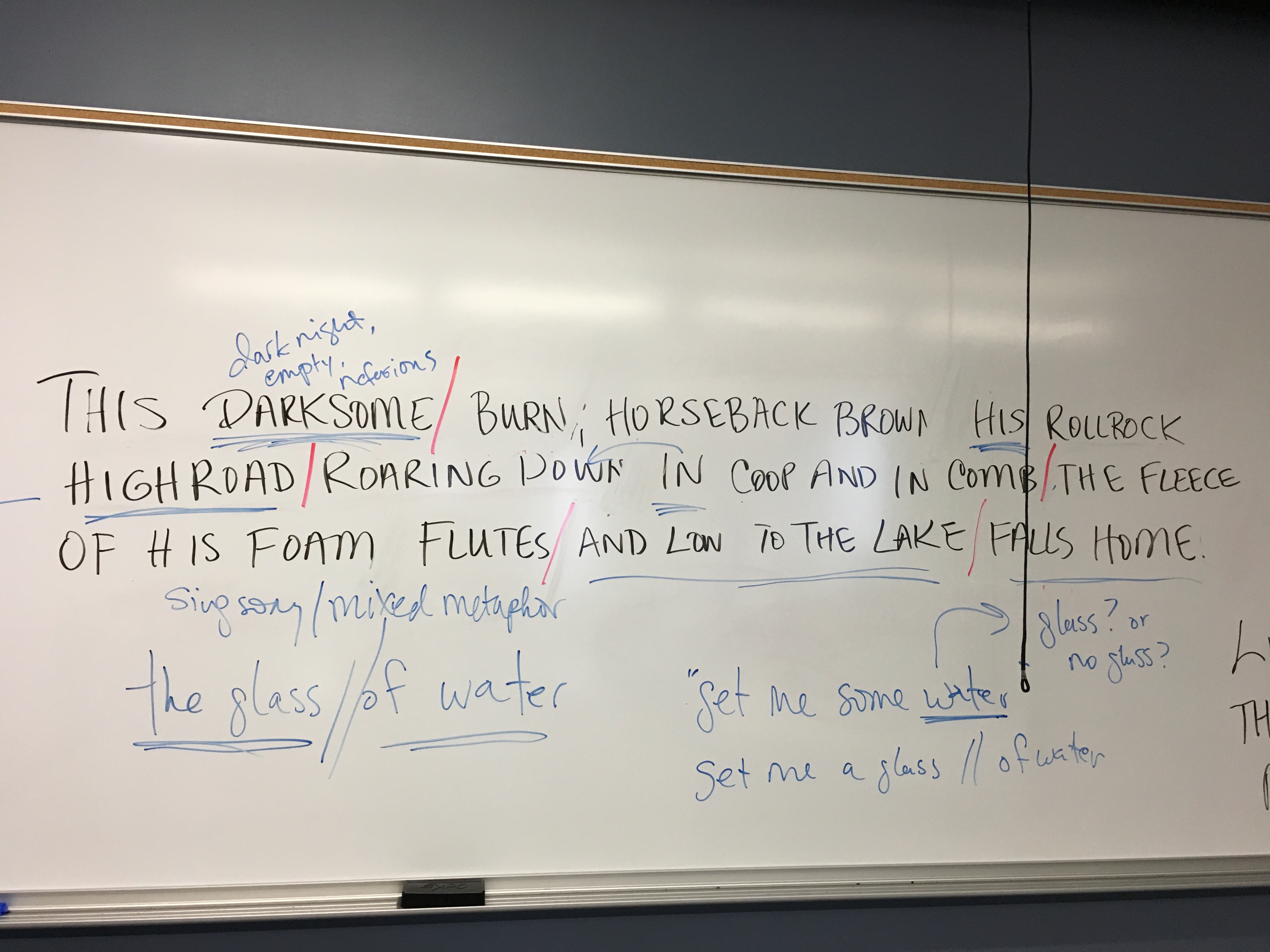
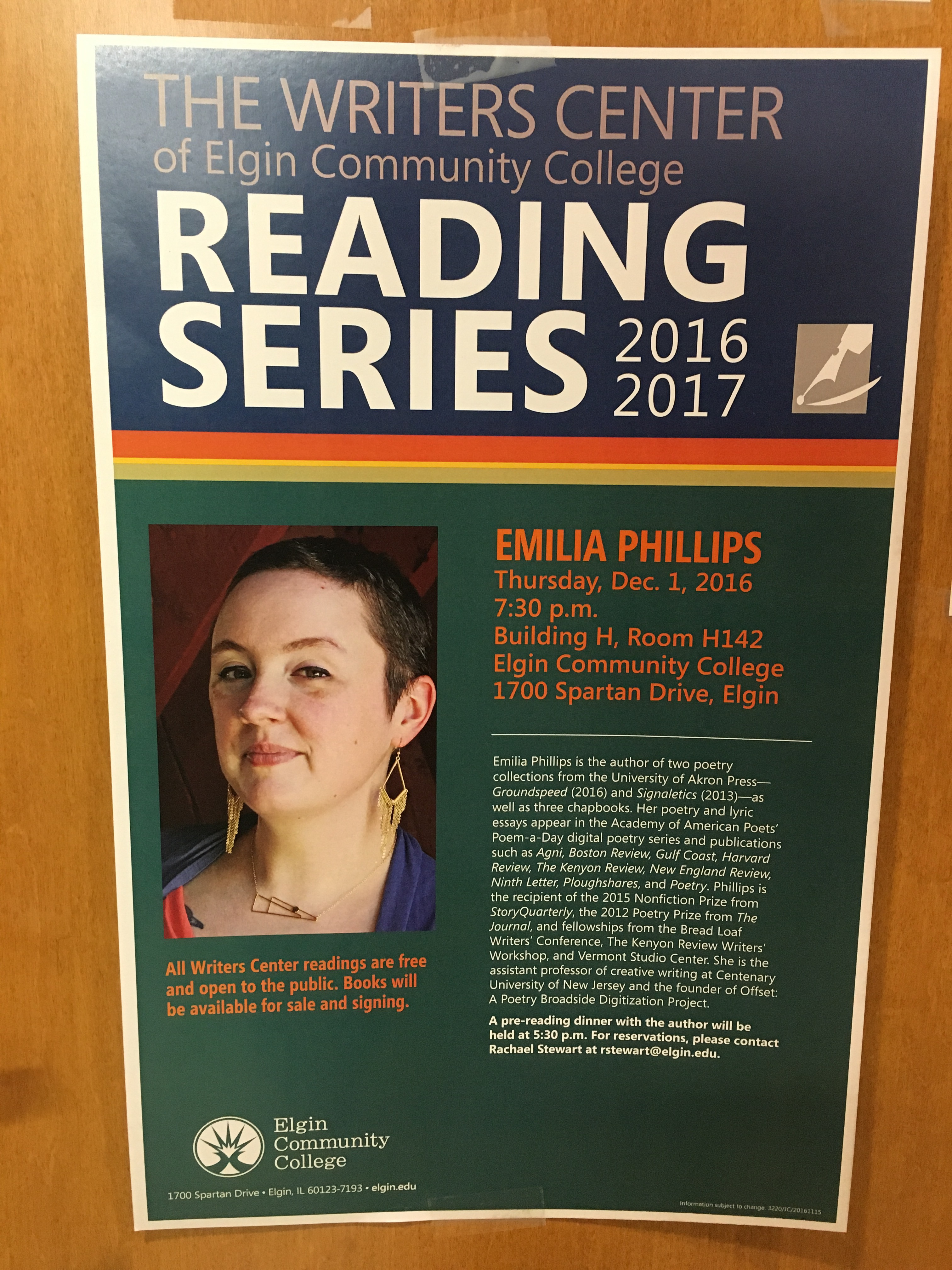
I visited Rachael Stewart’s creative writing class at Elgin Community College today, where I asked students to pay intuitive attention to where lines are broken. I wrote the first stanza of “Inverstaid” by Gerard Manley Hopkins without lineation on the board. I asked them to put line breaks where they think he broke them, and then I asked them to break the lines so that the end rhymes would be subverted. We then discussed how lines have meaning and sentences have meaning, how they can complement one another or come into conflict. We then read Ellen Bryant Voigt’s “The Bear” to talk line break and punctuation, and then Lynda Hull’s “Ornithology” to chart the musicality of free verse.


Presentation & Handouts for Lecture: “It’s Alive: Why Poetry Still Matters”

phillips-rutherford-hall-lecture-11-16-2016On Wednesday, November 16, I gave the lecture “It’s Alive: Why Poetry Still Matters” at Rutherford Hall in Allamuchy, New Jersey. Here are the materials for that talk:
This talk also transformed into my November 2016 blog post for Ploughshares, “Truth & Dread: Why Poetry Still Matters & The Risk of (Too Much) Empathy”:

Can the act of empathy, learned from literature and poetry, become an act of appropriation when we take it to our lived lives? This is a question I haven’t been able to answer. Each of us is not a sun around which others revolve; we cannot, like black holes, pull everything into us without risking erasure, of others, of ourselves. Perhaps more than the practice of empathy, poetry offers us the opportunity to listen, and not just in the way that it appeals to the same areas of the brain music stimulates, and not just in the way that we can hear the cadence and rhythm and sounds of poetry. Perhaps poetry offers us the opportunity to hear its many speakers, to not so much as internalize each of their voices and experiences as to confirm them, to say, you are you, you are a voice, I hear you.


Poetry Workshop Readings and Writing Exercise: “Befriend Me: Poems of Social Media & Technological Engagement”

When I am out of town on November 30th, my colleague will be discussing the poems from the “Befriend Me: Poems of Social Media & Technological Engagement” packet and then leading the Poetry Workshop in the “Befriend Me” writing exercise. I hope to do this again with my spring Craft of Poetry course, and go more in depth with the exercise and the class’s engagement. Thanks to all of those on social media who suggested additional poems for inclusion in this reading packet.

Composing aloud

With all the driving I’ve done the last couple weeks, I’ve been drafting poems aloud again & recording them on voice memo. I haven’t yet typed them up but I have transcribed them in my notebook. I’m waiting for the page, at least for a little bit. I will be writing about composing aloud for my next Ploughshares post, and I hope to draw on the experiences of other writers and make connections between craft choices and the method of composition.

Class at Hudson Valley Writers’ Center Tomorrow!

Tomorrow, I’m teaching a one-day course called “Walk the Line: The Tension Between Line & Syntax” at the Hudson Valley Writers’ Center in Sleepy Hollow, New York. We will consider the relationship between poetry’s vehicles of meaning: the line and the sentence. In doing so, we’ll investigate the ways in which these structures support, nuance, and deny one another to achieve resonance, depth, and subtext within a poem. This course will be generative, with exercises that rely on close reading and formal manipulation of texts, as well as the drafting of new pieces. Whether you want to learn more about what your favorite poets are doing with their poems or discover how to break lines in your own, this course will insist that poetry is a craft, honed by exercises and study.

When I finalize the course packet, I will share it here on Ears Roaring with Many Things. If you’re still interested in signing up, register through the HVWC website.

“Think Lagunitas business” Exercise

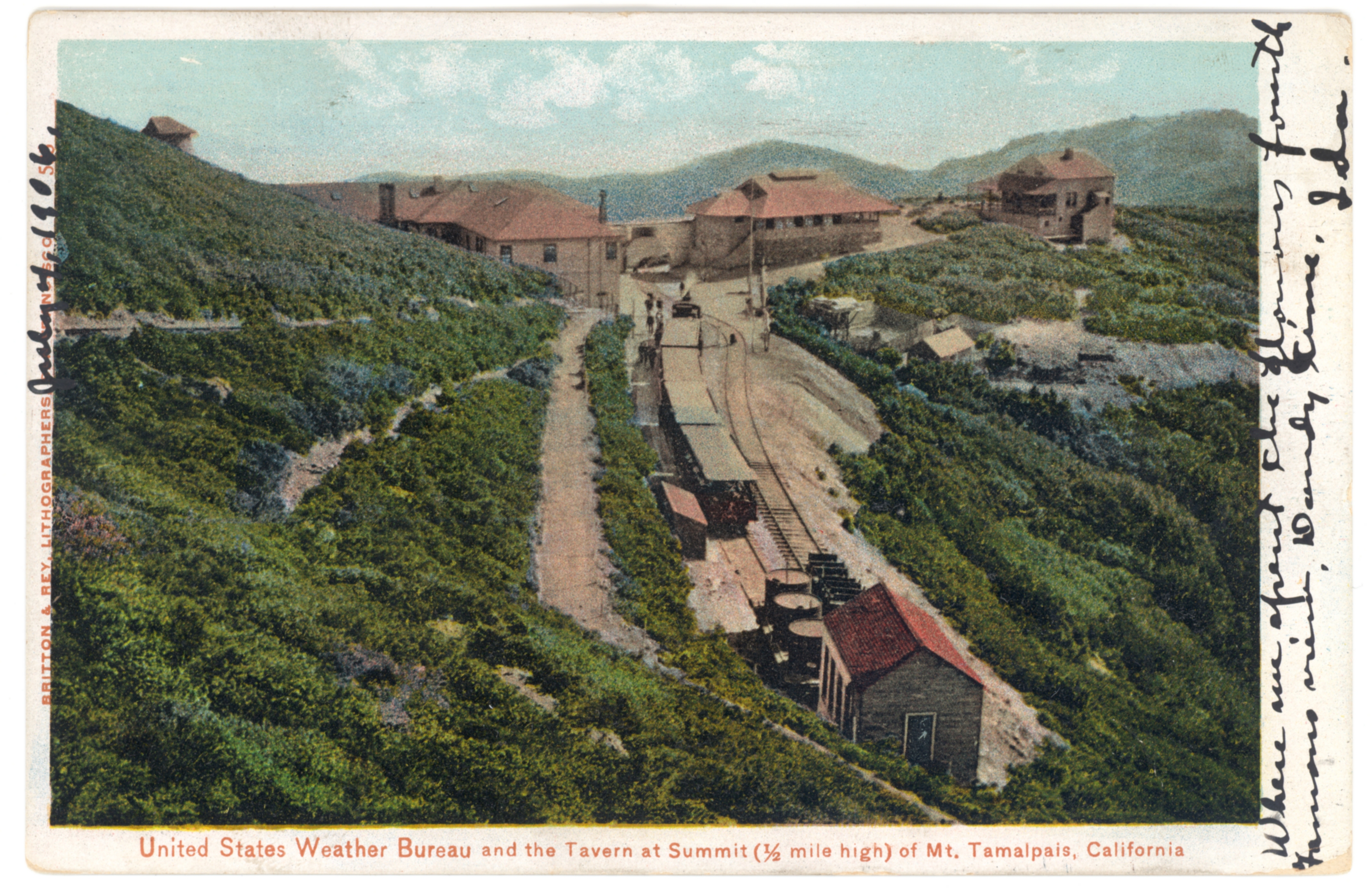
Postcard of the United States Weather Bureau buildings and tavern at the summit of Mt. Tamalpais, Marin County, California, circa 1906. (Source: NOAA Photo Library)

Class: Introduction to Creative Writing (The College of William & Mary)
Genre:
Poetry
Purpose:
To consider how language is the raw material with which all writers work and to consider the unique challenges that poetry in translation offers
Readings:
A packet of poetry in translation

A native speaker of a foreign language that you do not speak has given you a literal translation (that is, a word-for-word rendering) of a poem written by a poet who writes in her language. The native speaker has asked you to further translate the poem so that it makes sense and is a good poem.

The poem’s original language is from a unique language family and shares no roots with English. Because of this, there are some words that are almost untranslatable in English; the native speaker has done her best to provide you with some sense of those words, sometimes substituting phrases or even metaphors for individual objects. Additionally, because the grammar of the original language is so unique, the sentence structure often doesn’t work in English. Not only will you have to find translations for individual words, you’ll have to make sense of those words in foreign syntax.

You read the translation*…

Think Lagunitas business

Loss innovation. It seems that the old way of thinking. The idea, for example, eliminates the sense that the general idea of ​​light. The resurrection of the dead birch, black, the face of the first month, or any other theory of the world tribal carved sad because the skills to deal with the clown Beck, anything associated with Blackberry Blackberry word complaint if it does in this world, it is. We talked last night, my friend, marina trouble hearing sound thin. After that, I knew it from the start, and judges, and chin, hair, and the woman, and you, and I am his wife, and I remember that I love you still, it was several times small shoulders in his hands, and was surprised to see the face of violence, such as the drought and salt and the river of my childhood and Willow Iceland, sad songs levels, such as mud fish, we have a little money should pumpkin orange. It is difficult to deal with. It is necessary if we want to get an external desire eternal. And did the same to him. Reminds me a lot, and his hands and the length of the bread and said that his father hated him because he was asleep. Time was the word supernatural, flesh and body. Love, lunch and dinner, and BlackBerry.

*In order to produce this text, I ran Robert Hass’s “Meditation at Lagunitas” through several different languages (Maori, Chinese Traditional, German, French, Arabic, Finnish, Irish, and Icelandic) in Google Translate before translating it back into English.

The native speaker has also noted that the original poem was in one stanza and contained thirty-one lines. The literal translation, however, is in prose. She has converted the original poem into prose in order to preserve some semblance of the original syntax, and she hints that most of the lines contained between seven and ten words, except the last line, which only contained four.

You get to work and set about your translation systematically:

  1. You assess the overall tone of the poem, considering if it’s joyful, melancholic, bittersweet, or meditative.
  2. You then summarize the poem, identifying its:
    1. setting;
    2. speaker;
    3. addressee (if there is one) and/or audience;
    4. primary themes;
    5. and motivations and/or stakes.
  3. You now notate those places in the poem in which there seems to be some kind of shift in setting, direction, and/or tone. (This could also include an associative leap between images or thoughts. If you notice one of these leaps, briefly summarize the connection.)
  4. You then start the hard work of translating the poem, sentence-by-sentence, for clarity. At this point, you might begin to take some liberties with the text. As you’re revising the sentence, decide if you want to:
    1. change any words or phrases so that the poem will seem more accessible to North American readers (i.e. an American might write “truck” when an English translator would write “lorry”)
    2. or change any language that doesn’t seem essential to the overall meaning of the poem but that might make the poem sound more musical.
  5. Now begin to format the poem for line length, breaks, and stanza structure. Decide whether or not you want to try to mimic the poem’s original format. (If not, make a case for it.)
  6. Share your translation.

“Why Is Poetry Relevant?” Flash Essay Assignment

Salvador Dali illustrates Montaigne’s “Of Vanity” (1947)

Class: Writing Poetry (Virginia Commonwealth University)

Genre: Poetry

Purpose: To encourage students to look for the relevancy of their studies to culture; to consider the effects that poetry has on readers; and to explore their own motivations for seeking out poetry instruction.

Readings: Poetry‘s July/August 2014 issue that includes poems by Dean Young, Philip Fried, D.A. Powell, Traci Brimhall, Devin Johnston, Rosanna Warren, Amanda Calderon, Thomas Sayers Ellis, Rickey Laurentiis, Timothy Donnelly, and Alice Fulton

I’ve asked my students to write at least 500 words on “Why Is Poetry Relevant?” after they read Poetry‘s July/August 2014 issue this weekend. On Thursday, we talked a little bit about our expectations for what poetry is, can be—that many people believe that poetry was something impenetrable and written a century or more ago. My hope is that they will investigate this question on their own and arrive at a diverse conclusions on why poetry is relevant. With that, I’ll point you back to the opening of my Writing Poetry course description as a clue for this assignment’s motivations:

American poet C.D. Wright once wrote: “If I wanted to understand a culture, my own for instance . . . I would turn to poetry first. For it is my confirmed bias that the poets remain the most ‘stunned by existence,’ the most determined to redeem the world in words.” In this course, we will hold poetry to this noble standard, as an amplifier for the voices in our culture and an invocatory rendering of our world.