Tearing Down the Walls Exercise

"The Drawbridge" from "Imaginary Prisons" (1750) by Giambattista Piranesi
from “Imaginary Prisons” (1750) by Giambattista Piranesi

After a spirited discussion of the first six chapters of Italo Calvino’s Invisible Cities that included forays into questions of genre, style, and (with a little help from a Bachelard excerpt on “Intimate Immensity”) reality, my Writing Out of the Ordinary students took a break from their creative thinking to do some creative writing.

1. Pick one of the cities in Invisible Cities that you find the most outlandish, strange, or compelling.
2. Create a character that lives in one of these cities. Give that person a role in the community (i.e. a job, unemployment, a family, friends, etc.). Now write a brief sketch of no more than a page about a day in that character’s life. Make sure you take into account the unusual aspects of the city. Does the character visit the room of crystal globes in Fedora? What does the inhabitant of Baucis see looking at the ground? What are the goodbyes like when the people of Eutropia move to another identical city?
3. Now imagine that the fabulist foundation starts to erode. Write a narrative in which the city starts to become what we would think of as “normal” but which seems outlandish and strange to its inhabitants. Start small but by the end have the inhabitants’ whole reality challenged. Example: Maybe the inhabitants of Eutropia open the gates of their city with the intent of moving to the next one only to realize that there’s no other city nearby.

Because we ran out of time, the students will continue to work on 3 at the beginning of the next class. Once they are done writing, I’d like to add a fourth step to the exercise:

4. Reflect. What are the implications of the change for the character? Are interpersonal relationships changed? The character’s role? Is the character able to adapt to the changes? To what extend does that character cling to the old way of life? Is the change good or bad? In some small way, is the character a new character because of the new context? Does the old city live on in, still exist because of, the character’s memories and imagination?

I’m anxious to see what they come up with, especially because of the ouroboric discussion of invention and reality. I can’t help but think of Calvino himself writing that “a story is . . . an enchantment that acts on the passing of time, either contracting or dilating it.” With time, of course, comes change, and so at its root the exercise may be an exercise in time, an enchantment recharmed, an hourglass flipped on its head.

On Journaling: a Revelation

Codex Manesse, fol. 383r, Meister Konrad von Würzburg
Sometimes discussions with my students lead me to articulate things about writing that I’ve fathomed but haven’t been able to put into words. For instance, in Intro to Creative Writing this morning, my students were discussing Joan Didion’s “On Keeping a Notebook” and how they could use journaling as a foundation for their creative writing. Because of the students’ provocative questions and Didion’s exegesis on the practice—”I imagine . . . that the notebook is about other people. But of course it is not. . . . our notebooks give us away, for however dutifully we record what we see around us, the common denominator of all we see is always, transparently, shamelessly, the implacable ‘I.'”—I was able to finally say what I’ve often felt in keeping my writing journal:

Journaling is an exercise in being a character.

In keeping a journal, I distance myself from the self that appears in my writing. (Think Dante the writer vs. Dante the character.) This not only allows me to receive critical input without feeling as if I’m under attack but it also, and perhaps more importantly, gives me the opportunity to view my own writing as a reader would.

Maybe other writers out there have come to this realization, but the idea, and the way I was able to say it, surprised me in its clarity. Maybe this too is a product of journaling: I have distanced myself enough so that I am allowed to be surprised by myself, a moxie I find quite germane to the writing of the lyric.

Fantastic Creature Telephone Exercise

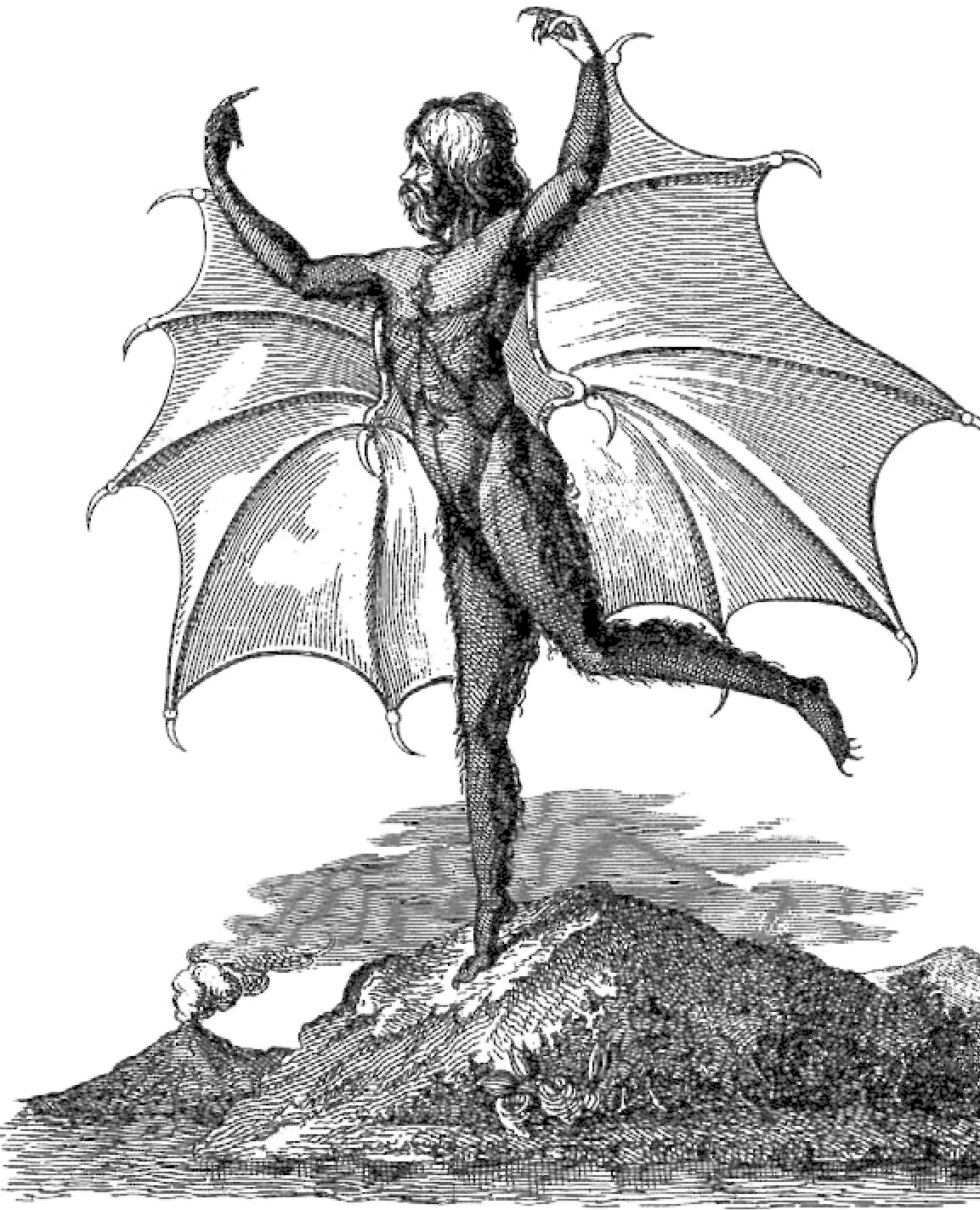
Portrait of a man-bat (Vespertilio-homo), from an edition of the moon series published in Naples. (Courtesy of the New York Public Library.) (1836)
Portrait of a man-bat from The Sun and the Moon: The Remarkable True Account of Hoaxers, Showmen, Dueling Journalists, and Lunar Man-Bats (1836), published in the US before 1923 and public domain in the US.

To jumpstart my Writing Out of the Ordinary students thinking about the weird and wild, I created the following exercise for the first day of class.

1. The class breaks up into groups of at least five. Each group designates a leader and forms a line.
2. Each leader reads an entry in Borges’s Book of Imaginary Beings for two minutes. (I used “The Bird That Makes the Rain,” “A Crossbreed by Kafka,” and the “Hare in the Moon” as they’re among the shortest entries in the book.)
3. The leader then returns to the group and whispers details about the creature to the next group member; each member then whispers it to the next until everyone has heard about the creature.
4. The last group member must write, from memory, a summary of the creature as it was last described.
5. Each group then hands the summary to the leader of an adjacent group.
6. The groups then brainstorm and write a narrative (daily routine, an encounter, origin story, etc.) for the new creature.

There’s several “translations” here that I asked my students to consider:

1. text to memory,
2. speech to hearing (multiplied by however many students are in a group),
3. intention of the writer (the last group member) to readers (the next group),
4. and information (transcription) to imagination (the narrative).

This exercise introduces students to a practice of imaginative thinking, asks them to consider readers’ relationship to text, locates significant and memorable details, and provides them with a chance to interact and thus establish a good rapport with one another—a boon to future workshops!