In Design as Art, Bruno Munari writes, “Not only does each letter of a word have a shape of its own, but all its letters taken together give shape to the word.” When we read, we read the shape of the word if the word is familiar to us. If the word is unfamiliar, we must read the shape of each letter, attributing sound to each one and combining them. We use this amalgamated sound to attempt to locate meaning. We troll our memories for previous usage. We look at context. If we’re scholars, we might even recognize roots and stems. In effect, in all of these investigative processes, we look to the history of the word—personal, textual, or etymological—in order to understand its present meaning.
Sometimes when I’m tired or sick or otherwise impaired, however, I look at words and they’re only shapes; they mean nothing. It makes reading more akin to viewing visual art, a Rothko perhaps. I look at the whole page, the shape, and the rivers of white across the lines. I see the words as bodies, as segmented insects. Regardless of whether or not I view the shape of the letters or words, meaning becomes untethered to those shapes. They become tangible. I care more for the vessel than what it contains.
While this as a permanent condition could be problematic, the transient aphasia provides me with a means to reboot language, the way time seems new and fresh on those rare and brief occasions when I forget how old I am. It reminds one that language is a symbol rather than an incarnation and that, in order for language to mean, I must be present. I must supply language with meaning. Reading is a transaction rather than a gift of information.
Words need me as much as I need them. When I realize this, suddenly the axis shifts again, and those shapes suddenly have definition.
I’d like to ban the word “slumber” from my students’ creative writing. I don’t think I’ve ever “slumbered.” So often, they believe it conveys a softness, but that double consonant “mb” with that unpleasant “er” actually seems more clunky to me that the simple “sleep.” Easy to say for easy sleep.
from People’s Cyclopedia of Universal Knowledge (1883)
A student wrote to me over the weekend to request a prompt for my Intro to Creative Writing‘s 5–7 page creative nonfiction assignment. Although I usually encourage students to locate their own subject matter as it’s a critical skill and they’ll likely care more about their handpicked subjects, I came up with several prompts that I’ll hold onto for future students who need a place to start.
The Conversationalist
Is there a story or several stories that you like to tell friends or new people you meet? Is the subject matter related or disparate? Write the story/stories that you tell, and the narrative of telling these stories. How have people reacted? Reflect. Why do you tell these stories? Do you find yourself wanting to create a certain impression on listeners? This piece, as it has three narrative components, has a lot of promise for fulfilling the page requirement.
Just a Phase
Was there a time that you tried to “be someone else,” to adopt a different personality? Describe in detail. Did you change your clothes? Your hair? Your interests? Your speech or accent? Many of us go through identity crises especially as adolescents. What did you do while you tried this out? Did you go somewhere? Did you make a fool of yourself or pull it off? When did you realize it wasn’t right for you? Why change? Do you feel nostalgic now? Show this.
Witness
Have you ever witnessed something violent, unsettling, or scary? Write about this and your reaction after. How long did it affect you? How did it change you? Did you intervene? Why or why not? Do you regret your decision to become involved or not involved? (See “Accident, June 1948” by Seamus Deane for an example.)
by Robert Fludd (1619)These days it takes me a longer time to get started on the page with a poem. I spend weeks only thinking about lines. Used to, all that wheel spinning and doubling back took place on the page. What’s interesting is how that’s allowed for a shift in my subject matter: I’m more willing to give a little space to the intangible, the ineffable. So perhaps, for me, subject matter is tied more to the medium than I originally anticipated.
I wonder how it would change if I started writing only by hand . . .
Garage met Chauffeurswoning te Zandvoort (1916) by Guillaume Frédéric la CroixClass: Intro to Creative Writing Genre: Creative nonfiction Readings: “Notes from a Native Daughter,” “Los Angeles Notebook,” and “Goodbye to All That” by Joan Didion; “Bread” by Jane Brox Time: 24 minutes
1. Describe the home you spent the most time in as a child including its location, distinctive features, the people, the food, the weather, etc. Be as thorough as possible. (7 min.)
2. Is there something that people often assume about the place that isn’t true? Write an anecdote about a time that someone made a presumption about where you were from. (i.e. Every evening while I had bronchitis I stopped at a pub in Mayfair to have a shot of Jack Daniel’s to ease my coughing before bed. The first night, the bartender asked to see my ID. When I handed him my Tennessee driver’s license, he said, “A Tennessee girls drinks Tennessee whiskey,” and, laughing, “Do you like your country music too?”) (5 min.)
3. Why do you think that outsiders often assume these things about your home? Speculate about why that is, how long that’s been true, and if it will continue to be true. Why or why not? Use this as a means to tell us a little bit of history about the place you grew up. You can use historical facts, family stories, gossip, rumors, etc. (7 min.)
4. If you weren’t from the area, how would you view your hometown? Would you visit or move there? Consider several possibilities. (5 min.)
This exercise allows students to look at a subject from different angles as well as helps them access something personal through exterior descriptions. In much the same way that they saw Didion revealed through the places she talks about (California’s Central Valley, Los Angeles, and New York), students should realize that, by the details they choose to talk about and the perceptions they reject or defend, they do some work to define themselves as well as the place, subject, and—perhaps most importantly—a conflict.
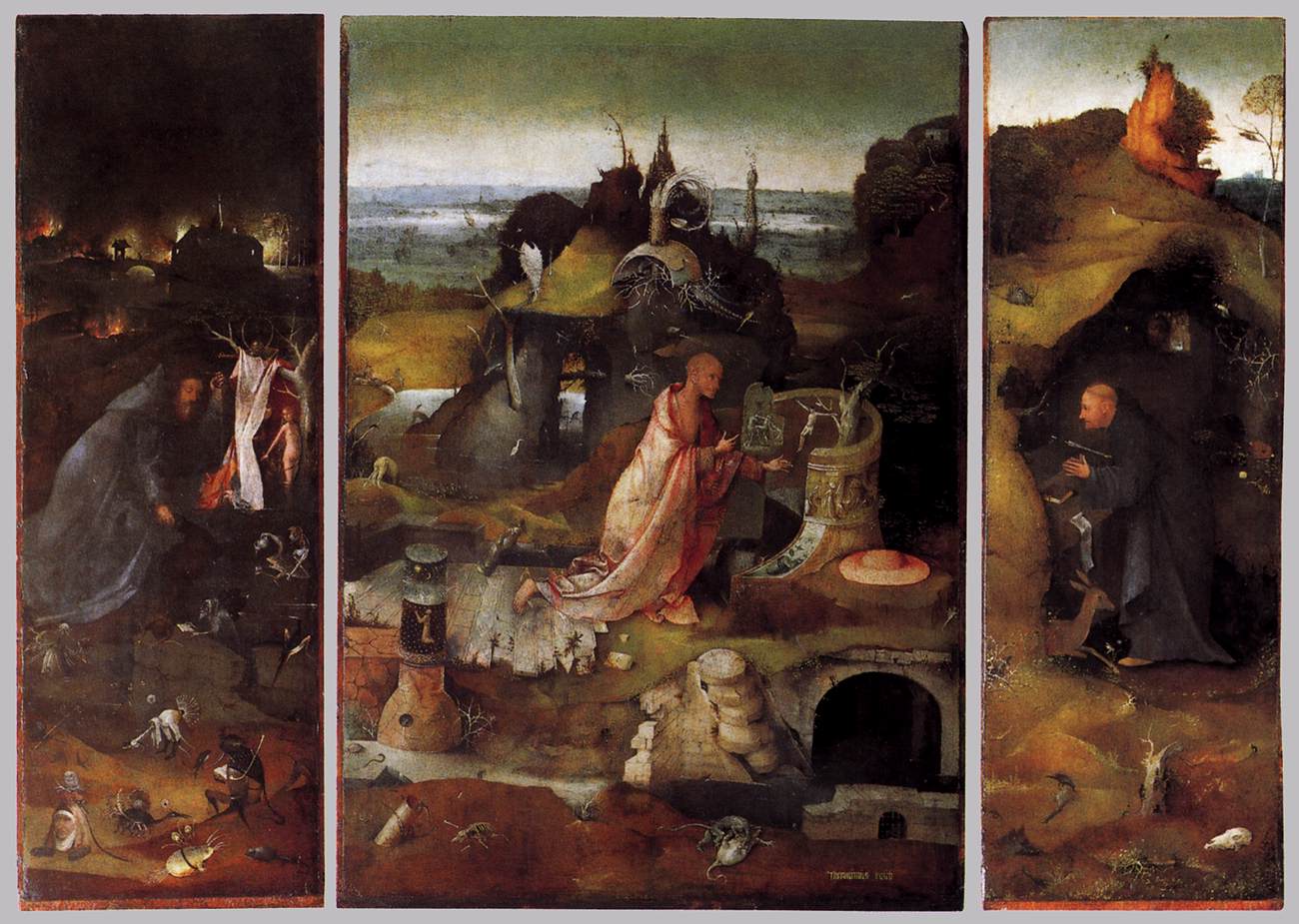
The Hermit Saints Triptych (1490s) by Hieronymus BoschMy Intro to Creative Writing class discussed Joan Didion’s “Slouching Towards Bethlehem,” “On Morality,” and “On Going Home” with regard to what they learned from the “Creative Nonfiction” and “Setting” chapters in Janet Burroway’s Imaginative Writing. After, they jumped into this exercise about place and how external details reveal internal information.
1. Write about entering a place that’s incredibly familiar to you (your dorm room, your car, etc., but not this classroom.) What do you notice? Use only concrete descriptions. Avoid emotional responses and abstractions. (5 min.)
2. Think of a time in which you returned to a place that was once familiar to you but to which you hadn’t been in a long time. (A childhood home, your old school, etc.) Write a scene in which you describe only your physical surroundings as you enter that place. What’s changed? What’s different? Compare and contrast your memory of the place with its current state. (5 min.)
3. Now write a similar sort of description about a time in which you entered a new place, particularly one in which you weren’t comfortable or one that has a culture that is unfamiliar to you (like Didion going into the Haight). Again, focus only on concrete details. (5 min.)
4. Read aloud your three entries. The class will then vote on which one was more immersive, compelling, and detailed.
5. Reflect: Why did the class choose that one? Did you write more about one than the others? If so, why do you think that is? As a reader, which one of these is more interesting to you? Why? Which one was the hardest to write? Why?
Overwhelmingly, the class chose either the second or third description as both seemed to reveal an internal conflict—the sense of something lost/irreparable or alienation. The best part is that the students didn’t write about these internal conflicts at all; rather, it was entirely implicit in the concrete details.
from “Imaginary Prisons” (1750) by Giambattista Piranesi
After a spirited discussion of the first six chapters of Italo Calvino’s Invisible Cities that included forays into questions of genre, style, and (with a little help from a Bachelard excerpt on “Intimate Immensity”) reality, my Writing Out of the Ordinary students took a break from their creative thinking to do some creative writing.
1. Pick one of the cities in Invisible Cities that you find the most outlandish, strange, or compelling.
2. Create a character that lives in one of these cities. Give that person a role in the community (i.e. a job, unemployment, a family, friends, etc.). Now write a brief sketch of no more than a page about a day in that character’s life. Make sure you take into account the unusual aspects of the city. Does the character visit the room of crystal globes in Fedora? What does the inhabitant of Baucis see looking at the ground? What are the goodbyes like when the people of Eutropia move to another identical city?
3. Now imagine that the fabulist foundation starts to erode. Write a narrative in which the city starts to become what we would think of as “normal” but which seems outlandish and strange to its inhabitants. Start small but by the end have the inhabitants’ whole reality challenged. Example: Maybe the inhabitants of Eutropia open the gates of their city with the intent of moving to the next one only to realize that there’s no other city nearby.
Because we ran out of time, the students will continue to work on 3 at the beginning of the next class. Once they are done writing, I’d like to add a fourth step to the exercise:
4. Reflect. What are the implications of the change for the character? Are interpersonal relationships changed? The character’s role? Is the character able to adapt to the changes? To what extend does that character cling to the old way of life? Is the change good or bad? In some small way, is the character a new character because of the new context? Does the old city live on in, still exist because of, the character’s memories and imagination?
I’m anxious to see what they come up with, especially because of the ouroboric discussion of invention and reality. I can’t help but think of Calvino himself writing that “a story is . . . an enchantment that acts on the passing of time, either contracting or dilating it.” With time, of course, comes change, and so at its root the exercise may be an exercise in time, an enchantment recharmed, an hourglass flipped on its head.
“Certainly literature would never have existed if some human beings had not been strongly inclined to introversion, discontented with the world as it is, inclined to forget themselves for hours and days on end and to fix their gaze on the immobility of silent words.”
Bottom part of plate LXXI. from Veranderingen der surinaemsche insekten, Amsterdam, Joannes Oosterwyk, 1719
Today in Writing Out of the Ordinary the class animatedly discussed Kafka’s “The Metamorphosis” and Márquez’s “A Very Old Man with Enormous Wings.” During the last twenty minutes of class, they participated in the following exercise that asks them to transform a character into another creature in the spirit of Gregor Samsa’s overnight transformation or à la the “fearful thunderclap” that “rent the sky in two and changed her into a spider”:
1. Outline the narrative of an extraordinary—think of “extraordinary” in terms of its literal meaning, “outside the normal course of events”— event (the time when . . . i.e. you broke your arm skiing, you shared an airport shuttle with the mayor, the woman sitting next to you in 16A threw up on the plane window during takeoff, etc.).
2. Now, pick a character that you’re willing to change.
3. Turn that character into another creature (ghost, sheep, centaur etc.) but allow the world to stay familiar. Rewrite it with that in mind. What changes? What can stay the same?
4. Now, reflect. Is there a way to get to something you couldn’t by making this change? Does it change what’s at stake in the piece? How did you attempt to keep the world realistic even when there was a fantastical creature in the scene?
I also emphasized that the realism in magical realism isn’t simply that the context of magical creature is realistic but that the magical creature is also depicted in a way that seems real to that world of the story. What’s realistic in a fictional space can be different than what’s realistic in our lives. Other thoughts I encouraged: How does one keep the narrative squarely in the world of magical realism and not drift into fantasy? How does one prevent the fantastical creature from being thought of as only allegory? We’ll continue to think about these things as the magical realism unit progresses.


![Utriusque cosmi maioris scilicet et minoris […] historia, tomus II (1619) by Robert Fludd](https://emiliaphillips.com/wp-content/uploads/2014/02/utriusque-cosmi-maioris-scilicet-et-minoris-e280a6-historia-tomus-ii-1619-by-robert-fludd.png)



 Emilia Phillips