“The Craft of Prose” Fall 2015: Course Description, Required Texts, and Grade Requirements

Instructor’s Course Description
As a means of exploring the craft of prose writing, we will read, analyze, and imitate two living writers: Chimamanda Ngozi Adichie and Jesmyn Ward. By reading two, book-length works by each writer—a short story collection and book-length essay by Adichie and a novel and memoir by Ward—we will see how these writers develop their unique styles across genres and locate how their personal concerns inform their fictional narratives. Additionally, we will supplement these texts with short stories and essays by some of the most influential prose writers of the 20th century to understand the history and development of American prose over the last one hundred years. We will translate these immersive reading experiences into writing skills through discussion, exercises, and workshop. Several times throughout the semester, students will turn in original writing for workshop, a collaborative discussion about writing techniques and their effects on readers, and later revise two of the pieces using the comments received in workshop. You should bring to this class a hard work ethic supported by curiosity and generosity. We will base our discussions on how texts work rather than what they mean, after Francine Prose’s ideal of “reading like a writer.” My approach to teaching writing is founded on the belief that our writing skills must be practiced and cultivated, and that one must continually challenge one’s aesthetics, habits, and concerns throughout one’s writing life in order to write anything of consequence to one’s readers and, perhaps more importantly, one’s self.

Required Texts

  • The Thing Around Your Neck by Chimamanda Ngozi Adichie. Anchor, 2010. ISBN: 978-0307455918
  • We Should All Be Feminists by Chimamanda Ngozi Adichie. Anchor, 2015. ISBN: 978-1101911761.
  • The Best American Essays of the Century, ed. Joyce Carol Oates. Mariner, 2001. ISBN: 978-0618155873.
  • The Best American Short Stories of the Century, ed. John Updike. Mariner, 2000. ISBN: 978-0395843673.
  • Men We Reaped: A Memoir by Jesmyn Ward. Bloomsbury USA, 2014. ISBN: 978-1608197651
  • Salvage the Bones by Jesmyn Ward. Bloomsbury USA, 2012. ISBN: 978-1608196265

Grade Requirements

  • Class Participation (10%)
  • Group Presentation (15%)
  • Four Workshop Pieces (40%)
  • Two Revisions (15%)
  • Two Imitations (10%)
  • Discussion Board Participation (5%)
  • Final Reading (5%)

“Ornithology” Poetry Analysis and Imitation Exercise

Class: Introduction to Creative Writing (The College of William & Mary)
Genre:
Poetry
Purpose:
To become more scrupulous readers of poetry

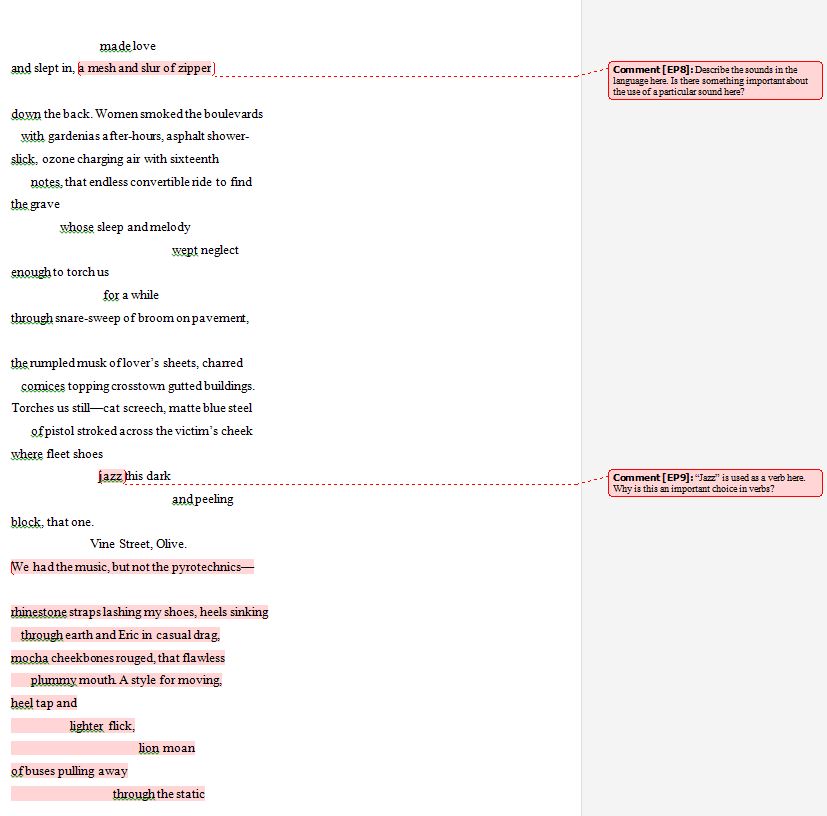
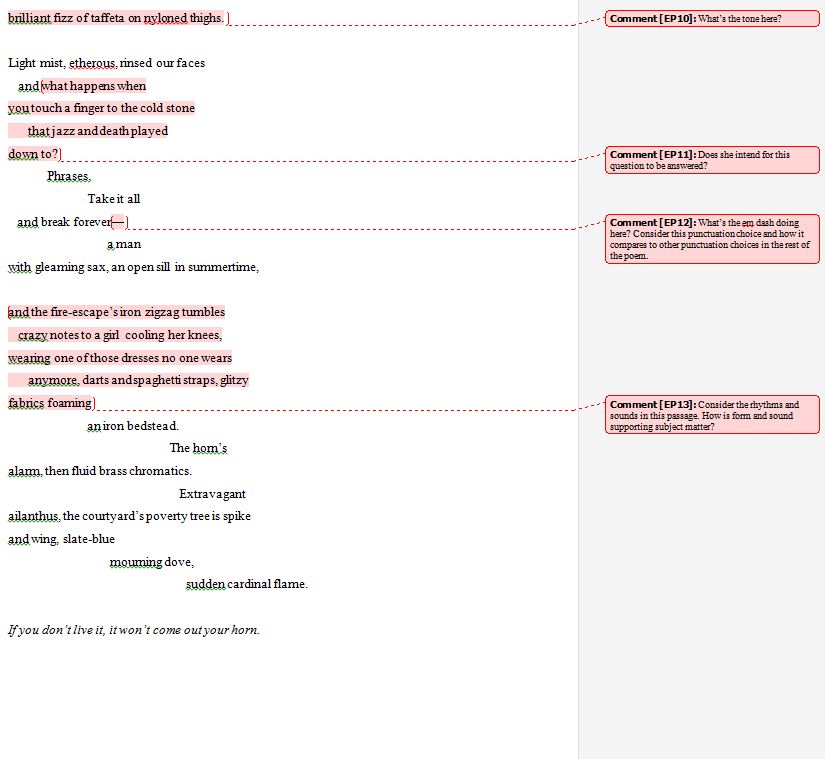
In order to prepare my Intro to Creative Writing students for talking more about poetry with regard to the author’s intentionality before their poetry workshop, I’m asking them to read and examine the poem “Ornithology” by Lynda Hull. They then have to answer questions about specifics in the poem. I’ve provided these questions via track changes in Microsoft Word:

Ornithology Poetry Analysis Exercise screenshot - 1 Ornithology Poetry Analysis Exercise screenshot - 2 Ornithology Poetry Analysis Exercise screenshot - 3

Once they respond to these questions on their own, we will then discuss the possibilities. My hope is that they will see the value in discussing the possibilities rather than strive to make proclamations about what the poem is or what it’s doing.

After they complete the analysis, I’m going to ask them to try to write an imitation of at least ten lines (the formal unit that’s repeated throughout the poem) with special attention to sound and rhythm.

“Babylon: A Place You’ve Only Heard Of” Exercise

"Abbildung der Stadt Babylon" ("Picture of the City of Babylon"),  Erasmus Francisci, copper engraving on paper, 1680
“Abbildung der Stadt Babylon” (“Picture of the City of Babylon”), Erasmus Francisci, copper engraving on paper, 1680

Class: Introduction to Creative Writing (The College of William & Mary)
Genre: Nonfiction
Purpose: To examine how place becomes setting and to cultivate an “outsider’s” point of view
Readings: “Goodbye to All That,” “Babylon,” and “No Man’s Land” from Eula Biss’s Notes from No Man’s Land and “Goodbye to All That” by Joan Didion


  1. Think about a city or country that you’ve never heard of but have never been to. This can be a real (Saigon), mythic (Troy), or imagined place. Describe what you know or imagine to know about this place. Write for 5 minutes.
  2. Now think about your hometown. Describe it as you remember it, including the homes, the landscape, the stores, the values, etc. Write for 5 minutes.
  3. Write a paragraph that considers similarities between the place you’ve never been and your hometown. Write for 3 minutes.
  4. Is there something notable or notorious about your hometown? Write for 3 minutes about how outsiders might view your hometown. Is there something unique to your hometown and therefore strange to outsiders? Would an outsider have prejudices against your hometown? Write for 3 minutes.
  5. How might you be like the outsider with the place you’ve never been? Write a meditation on these similarities for 5 minutes.

“Nobody Knows Your Name” Exercise

Kabuki Marquee (1822) by Utagawa Toyokuni I (Japan, 1769-1825)

Class: Introduction to Creative Writing (The College of William & Mary)
Genre: Nonfiction
Purpose: To explore the self as a character and subject
Readings: Chapters 8 (“Creative Nonfiction”) in Janet Burroway’s Imaginative Writing and “Nobody Knows Your Name” of Eula Biss’s Notes from No Man’s Land

Do you know the story of your name? Its meaning and its history? Do you know why your parents named you what they named you? Are there other famous people with your name? Is your name particularly popular or obscure? What does your last name say about your ancestry, if anything? What are misconceptions about your name? Is your name easily mispronounced or misspelled; if so, give us a narrative about someone getting your name wrong. Are their misconceptions about you based on your name? How would address those who make judgments on a person based on their name? If you don’t know what your name means, speculate and/or invent your own personal meaning for your name based on your experiences, the sounds in your name, etc.. Do you define your name or does your name define you? Write for 10 minutes.

“Joe had some water”: Intro to Creative Writing Discussion about Image, Specificity, Significance, and Precision

After talking about Janet Burroway’s Image chapter in Imaginative Writing, my class took our discussion to the white board to consider problems with translating experience and ideas in language, the fundamentals of significant detail, and the precision of language.

I asked them to consider all of the possible meanings for each of these sentences:

“Joe had some water.”
—He drank some water; he has water to drink; he had water for watering his plants, etc.

“Joe had a glass of water.”
—He drank the glass of water; he had a glass of water to drink, etc.

“Joe had a glass of water on the table.”
—He had water to drink on the table and he hadn’t finished drinking it.

We explored the slippery nature of the word “had” in all of these cases, and then we thought about how context could change the sentences. We considered the difference between “a glass of water” versus a “water glass,” how the second doesn’t necessarily mean that the glass contains water, rather it could designated as a glass for water. Additionally, having the read come to “glass” before “water” would help form the image for the reader as it provides the container before what’s contained inside it.

IMG_3326.JPG

“Backwards Story a Telling” Exercise

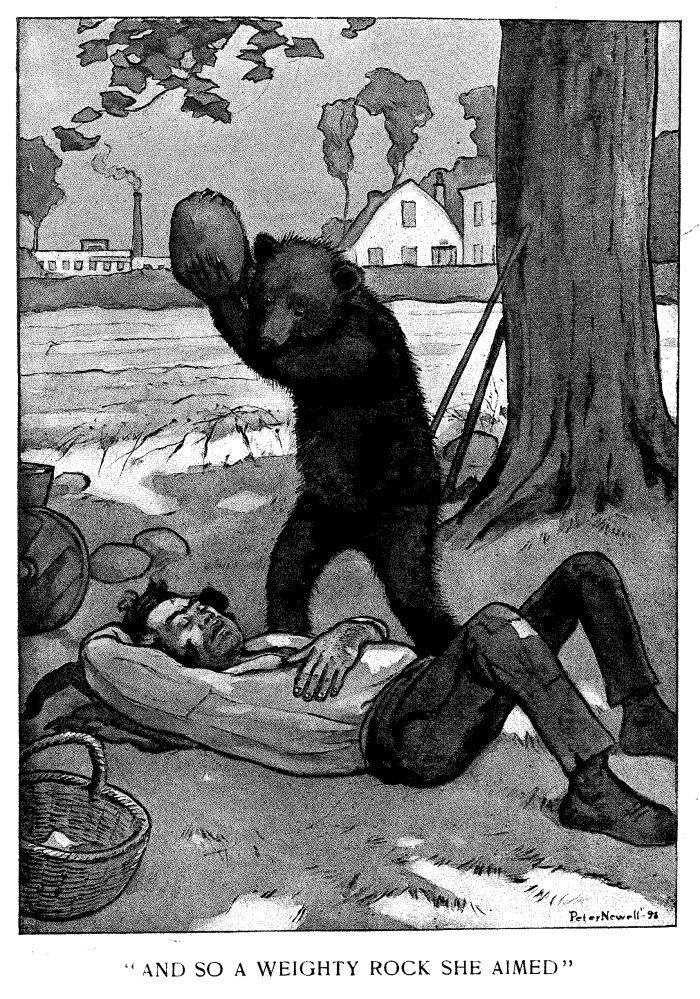
Illustration from Fables for the Frivolous by Guy Wetmore Carryl, with illustrations by Peter Newell (1898)

Class: Introduction to Creative Writing (The College of William & Mary)
Genre: Fiction
Purpose: To open up discussion about plot structure and significant details
Readings: Chapters 9 (“Fiction”) and 6 (“Story”) in Janet Burroway’s Imaginative Writing

  1. Watch a viral video without taking notes. (“Texting Guy Almost Runs Into Bear”: http://youtu.be/WYsAkjfXxzU)
  2. Write a summary of what happens in the video. (2 min.)
  3. Now write a scene from the point of view of the bear or the man. Try to tap into their thoughts and moment-by-moment perceptions. Include as many details as you can in 5 minutes. Here’s the hitch: you must tell the story in reverse chronological order! (Tell the story backwards!)
  4. Look at the inverted check mark diagram of pg. 173 in Burroway. Discuss how the check mark works for a chronological story compared to the story told in reverse. Where does the conflict fall in your scene? The crisis (climax)? Is there resolution? Were there any details you thought of telling the story backwards that you might not have thought of telling the story chronologically?

“One Story, Three Genres” Exercise

Class: Introduction to Creative Writing (The College of William & Mary)
Genre: Fiction, Nonfiction, and Poetry
Purpose: To consider how writers of three genres go about approaching similar subject matter; to introduce distinctions between the genres; and to introduce key drafting and revision considerations based on reading from Janet Burroway’s Imaginative Writing
Readings: Chapters 1 (“Invitation to the Writer”) and 7 (“Development and Revision”) in Janet Burroway’s Imaginative Writing

The_three_bears_pg_14

  1. Pick a favorite nursery rhyme, myth, or religious tale that you know by heart. Write a brief summary of the story in 2 to 5 sentences.
  2. If you were writing this narrative as a short story, how would you change it? What elements would you include? How would the style change?
  3. If you were writing this narrative as a poem, how would you change it? What would be your first steps to writing the poem? What would you leave out? What would you add in?
  4. If you were using this narrative as a basis for nonfiction, how would you frame it? How can you approach this subject matter in that way?
  5. Free write for ten minutes and begin to convert your summary into either a short story, a poem, or personal essay.

Hybrid Assignment in Introductory Creative Writing Class

For my intro to creative writing class at William & Mary this semester, I’m asking students to write one hybrid work as their final workshop piece. Often I feel like these introductory classes set up limits for students, but I wonder if allowing them to see genre as something that’s a little more fluid will encourage continued reading across the genres, an understanding that writing techniques can be used across genres, and creativity with the execution of their ideas. They will be reading a few hybrid texts at the end of the semester, too. The hybrid assignment will also give us a chance to review what we’ve gone over about the three genres by forcing us to consider their respective challenges. I think it will also give students the opportunity to tackle issues they faced across multiple assignments. Say they struggled with point of view in their poetry and concrete details in their nonfiction, but the poems presented strong images and their nonfiction offered an unwavering first-person. Perhaps they’ll be able to double up on their strengths through a hybrid work.

Regardless of the success of their pieces, I hope that we can have a great discussion that will prepare them for debates about form and theory in upper-level, genre-specific courses. Additionally, I don’t want to have a situation where I say, “You’ll discuss these forms if you choose to continue taking creative writing courses.” I want to be able to answer these inevitable questions thoroughly, not offhandedly in a minute or so in the middle of a workshop. Besides, you never know which discussion might excite a student about writing. Maybe those slippery hybrid genres are what really interest some students and they might not know it until you offer it to them!

Staggering Assignments

Distillation by Alembic, 1910. (Published before 1923 and public domain in the US.)

In my poetry class, I decided to stagger revision assignments throughout the semester instead of assigning a final portfolio, because I wanted:

  1. to avoid end-of-the-semester-grading fatigue, in order to ensure that I was always fresh and never rushed in grading;
  2. to alleviate students’ end-of-the-semester stress, so that they would be able to concentrate on revising individual poems rather than meeting basic requirements of a portfolio (better— instead of more—work at a time);
  3. to give students a better, ongoing sense of how they are progressing in the course;
  4. and to situate revision as an integral and ongoing part of the writing process that goes hand-in-hand with writing new poems and reading.

Structuring the course in this way, I felt like I was able to give more feedback, and my students’ revisions improved. In previous courses, a revision unit at the end of the semester suggested that revision was an afterthought to the writing process. By having students revise throughout the semester, workshop directly correlated to students’ next steps and, in their self-assessments, they often referred to feedback they received from their peers. Workshop, therefore, was explicitly linked to revision; it wasn’t the end but the means of their creative work—not a junkyard, but an alchemical machine.