Three Places Exercise

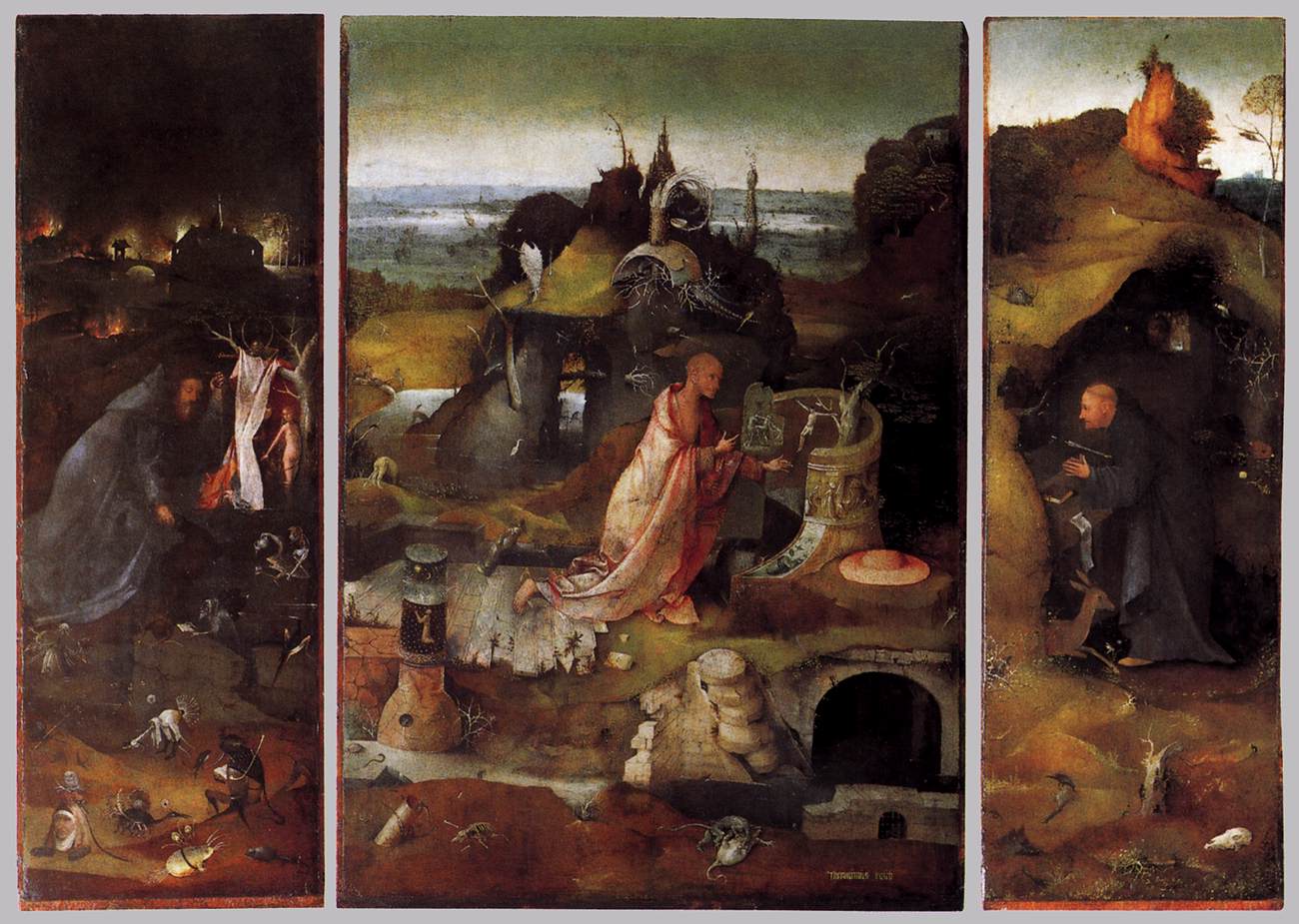
    The Hermit Saints Triptych (1490s) by Hieronymus Bosch
    The Hermit Saints Triptych (1490s) by Hieronymus Bosch
    My Intro to Creative Writing class discussed Joan Didion’s “Slouching Towards Bethlehem,” “On Morality,” and “On Going Home” with regard to what they learned from the “Creative Nonfiction” and “Setting” chapters in Janet Burroway’s Imaginative Writing. After, they jumped into this exercise about place and how external details reveal internal information.

    1. Write about entering a place that’s incredibly familiar to you (your dorm room, your car, etc., but not this classroom.) What do you notice? Use only concrete descriptions. Avoid emotional responses and abstractions. (5 min.)
    2. Think of a time in which you returned to a place that was once familiar to you but to which you hadn’t been in a long time. (A childhood home, your old school, etc.) Write a scene in which you describe only your physical surroundings as you enter that place. What’s changed? What’s different? Compare and contrast your memory of the place with its current state. (5 min.)
    3. Now write a similar sort of description about a time in which you entered a new place, particularly one in which you weren’t comfortable or one that has a culture that is unfamiliar to you (like Didion going into the Haight). Again, focus only on concrete details. (5 min.)
    4. Read aloud your three entries. The class will then vote on which one was more immersive, compelling, and detailed.
    5. Reflect: Why did the class choose that one? Did you write more about one than the others? If so, why do you think that is? As a reader, which one of these is more interesting to you? Why? Which one was the hardest to write? Why?

    Overwhelmingly, the class chose either the second or third description as both seemed to reveal an internal conflict—the sense of something lost/irreparable or alienation. The best part is that the students didn’t write about these internal conflicts at all; rather, it was entirely implicit in the concrete details.

Tearing Down the Walls Exercise

"The Drawbridge" from "Imaginary Prisons" (1750) by Giambattista Piranesi
from “Imaginary Prisons” (1750) by Giambattista Piranesi

After a spirited discussion of the first six chapters of Italo Calvino’s Invisible Cities that included forays into questions of genre, style, and (with a little help from a Bachelard excerpt on “Intimate Immensity”) reality, my Writing Out of the Ordinary students took a break from their creative thinking to do some creative writing.

1. Pick one of the cities in Invisible Cities that you find the most outlandish, strange, or compelling.
2. Create a character that lives in one of these cities. Give that person a role in the community (i.e. a job, unemployment, a family, friends, etc.). Now write a brief sketch of no more than a page about a day in that character’s life. Make sure you take into account the unusual aspects of the city. Does the character visit the room of crystal globes in Fedora? What does the inhabitant of Baucis see looking at the ground? What are the goodbyes like when the people of Eutropia move to another identical city?
3. Now imagine that the fabulist foundation starts to erode. Write a narrative in which the city starts to become what we would think of as “normal” but which seems outlandish and strange to its inhabitants. Start small but by the end have the inhabitants’ whole reality challenged. Example: Maybe the inhabitants of Eutropia open the gates of their city with the intent of moving to the next one only to realize that there’s no other city nearby.

Because we ran out of time, the students will continue to work on 3 at the beginning of the next class. Once they are done writing, I’d like to add a fourth step to the exercise:

4. Reflect. What are the implications of the change for the character? Are interpersonal relationships changed? The character’s role? Is the character able to adapt to the changes? To what extend does that character cling to the old way of life? Is the change good or bad? In some small way, is the character a new character because of the new context? Does the old city live on in, still exist because of, the character’s memories and imagination?

I’m anxious to see what they come up with, especially because of the ouroboric discussion of invention and reality. I can’t help but think of Calvino himself writing that “a story is . . . an enchantment that acts on the passing of time, either contracting or dilating it.” With time, of course, comes change, and so at its root the exercise may be an exercise in time, an enchantment recharmed, an hourglass flipped on its head.

Italo Calvino on introversion

“Certainly literature would never have existed if some human beings had not been strongly inclined to introversion, discontented with the world as it is, inclined to forget themselves for hours and days on end and to fix their gaze on the immobility of silent words.”

—Italo Calvino, “Quickness”

On Journaling: a Revelation

Codex Manesse, fol. 383r, Meister Konrad von Würzburg
Sometimes discussions with my students lead me to articulate things about writing that I’ve fathomed but haven’t been able to put into words. For instance, in Intro to Creative Writing this morning, my students were discussing Joan Didion’s “On Keeping a Notebook” and how they could use journaling as a foundation for their creative writing. Because of the students’ provocative questions and Didion’s exegesis on the practice—”I imagine . . . that the notebook is about other people. But of course it is not. . . . our notebooks give us away, for however dutifully we record what we see around us, the common denominator of all we see is always, transparently, shamelessly, the implacable ‘I.'”—I was able to finally say what I’ve often felt in keeping my writing journal:

Journaling is an exercise in being a character.

In keeping a journal, I distance myself from the self that appears in my writing. (Think Dante the writer vs. Dante the character.) This not only allows me to receive critical input without feeling as if I’m under attack but it also, and perhaps more importantly, gives me the opportunity to view my own writing as a reader would.

Maybe other writers out there have come to this realization, but the idea, and the way I was able to say it, surprised me in its clarity. Maybe this too is a product of journaling: I have distanced myself enough so that I am allowed to be surprised by myself, a moxie I find quite germane to the writing of the lyric.