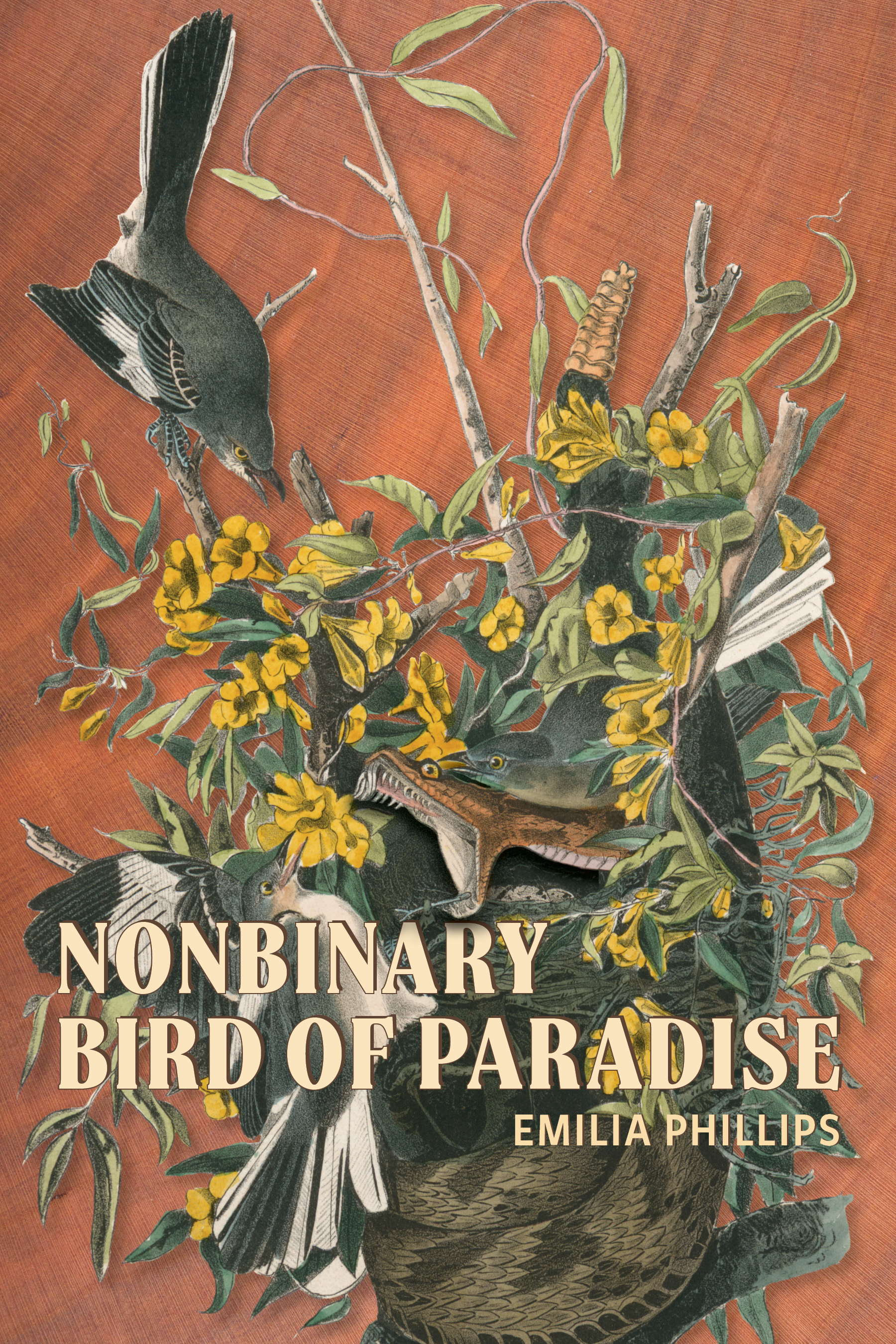
For “Spin,” students will be negotiating subtext, rumor, dramatic irony, subjectivity, objectivity, and context in our readings and their own work. Students will discuss the elements of reportage and rumor in their icebreaker text, Harry Potter and the Goblet of Fire, and then discern the difference between Rowling’s subtext and the subtext, however erroneous, read into the actions of the protagonists by other characters. Students will likewise watch a clip from the 1966 film Who’s Afraid of Virginia Woolf? and identify elements of dialogue, actions, body language, and gestures that reveal subtext, and then they will do a writing exercise in which they describe the innocent actions of a character in public and then re-describe them in the point of view of a law enforcement official, private investigator, reporter, or suspicious bystander who misconstrues, willfully or automatically, the actions of that innocent person.
“Debate” Writing Exercise for Craft of Prose
In the “Debate” writing exercise, students are asked to create two characters—political candidates—with unique syntax and diction in order to debate a phony issue, like whether muffins should actually be called cake, for example. In doing so, they learn how to format dialogue; to progress action through dialogue; and how to demonstrate a character’s values, motivations, and background through dialogue.
New relevant reading for my Literary Editing & Publishing class
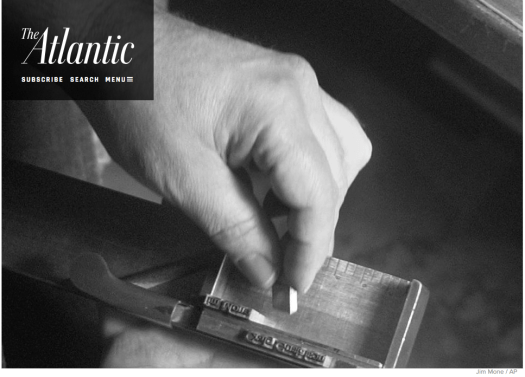
On The Atlantic, Lindsay Lynch writes about typesetting letterpress and the en space in “How I Came to Love the En Space”:
To understand letterpress printing, imagine that every letter you see on your screen is an object, a tiny piece of metal. Not only is every letter an object, but every space between every letter is also an object. Every space between words, every space between lines—every bit of white space is an object. When typesetting, a printer has to think about negative space as something tangible.
This is where the en space comes in. An en space is a rectangular piece of metal or wood whose primary purpose is to be smaller than the metal or wood type being printed. The en space isn’t type-high—it doesn’t sit proud like an ordinary character—so it doesn’t catch ink when it’s run through the press. It just holds printable type together in a tight grid, creating spaces between words. It is never seen, but without it, everything printed would be nonsense.
“Pop Art” Writing Exercise for my Online Prose Workshop
Last week, my Online Prose Workshop read “Hepburn and Garbo” (pgs. 151–165) and “Ten Notes on Oscar Weekend” (212–221) in Zadie Smith’s Changing My Mind; “Upon This Rock” from John Jeremiah Sullivan’s Pulphead; and “Looking Around” from Anne Lamott’s Bird by Bird. They then completed the following reading discussion:
Changing My Mind is a series of occasional essays. Select one of Smith’s essay from your Introductory week assignments and one from the Week 1 assignments, and compare and contrast the occasions for these pieces. How do the occasions for each piece change the tone of the piece? (Hint: describe the tone of each piece and then make the connection between each essay’s occasion and its tone.) Please upload this by 11:59 pm on Saturday, September 17.
This week, they are completing a writing exercise called “Pop Art”:
Freewrite 250 words about your experience encountering something to do with pop culture. This could be about the time you met a celebrity or the time you camped out for tickets for a concert. It could even be about watching the VMFAs in your pajamas on the couch. Please upload this by 11:59 pm on Saturday, September 24.
Class at Hudson Valley Writers’ Center Tomorrow!
Tomorrow, I’m teaching a one-day course called “Walk the Line: The Tension Between Line & Syntax” at the Hudson Valley Writers’ Center in Sleepy Hollow, New York. We will consider the relationship between poetry’s vehicles of meaning: the line and the sentence. In doing so, we’ll investigate the ways in which these structures support, nuance, and deny one another to achieve resonance, depth, and subtext within a poem. This course will be generative, with exercises that rely on close reading and formal manipulation of texts, as well as the drafting of new pieces. Whether you want to learn more about what your favorite poets are doing with their poems or discover how to break lines in your own, this course will insist that poetry is a craft, honed by exercises and study.
When I finalize the course packet, I will share it here on Ears Roaring with Many Things. If you’re still interested in signing up, register through the HVWC website.
“In Medias Res” Writing Exercise for Craft of Prose
In “In Medias Res,” students write and re-write a scene in the three different points of view from a YouTube video of a man texting and running into a wild bear. They likewise create a character profile for their point of view character to navigate Anne Lamott’s suggestion of an “emotional acre.” In doing so, they negotiate the scope, immediacy, and language of each point of view, and consider how “in the middle of things” each point of view feels.
Reading Exercise “Begin Again” for Craft of Prose
In this reading exercise, students are responding to and annotating different literary devices and features—including dialogue, active voice, unique diction, etcetera—in the opening pages of five chapters (13–18) of the class’s icebreaker text, Harry Potter and the Goblet of Fire.
Writing Exercise “Step 1” for Craft of Prose
In “Step 1,” I’m asking students to develop their skills in the imperative and descriptive moods so that a character and/or narrator can demonstrate or walk through an concept or action. They will base their preliminary discussion on “The Unforgivable Curses” chapter of Harry Potter and the Goblet of Fire, the semester’s icebreaker text, as well as read the opening pages of Lorrie Moore’s “How To Be an Other Woman.” In doing so, they will likewise refer to some of the terminology we’ve gone over in previous classes—diction, syntax, dialogue, concrete details, point of view—and demonstrate their understanding of that terminology by relying on those literary concepts to make an effective piece.
On the board, end of Thursday’s Literary Editing & Publishing course

Guess Who Reading Discussion Prompt for Craft of Prose
In this reading discussion prompt, students are asked to consider what elements contribute to our understanding of character in this “Guess Who” game in which students draw a character who appears in chapters 3–12 of Harry Potter and the Goblet of Fire and then describe them by answering a series of questions. They will use their descriptions to come up with three clues about the character: one is a concrete detail about the character’s appearance, the second is to identify a scene in which they appear, and the third is a literary craft element that helps reveal their character.
 Emilia Phillips