Course Descriptions & Reading Lists for ENG 2015: Poetry Workshop & ENG 2016: Prose Workshop

ENG 2015: POETRY WORKSHOP

Instructor’s Course Description
American poet C.D. Wright once wrote: “If I wanted to understand a culture, my own for instance . . . I would turn to poetry first. For it is my confirmed bias that the poets remain the most ‘stunned by existence,’ the most determined to redeem the world in words.” In this course, we will hold poetry to this noble standard, as an amplifier for the voices in our culture and an invocatory rendering of our world. In doing so, I’ll ask you to not only read and write poetry but also begin to look at your surroundings as a poet would. This requires close examination of images, scrutiny of your thoughts and feelings about subject matter, and consideration for other points of view. Additionally, you will be asked to think deeply about language, in terms of its meanings, its sounds, its rhythms, and its forms. You should bring to this class a hard work ethic supported by curiosity and generosity. As a means of introduction to the craft of poetry, students will submit original poems for workshop, a collaborative discussion about writing techniques and their effects on readers. In addition to workshop, you will be asked to engage with the writing of contemporary poets, to read like a writer would. I’ve chosen a couple of poetry collections and The Best American Poetry 2015 so that you will have a lens through which to examine the current landscape of American poetry and to see that even today poets are still trying to “redeem the world in words.”

Required Texts

  • The Best American Poetry 2015, ed. Sherman Alexie. Scribner, 2015. ISBN: 978-1476708195
  • Charms Against Lightning by James Arthur. Copper Canyon, 2012. ISBN: 978-1556593871*
  • Poems by Elizabeth Bishop. FSG, 2011. ISBN: 978-0374532369
  • A Larger Country by Tomás Q. Morín. Copper Canyon, 2012. ISBN: 978-0966339598*
  • Miscellaneous poems/packets on Moodle

*Arthur and Morín will be reading at Centenary College on September 23, 2015.


ENG 2016: PROSE WORKSHOP (ONLINE)

Instructor’s Course Description
This online course will introduce students to a variety of prose forms: flash fiction, the short story, personal essay, and memoir. Using Janet Burroway’s Imaginative Writing as a technique and terminology guide, students will analyze published prose and write their own pieces for workshop, a collaborative discussion about the effects of writers’ choices on readers. You should bring to this class a hard work ethic supported by curiosity and generosity. We will base our discussions on how texts work rather than what they mean, after Francine Prose’s ideal of “reading like a writer.” My approach to teaching writing is founded on the belief that our writing skills must be practiced and cultivated, and that one must continually challenge one’s aesthetics, habits, and concerns throughout one’s writing life in order to write anything of consequence to one’s readers and, perhaps more importantly, one’s self.

Required Texts

  • Imaginative Writing: The Elements of Craft by Janet Burroway. Longman, 2014. ISBN: 978-0134053240
  • The Best American Short Stories 2014, ed. Jennifer Egan. Mariner, 2014. ISBN: 978-0547868868
  • The Best American Essays 2014, ed. John Jeremiah Sullivan. Mariner, 2014. ISBN: 978-0544309906
  • Miscellaneous readings on Moodle
 

“The Craft of Prose” Fall 2015: Course Description, Required Texts, and Grade Requirements

Instructor’s Course Description
As a means of exploring the craft of prose writing, we will read, analyze, and imitate two living writers: Chimamanda Ngozi Adichie and Jesmyn Ward. By reading two, book-length works by each writer—a short story collection and book-length essay by Adichie and a novel and memoir by Ward—we will see how these writers develop their unique styles across genres and locate how their personal concerns inform their fictional narratives. Additionally, we will supplement these texts with short stories and essays by some of the most influential prose writers of the 20th century to understand the history and development of American prose over the last one hundred years. We will translate these immersive reading experiences into writing skills through discussion, exercises, and workshop. Several times throughout the semester, students will turn in original writing for workshop, a collaborative discussion about writing techniques and their effects on readers, and later revise two of the pieces using the comments received in workshop. You should bring to this class a hard work ethic supported by curiosity and generosity. We will base our discussions on how texts work rather than what they mean, after Francine Prose’s ideal of “reading like a writer.” My approach to teaching writing is founded on the belief that our writing skills must be practiced and cultivated, and that one must continually challenge one’s aesthetics, habits, and concerns throughout one’s writing life in order to write anything of consequence to one’s readers and, perhaps more importantly, one’s self.

Required Texts

  • The Thing Around Your Neck by Chimamanda Ngozi Adichie. Anchor, 2010. ISBN: 978-0307455918
  • We Should All Be Feminists by Chimamanda Ngozi Adichie. Anchor, 2015. ISBN: 978-1101911761.
  • The Best American Essays of the Century, ed. Joyce Carol Oates. Mariner, 2001. ISBN: 978-0618155873.
  • The Best American Short Stories of the Century, ed. John Updike. Mariner, 2000. ISBN: 978-0395843673.
  • Men We Reaped: A Memoir by Jesmyn Ward. Bloomsbury USA, 2014. ISBN: 978-1608197651
  • Salvage the Bones by Jesmyn Ward. Bloomsbury USA, 2012. ISBN: 978-1608196265

Grade Requirements

  • Class Participation (10%)
  • Group Presentation (15%)
  • Four Workshop Pieces (40%)
  • Two Revisions (15%)
  • Two Imitations (10%)
  • Discussion Board Participation (5%)
  • Final Reading (5%)

“Rivers Into Seas”: Line Into Meaning

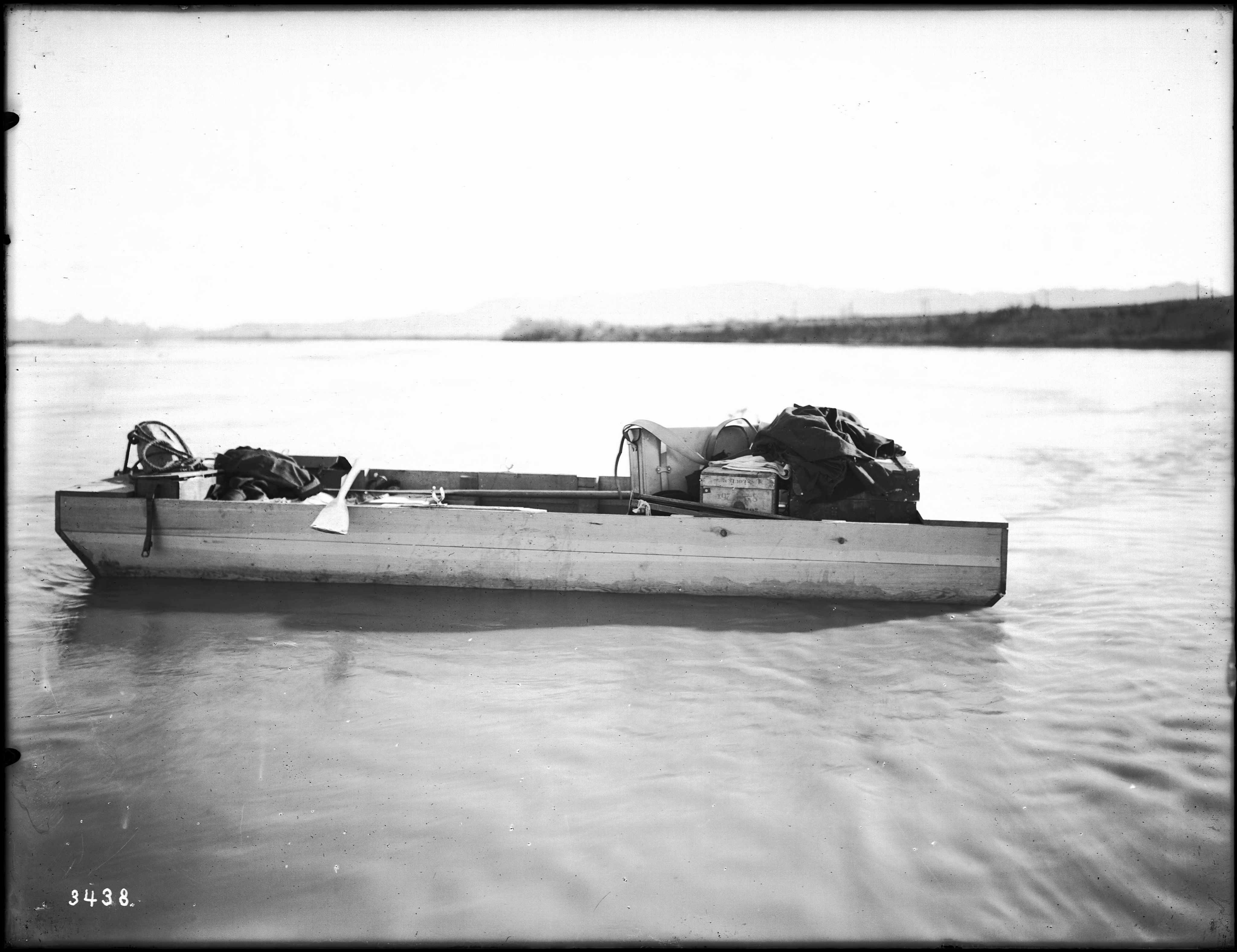
Small outboard stranded on a sandbar in the Colorado River, ca.1900

Genre: Poetry
Purpose:
To push the boundaries of the line, sentence, and punctuation to add subtext and texture to poems
Readings:
Lynda Hull, Claudia Emerson, Ocean Vuong, Tarfia Faizullah, Jamaal May, Ross Gay

*This prompt was given to Mary Szybist’s workshop at the 2015 Kenyon Review Writers’ Workshop

In this prompt, I’d like for you to explore the ways in which you can complicate your poems with subtext and refine them with dramatic, imagistic, and rhythmic textures through the relationship between the line/form and the sentence.

  1. Write a heavily enjambed poem about deceit, doublespeak, a fallible memory, or letting someone down easy. Each line of this poem must make its own kind of sense separate from the sentence(s) to which it belongs. Each line may support, nuance, or buck against its parent syntactical meaning(s). Take a look at Lynda Hull’s “Rivers Into Seas.” In order to examine this phenomenon, it might be helpful to read the poem for its sentences initially, and then reread it line-by-line with an exaggerated pause at each break. What lines assert themselves as a complete thought, sentence, or image? How does that relate to the syntax?
  2. Write a poem that takes the first prompt further by including little or no punctuation. Choose whether or not you’d like to introduce alternatives to traditional punctuation, through in-line white space (also called visual caesuras) as found in Claudia Emerson’s “Midwife”; line breaks, like those in Ocean Vuong’s “Ode to Masturbation”; capitalization at the start of sentences; or some combination. (Keep in mind that in-line white space also can be used as a means to emphasize certain images or phrases; to modulate the reader’s pace; or to imitate an action taking place in the poem.)
  3. Write a poem in two columns. The columns must make (a certain) sense if read together and apart. See “Aubade Ending with the Death of a Mosquito” by Tarfia Faizullah and “I Do Have a Seam” by Jamaal May.
  4. Write a poem in one sentence or run-on sentence that uses the line as a break for breath that befits the action of the poem or the way in which the speaker might tell the story. See Ross Gay’s “For Some Slight I Can’t Quite Recall.”

Form’s Relationship to Subject Matter + “Escape in Brilliant Highways: A Form Imitation Exercise”

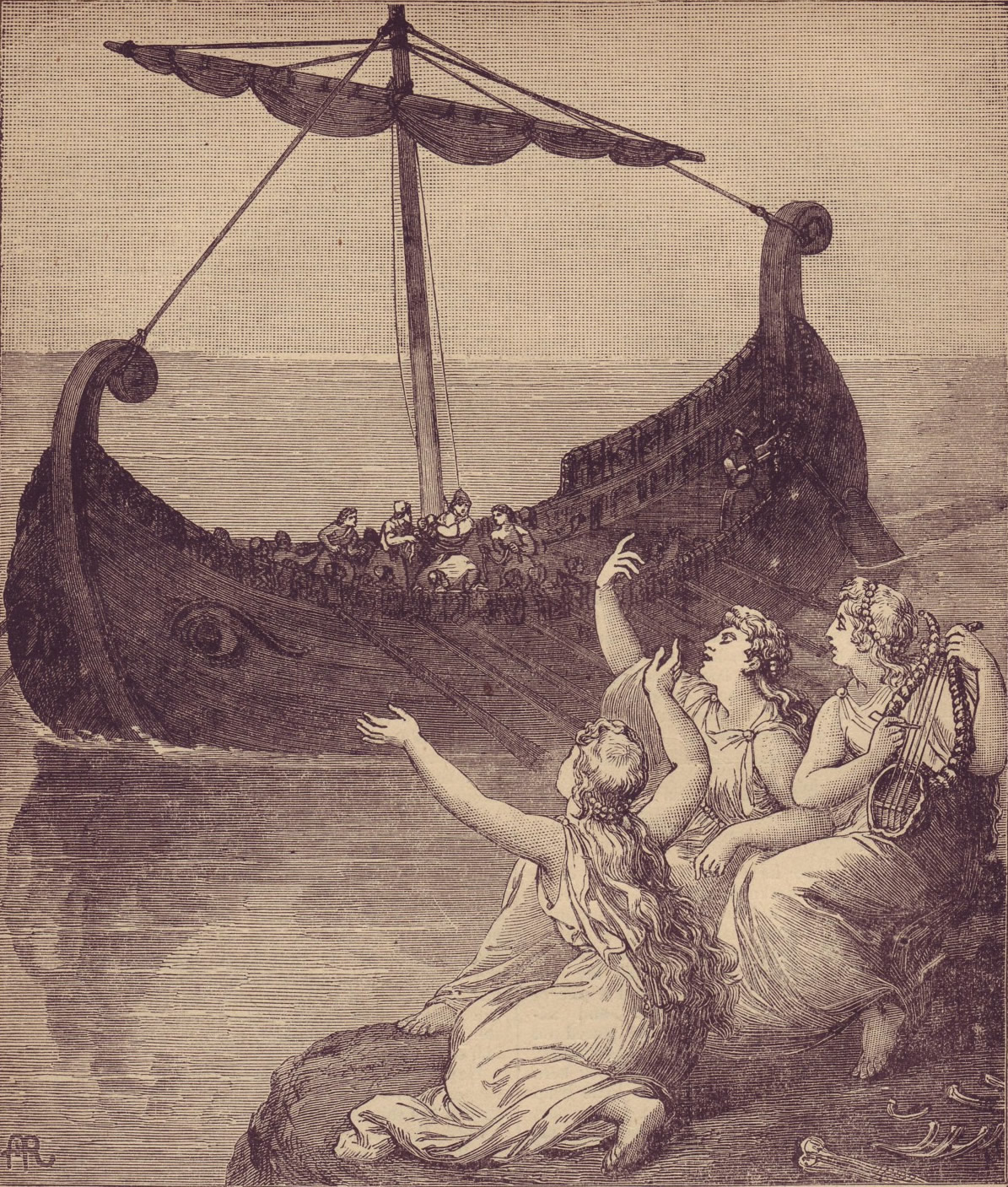
The_Sirens_imploring_Ulysses_to_stay_(1886)

Genre: Poetry
Purpose:
To consider how form changes meaning, emphasis, and tone; to practice imitation
Readings:
“Envy of Other People’s Poems” by Robert Hass along with excerpts of poems by Larry Levis, Terrance Hayes, Natalie Diaz, Lynda Hull, George Oppen, and Linda Gregerson

Let’s look at “Envy of Other People’s Poems” by American poet Robert Hass. I’ve removed the lineation so that the poem appears as prose:

ROBERT HASS
“Envy of Other People’s Poems”

In one version of the legend the sirens couldn’t sing. It was only a sailor’s story that they could. So Odysseus, lashed to the mast, was harrowed by a music that he didn’t hear—plungings of the sea, wind-sheer, the off-shore hunger of the birds—and the mute women gathering kelp for garden mulch, seeing him strain against the cordage, seeing the awful longing in his eyes, are changed forever on their rocky waste of island by their imagination of his imagination of the song they didn’t sing.

With this poem as our foundation, let’s consider the symbiotic relationship between a poem’s subject matter and language. For the purposes of this class, “form” will be used less to talk about received forms like sonnets or ghazals but more about the format of the poem on the page, including its line length, breaks (enjambments and end-stops), drop lines, stanzas, etc.

Escape in Brilliant Highways: A Form Imitation Exercise

  1. Read the following excerpts from poems by other poets and reformat the Hass poem using the formal principles apparent in each of the excerpts. Keep in mind you shouldn’t rewrite any language of the poem; only manipulate line and stanza breaks, indentions, and spacing. As you read each excerpt, make notes about unifying formal strategies that you must include in the formal imitation.

a.

LARRY LEVIS
Excerpt from “Anastasia & Sandman”

The brow of a horse in that moment when
The horse is drinking water so deeply from a trough
It seems to inhale the water, is holy.
I refuse to explain.

When the horse had gone the water in the trough,
All through the empty summer,

Went on reflecting clouds & stars.

The horse cropping grass in a field,
And the fly buzzing around its eyes, are more real
Than the mist in one corner of the field.

Or the angel hidden in the mist, for that matter.

b.

TERRANCE HAYES
Excerpt from “At Pegasus”

They are like those crazy women
       who tore Orpheus
              when he refused to sing,

these men grinding
       in the strobe & black lights
              of Pegasus. All shadow & sound.

“I’m just here for the music,”
       I tell the man who asks me
              to the floor.

c.

NATALIE DIAZ
Excerpt from “Cloud Watching”

Betsy Ross needled hot stars to Mr. Washington’s bedspread—
       they weren’t hers to give. So, when the cavalry came,
              we ate their horses. Then, unfortunately, our bellies were filled
                     with bullet holes.

d.

LYNDA HULL
Excerpt from “Tide of Voices”

At the hour the streetlights come on, buildings
turn abstract. The Hudson, for a moment, formal.
We drink bourbon on the terrace and you speak
in the evening voice, weighted deep in the throat.

They plan to harvest oysters, you tell me,
from the harbor by Jersey City, how the waters
will be clean again in twenty years. I imagine nets
burdened with rough shells, the meat dun and sexual.

e.

GEORGE OPPEN
Excerpt from “Myth of the Blaze”

night – sky           bird’s           world
to know           to know           in my life to know
what I have said to myself

the dark to escape in brilliant highways
of the night sky, finally
why had they not

killed me why did they fire that warning
wounding cannon only the one round I hold a
superstition

because of this           lost to be lost           Wyatt’s
lyric and Rezi’s
running thru my mind
in the destroyed (and guilty) Theatre
of the War           I’d cried

f.

LINDA GREGERSON
Excerpt from “Sostenuto”

       Night. Or what

                     they have of it at altitude
like this, and filtered
              air, what was

in my lungs just an hour ago is now
              in yours,
                     there’s only so much air to go

       around.

  1. After creating your formal imitations of “Envy of Other People’s Poems,” reflect on each of these imitations and jot down your thoughts to these questions: How has the new form changed the poem? Has the meaning or tone changed? How so?
  1. Discuss.
  1. Now, let’s look at the Hass poem formatted as the author intended it.

ROBERT HASS
Envy of Other People’s Poems

In one version of the legend the sirens couldn’t sing.
It was only a sailor’s story that they could.
So Odysseus, lashed to the mast, was harrowed
By a music that he didn’t hear—plungings of the sea,
Wind-sheer, the off-shore hunger of the birds—
And the mute women gathering kelp for garden mulch,
Seeing him strain against the cordage, seeing
the awful longing in his eyes, are changed forever
On their rocky waste of island by their imagination
Of his imagination of the song they didn’t sing.

  1. Discuss. What are your reactions to the poem? Why did Hass format the poem the way that he did? What might subject matter have to do with the format? How did reformatting the poem reveal the author’s intentions about his form? How does the meaning of the poem change based on its form?

Photo with My MFA Teachers

Since we learn so much about teaching from our teachers, I wanted to post a recent photo with my three MFA professors: Kathleen Graber, David Wojahn, and Greg Donovan. Thank you for everything, you three.

Kathleen Graber, David Wojahn, Emilia Phillips, and Greg Donovan, May 2015

“I look in the mirror and hold up my mangled hand”: An Adversarial Persona Exercise

Jack_dempsey_ring_loc_50497v
Genre:
Poetry
Purpose:
To consider how persona, point of view, voice, argument, and empathy can support and/or complicate one another
Readings:
“Skinhead” by Patricia Smith

  1. Watch Patricia Smith perform “Skinhead”: https://youtu.be/Klb5TniRGao. Discuss.
  2. Jot down some notes about a situation in which you found yourself in direct opposition with someone else. Perhaps it’s as extreme as the violent racism in Smith’s poem or as routine as having the same seat number assignment as another person on a flight. The best situation is one in which the conflict was never or not easily resolved. (2–5 min.)
  3. Describe the diction that person uses and provide some examples. (1–2 min.)
  4. Now freewrite in the voice of that person as if he or she is addressing you. What would they say? How would they defend themselves against complaints about their actions toward you. (5–7 min.)
  5. Share your efforts. Did the exercise of writing in their voices change your opinions of your adversaries? What does this reveal about poetry’s ability to engage in empathy? Do your opinions carry into your rendering of their voice?

“Ornithology” Poetry Analysis and Imitation Exercise

Class: Introduction to Creative Writing (The College of William & Mary)
Genre:
Poetry
Purpose:
To become more scrupulous readers of poetry

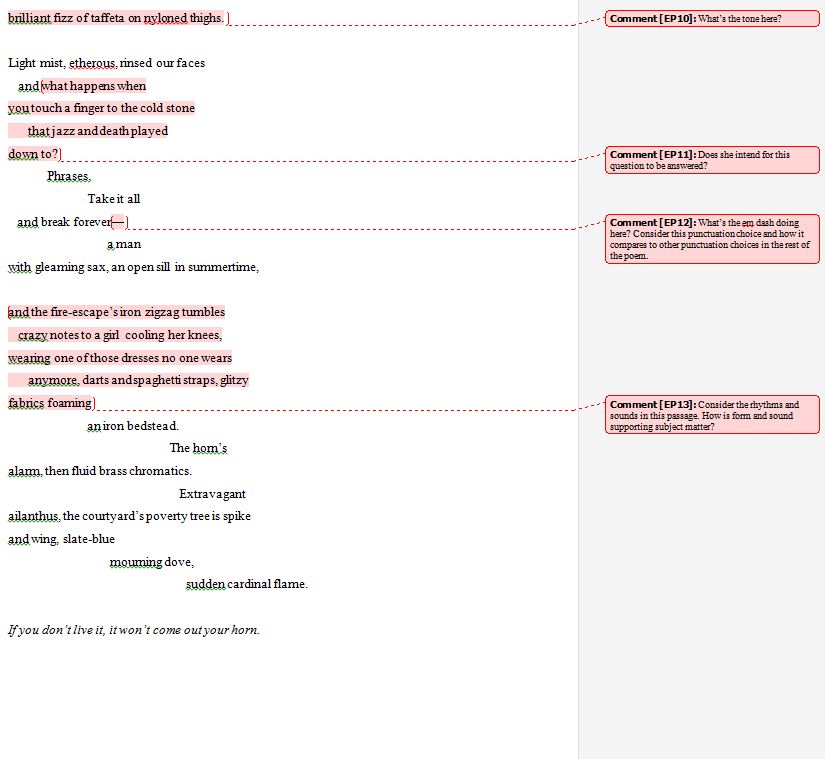
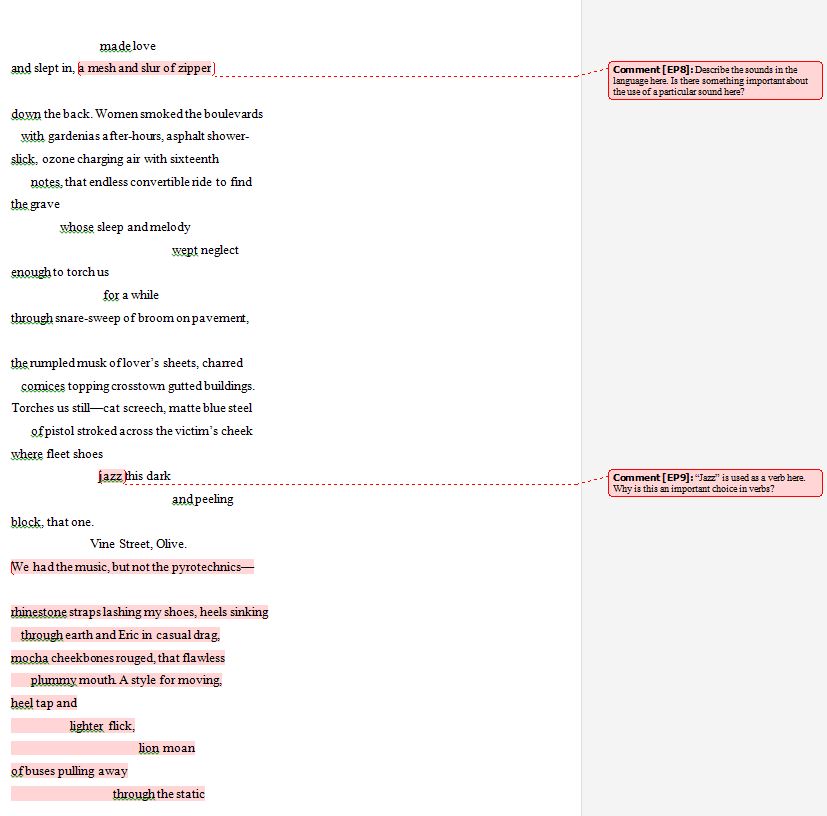
In order to prepare my Intro to Creative Writing students for talking more about poetry with regard to the author’s intentionality before their poetry workshop, I’m asking them to read and examine the poem “Ornithology” by Lynda Hull. They then have to answer questions about specifics in the poem. I’ve provided these questions via track changes in Microsoft Word:

Ornithology Poetry Analysis Exercise screenshot - 1 Ornithology Poetry Analysis Exercise screenshot - 2 Ornithology Poetry Analysis Exercise screenshot - 3

Once they respond to these questions on their own, we will then discuss the possibilities. My hope is that they will see the value in discussing the possibilities rather than strive to make proclamations about what the poem is or what it’s doing.

After they complete the analysis, I’m going to ask them to try to write an imitation of at least ten lines (the formal unit that’s repeated throughout the poem) with special attention to sound and rhythm.

“Think Lagunitas business” Exercise

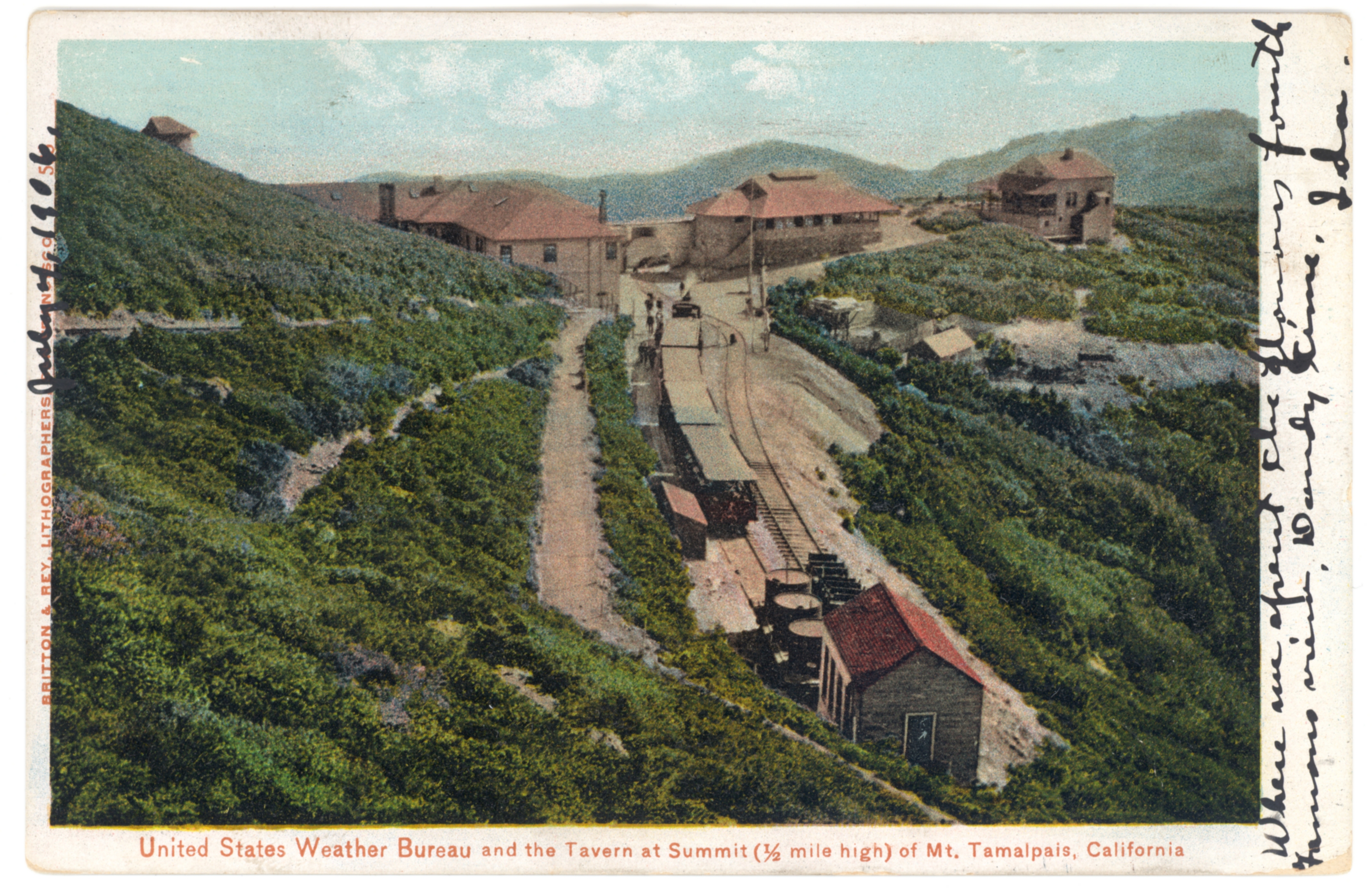
Postcard of the United States Weather Bureau buildings and tavern at the summit of Mt. Tamalpais, Marin County, California, circa 1906. (Source: NOAA Photo Library)

Class: Introduction to Creative Writing (The College of William & Mary)
Genre:
Poetry
Purpose:
To consider how language is the raw material with which all writers work and to consider the unique challenges that poetry in translation offers
Readings:
A packet of poetry in translation

A native speaker of a foreign language that you do not speak has given you a literal translation (that is, a word-for-word rendering) of a poem written by a poet who writes in her language. The native speaker has asked you to further translate the poem so that it makes sense and is a good poem.

The poem’s original language is from a unique language family and shares no roots with English. Because of this, there are some words that are almost untranslatable in English; the native speaker has done her best to provide you with some sense of those words, sometimes substituting phrases or even metaphors for individual objects. Additionally, because the grammar of the original language is so unique, the sentence structure often doesn’t work in English. Not only will you have to find translations for individual words, you’ll have to make sense of those words in foreign syntax.

You read the translation*…

Think Lagunitas business

Loss innovation. It seems that the old way of thinking. The idea, for example, eliminates the sense that the general idea of ​​light. The resurrection of the dead birch, black, the face of the first month, or any other theory of the world tribal carved sad because the skills to deal with the clown Beck, anything associated with Blackberry Blackberry word complaint if it does in this world, it is. We talked last night, my friend, marina trouble hearing sound thin. After that, I knew it from the start, and judges, and chin, hair, and the woman, and you, and I am his wife, and I remember that I love you still, it was several times small shoulders in his hands, and was surprised to see the face of violence, such as the drought and salt and the river of my childhood and Willow Iceland, sad songs levels, such as mud fish, we have a little money should pumpkin orange. It is difficult to deal with. It is necessary if we want to get an external desire eternal. And did the same to him. Reminds me a lot, and his hands and the length of the bread and said that his father hated him because he was asleep. Time was the word supernatural, flesh and body. Love, lunch and dinner, and BlackBerry.

*In order to produce this text, I ran Robert Hass’s “Meditation at Lagunitas” through several different languages (Maori, Chinese Traditional, German, French, Arabic, Finnish, Irish, and Icelandic) in Google Translate before translating it back into English.

The native speaker has also noted that the original poem was in one stanza and contained thirty-one lines. The literal translation, however, is in prose. She has converted the original poem into prose in order to preserve some semblance of the original syntax, and she hints that most of the lines contained between seven and ten words, except the last line, which only contained four.

You get to work and set about your translation systematically:

  1. You assess the overall tone of the poem, considering if it’s joyful, melancholic, bittersweet, or meditative.
  2. You then summarize the poem, identifying its:
    1. setting;
    2. speaker;
    3. addressee (if there is one) and/or audience;
    4. primary themes;
    5. and motivations and/or stakes.
  3. You now notate those places in the poem in which there seems to be some kind of shift in setting, direction, and/or tone. (This could also include an associative leap between images or thoughts. If you notice one of these leaps, briefly summarize the connection.)
  4. You then start the hard work of translating the poem, sentence-by-sentence, for clarity. At this point, you might begin to take some liberties with the text. As you’re revising the sentence, decide if you want to:
    1. change any words or phrases so that the poem will seem more accessible to North American readers (i.e. an American might write “truck” when an English translator would write “lorry”)
    2. or change any language that doesn’t seem essential to the overall meaning of the poem but that might make the poem sound more musical.
  5. Now begin to format the poem for line length, breaks, and stanza structure. Decide whether or not you want to try to mimic the poem’s original format. (If not, make a case for it.)
  6. Share your translation.

“Babylon: A Place You’ve Only Heard Of” Exercise

"Abbildung der Stadt Babylon" ("Picture of the City of Babylon"),  Erasmus Francisci, copper engraving on paper, 1680
“Abbildung der Stadt Babylon” (“Picture of the City of Babylon”), Erasmus Francisci, copper engraving on paper, 1680

Class: Introduction to Creative Writing (The College of William & Mary)
Genre: Nonfiction
Purpose: To examine how place becomes setting and to cultivate an “outsider’s” point of view
Readings: “Goodbye to All That,” “Babylon,” and “No Man’s Land” from Eula Biss’s Notes from No Man’s Land and “Goodbye to All That” by Joan Didion


  1. Think about a city or country that you’ve never heard of but have never been to. This can be a real (Saigon), mythic (Troy), or imagined place. Describe what you know or imagine to know about this place. Write for 5 minutes.
  2. Now think about your hometown. Describe it as you remember it, including the homes, the landscape, the stores, the values, etc. Write for 5 minutes.
  3. Write a paragraph that considers similarities between the place you’ve never been and your hometown. Write for 3 minutes.
  4. Is there something notable or notorious about your hometown? Write for 3 minutes about how outsiders might view your hometown. Is there something unique to your hometown and therefore strange to outsiders? Would an outsider have prejudices against your hometown? Write for 3 minutes.
  5. How might you be like the outsider with the place you’ve never been? Write a meditation on these similarities for 5 minutes.