Form’s Relationship to Subject Matter + “Escape in Brilliant Highways: A Form Imitation Exercise”

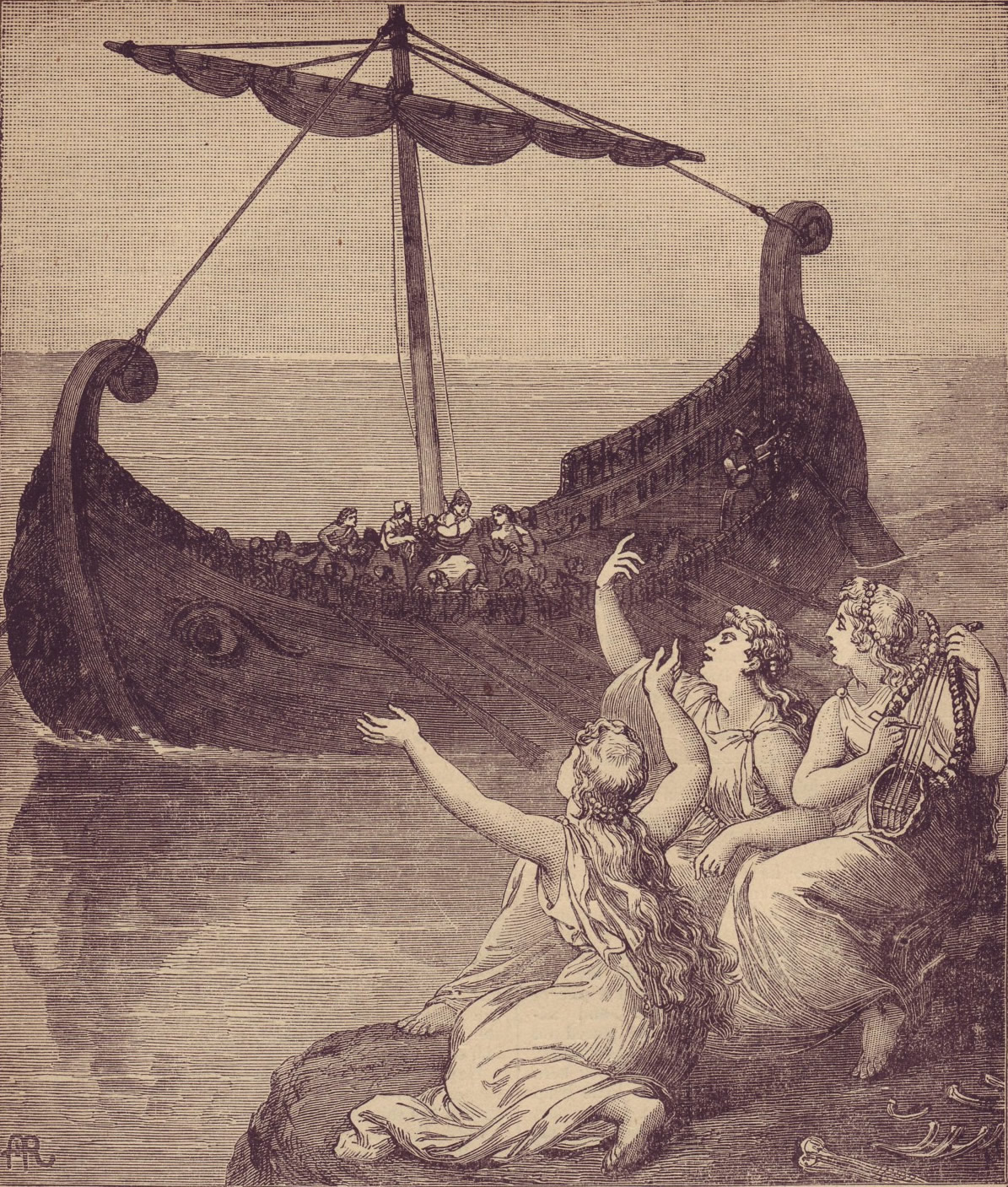
The_Sirens_imploring_Ulysses_to_stay_(1886)

Genre: Poetry
Purpose:
To consider how form changes meaning, emphasis, and tone; to practice imitation
Readings:
“Envy of Other People’s Poems” by Robert Hass along with excerpts of poems by Larry Levis, Terrance Hayes, Natalie Diaz, Lynda Hull, George Oppen, and Linda Gregerson

Let’s look at “Envy of Other People’s Poems” by American poet Robert Hass. I’ve removed the lineation so that the poem appears as prose:

ROBERT HASS
“Envy of Other People’s Poems”

In one version of the legend the sirens couldn’t sing. It was only a sailor’s story that they could. So Odysseus, lashed to the mast, was harrowed by a music that he didn’t hear—plungings of the sea, wind-sheer, the off-shore hunger of the birds—and the mute women gathering kelp for garden mulch, seeing him strain against the cordage, seeing the awful longing in his eyes, are changed forever on their rocky waste of island by their imagination of his imagination of the song they didn’t sing.

With this poem as our foundation, let’s consider the symbiotic relationship between a poem’s subject matter and language. For the purposes of this class, “form” will be used less to talk about received forms like sonnets or ghazals but more about the format of the poem on the page, including its line length, breaks (enjambments and end-stops), drop lines, stanzas, etc.

Escape in Brilliant Highways: A Form Imitation Exercise

  1. Read the following excerpts from poems by other poets and reformat the Hass poem using the formal principles apparent in each of the excerpts. Keep in mind you shouldn’t rewrite any language of the poem; only manipulate line and stanza breaks, indentions, and spacing. As you read each excerpt, make notes about unifying formal strategies that you must include in the formal imitation.

a.

LARRY LEVIS
Excerpt from “Anastasia & Sandman”

The brow of a horse in that moment when
The horse is drinking water so deeply from a trough
It seems to inhale the water, is holy.
I refuse to explain.

When the horse had gone the water in the trough,
All through the empty summer,

Went on reflecting clouds & stars.

The horse cropping grass in a field,
And the fly buzzing around its eyes, are more real
Than the mist in one corner of the field.

Or the angel hidden in the mist, for that matter.

b.

TERRANCE HAYES
Excerpt from “At Pegasus”

They are like those crazy women
       who tore Orpheus
              when he refused to sing,

these men grinding
       in the strobe & black lights
              of Pegasus. All shadow & sound.

“I’m just here for the music,”
       I tell the man who asks me
              to the floor.

c.

NATALIE DIAZ
Excerpt from “Cloud Watching”

Betsy Ross needled hot stars to Mr. Washington’s bedspread—
       they weren’t hers to give. So, when the cavalry came,
              we ate their horses. Then, unfortunately, our bellies were filled
                     with bullet holes.

d.

LYNDA HULL
Excerpt from “Tide of Voices”

At the hour the streetlights come on, buildings
turn abstract. The Hudson, for a moment, formal.
We drink bourbon on the terrace and you speak
in the evening voice, weighted deep in the throat.

They plan to harvest oysters, you tell me,
from the harbor by Jersey City, how the waters
will be clean again in twenty years. I imagine nets
burdened with rough shells, the meat dun and sexual.

e.

GEORGE OPPEN
Excerpt from “Myth of the Blaze”

night – sky           bird’s           world
to know           to know           in my life to know
what I have said to myself

the dark to escape in brilliant highways
of the night sky, finally
why had they not

killed me why did they fire that warning
wounding cannon only the one round I hold a
superstition

because of this           lost to be lost           Wyatt’s
lyric and Rezi’s
running thru my mind
in the destroyed (and guilty) Theatre
of the War           I’d cried

f.

LINDA GREGERSON
Excerpt from “Sostenuto”

       Night. Or what

                     they have of it at altitude
like this, and filtered
              air, what was

in my lungs just an hour ago is now
              in yours,
                     there’s only so much air to go

       around.

  1. After creating your formal imitations of “Envy of Other People’s Poems,” reflect on each of these imitations and jot down your thoughts to these questions: How has the new form changed the poem? Has the meaning or tone changed? How so?
  1. Discuss.
  1. Now, let’s look at the Hass poem formatted as the author intended it.

ROBERT HASS
Envy of Other People’s Poems

In one version of the legend the sirens couldn’t sing.
It was only a sailor’s story that they could.
So Odysseus, lashed to the mast, was harrowed
By a music that he didn’t hear—plungings of the sea,
Wind-sheer, the off-shore hunger of the birds—
And the mute women gathering kelp for garden mulch,
Seeing him strain against the cordage, seeing
the awful longing in his eyes, are changed forever
On their rocky waste of island by their imagination
Of his imagination of the song they didn’t sing.

  1. Discuss. What are your reactions to the poem? Why did Hass format the poem the way that he did? What might subject matter have to do with the format? How did reformatting the poem reveal the author’s intentions about his form? How does the meaning of the poem change based on its form?

“Ornithology” Poetry Analysis and Imitation Exercise

Class: Introduction to Creative Writing (The College of William & Mary)
Genre:
Poetry
Purpose:
To become more scrupulous readers of poetry

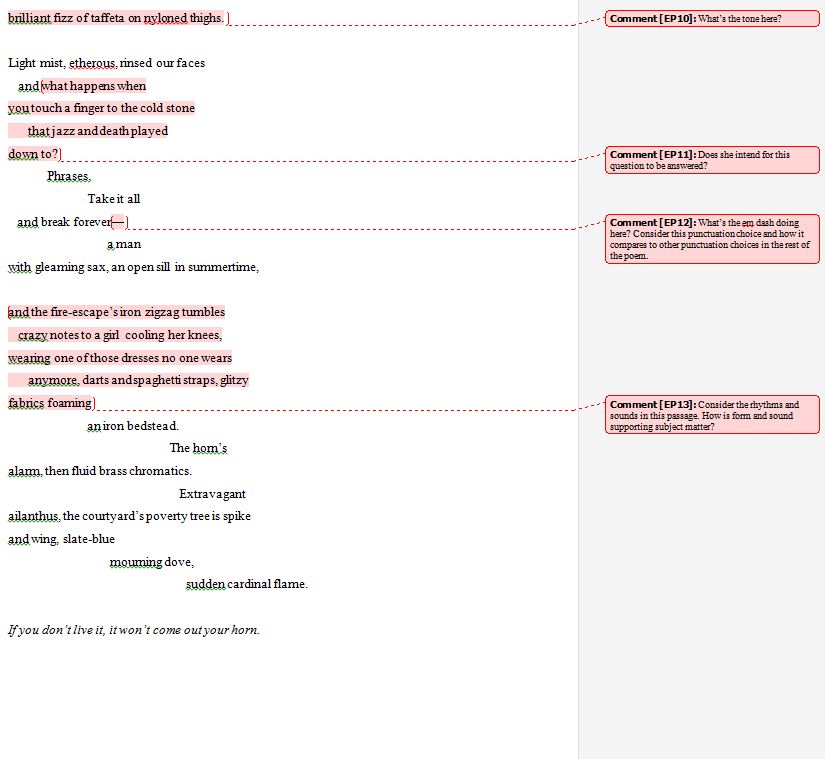
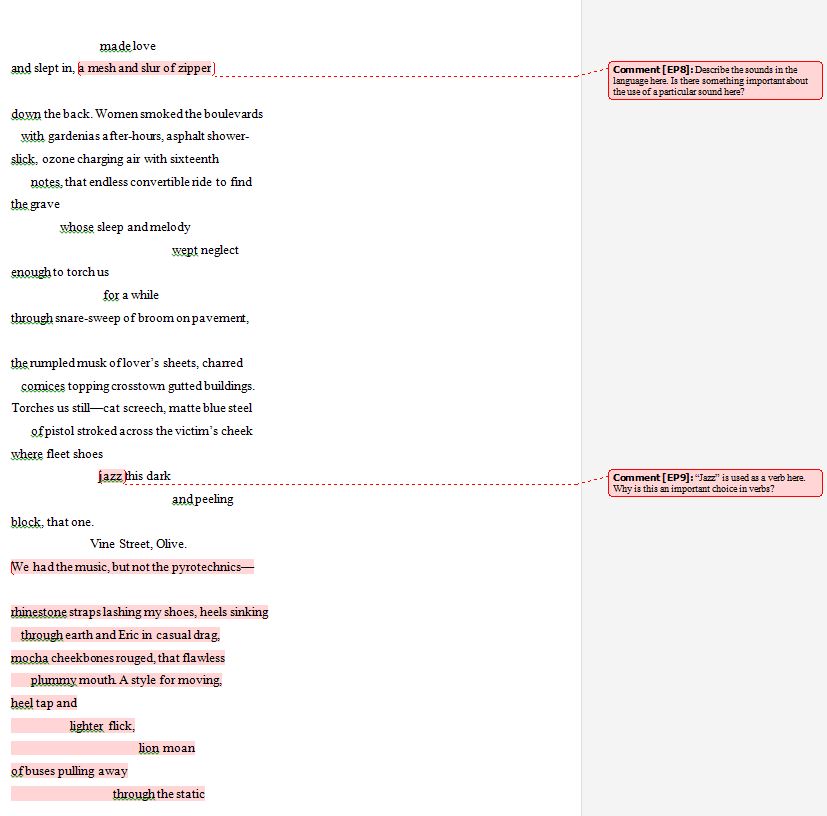
In order to prepare my Intro to Creative Writing students for talking more about poetry with regard to the author’s intentionality before their poetry workshop, I’m asking them to read and examine the poem “Ornithology” by Lynda Hull. They then have to answer questions about specifics in the poem. I’ve provided these questions via track changes in Microsoft Word:

Ornithology Poetry Analysis Exercise screenshot - 1 Ornithology Poetry Analysis Exercise screenshot - 2 Ornithology Poetry Analysis Exercise screenshot - 3

Once they respond to these questions on their own, we will then discuss the possibilities. My hope is that they will see the value in discussing the possibilities rather than strive to make proclamations about what the poem is or what it’s doing.

After they complete the analysis, I’m going to ask them to try to write an imitation of at least ten lines (the formal unit that’s repeated throughout the poem) with special attention to sound and rhythm.

“Think Lagunitas business” Exercise

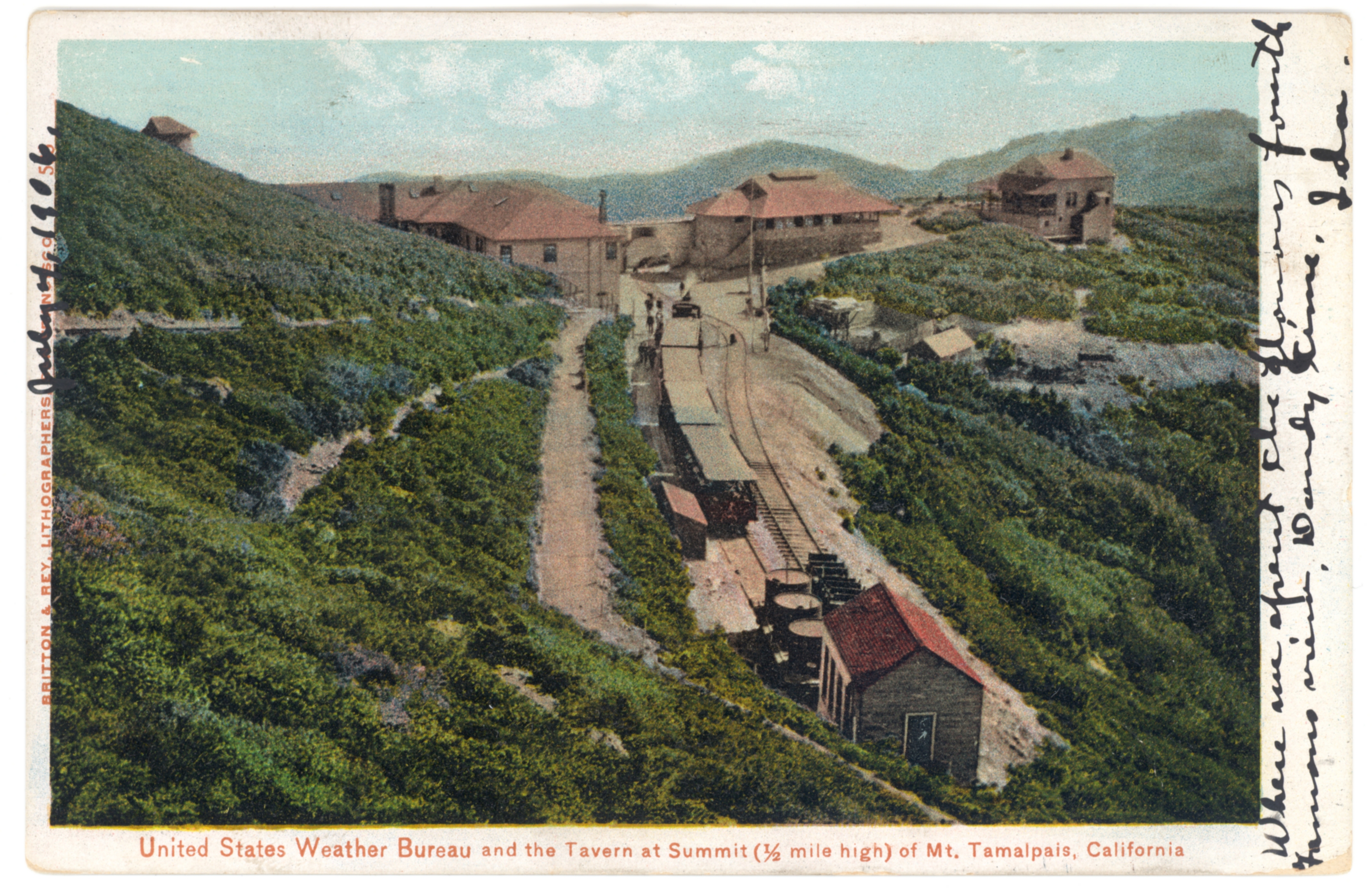
Postcard of the United States Weather Bureau buildings and tavern at the summit of Mt. Tamalpais, Marin County, California, circa 1906. (Source: NOAA Photo Library)

Class: Introduction to Creative Writing (The College of William & Mary)
Genre:
Poetry
Purpose:
To consider how language is the raw material with which all writers work and to consider the unique challenges that poetry in translation offers
Readings:
A packet of poetry in translation

A native speaker of a foreign language that you do not speak has given you a literal translation (that is, a word-for-word rendering) of a poem written by a poet who writes in her language. The native speaker has asked you to further translate the poem so that it makes sense and is a good poem.

The poem’s original language is from a unique language family and shares no roots with English. Because of this, there are some words that are almost untranslatable in English; the native speaker has done her best to provide you with some sense of those words, sometimes substituting phrases or even metaphors for individual objects. Additionally, because the grammar of the original language is so unique, the sentence structure often doesn’t work in English. Not only will you have to find translations for individual words, you’ll have to make sense of those words in foreign syntax.

You read the translation*…

Think Lagunitas business

Loss innovation. It seems that the old way of thinking. The idea, for example, eliminates the sense that the general idea of ​​light. The resurrection of the dead birch, black, the face of the first month, or any other theory of the world tribal carved sad because the skills to deal with the clown Beck, anything associated with Blackberry Blackberry word complaint if it does in this world, it is. We talked last night, my friend, marina trouble hearing sound thin. After that, I knew it from the start, and judges, and chin, hair, and the woman, and you, and I am his wife, and I remember that I love you still, it was several times small shoulders in his hands, and was surprised to see the face of violence, such as the drought and salt and the river of my childhood and Willow Iceland, sad songs levels, such as mud fish, we have a little money should pumpkin orange. It is difficult to deal with. It is necessary if we want to get an external desire eternal. And did the same to him. Reminds me a lot, and his hands and the length of the bread and said that his father hated him because he was asleep. Time was the word supernatural, flesh and body. Love, lunch and dinner, and BlackBerry.

*In order to produce this text, I ran Robert Hass’s “Meditation at Lagunitas” through several different languages (Maori, Chinese Traditional, German, French, Arabic, Finnish, Irish, and Icelandic) in Google Translate before translating it back into English.

The native speaker has also noted that the original poem was in one stanza and contained thirty-one lines. The literal translation, however, is in prose. She has converted the original poem into prose in order to preserve some semblance of the original syntax, and she hints that most of the lines contained between seven and ten words, except the last line, which only contained four.

You get to work and set about your translation systematically:

  1. You assess the overall tone of the poem, considering if it’s joyful, melancholic, bittersweet, or meditative.
  2. You then summarize the poem, identifying its:
    1. setting;
    2. speaker;
    3. addressee (if there is one) and/or audience;
    4. primary themes;
    5. and motivations and/or stakes.
  3. You now notate those places in the poem in which there seems to be some kind of shift in setting, direction, and/or tone. (This could also include an associative leap between images or thoughts. If you notice one of these leaps, briefly summarize the connection.)
  4. You then start the hard work of translating the poem, sentence-by-sentence, for clarity. At this point, you might begin to take some liberties with the text. As you’re revising the sentence, decide if you want to:
    1. change any words or phrases so that the poem will seem more accessible to North American readers (i.e. an American might write “truck” when an English translator would write “lorry”)
    2. or change any language that doesn’t seem essential to the overall meaning of the poem but that might make the poem sound more musical.
  5. Now begin to format the poem for line length, breaks, and stanza structure. Decide whether or not you want to try to mimic the poem’s original format. (If not, make a case for it.)
  6. Share your translation.

“Encounter” Exercise

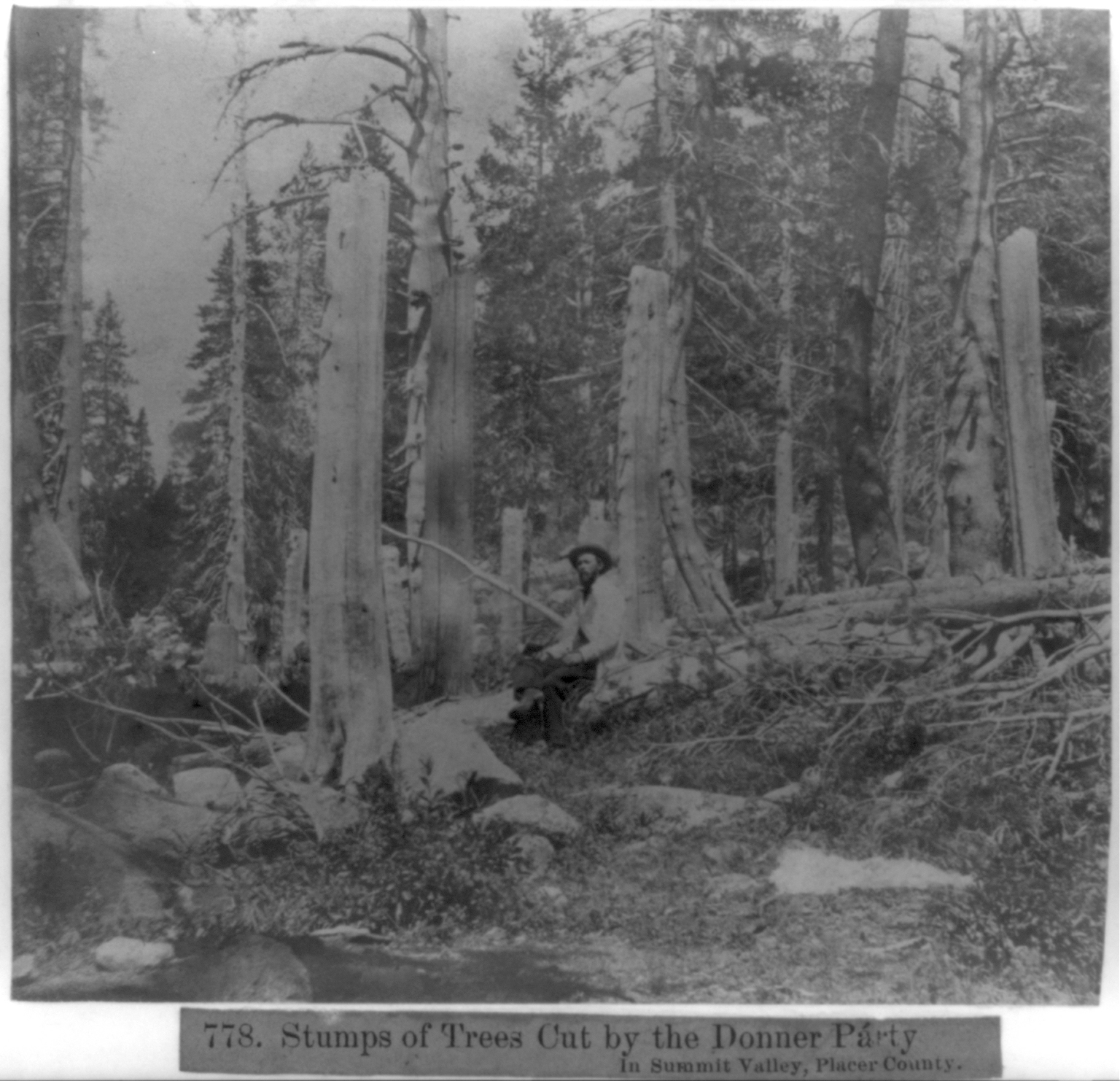
"Stumps of trees cut by the Donner Party in Summit Valley, Placer County" Grayscaled albumen print, half stereograph. (1866) via the Library of Congress
“Stumps of trees cut by the Donner Party in Summit Valley, Placer County” Grayscaled albumen print, half stereograph. (1866) via the Library of Congress

Class: Introduction to Creative Writing (The College of William & Mary)
Genre: Fiction
Purpose: To explore Burroway’s concept of “Character as Image”; examine potential of non-verbal communication; and situate the reader to receive information along with a character
Readings: Chapters 4 (“Character”) and Gabriel García Márquez’s “The Handsomest Drowned Man in the World” in Janet Burroway’s Imaginative Writing

Two characters come upon one another in the middle of a forest. Something bad—but not melodramatic*—has happened to one character and that character needs help. When the first character tries to tell the second what’s wrong, it’s revealed that the two characters don’t speak the same language. (This could include sign language.)

Write a scene from the point of view of the second character (first person “I”) while the first character tries to communicate the problem using only gestures, drawing, or other non-verbal communication. Additionally:

  • the second character cannot know what the problem is before the first character reveals it in this scene;
  • the second character should notice details throughout the interaction that reveal more about the first character (i.e. clothing, appearance, possessions, etc.)
  • the second character may or may not—or even cannot—help.

*Challenge yourself to come up with a problem that doesn’t involve far-fetched plot lines, flat characters, and easy conclusions. This means it would be best to avoid killers, aliens, and monsters. Think about more ordinary but equally tension-filled situations like a farmer whose lost a bull, a teenager who has a flat tire but doesn’t know how to change it, a hunter who accidentally shot his buddy in the foot, etcetera.

“Backwards Story a Telling” Exercise

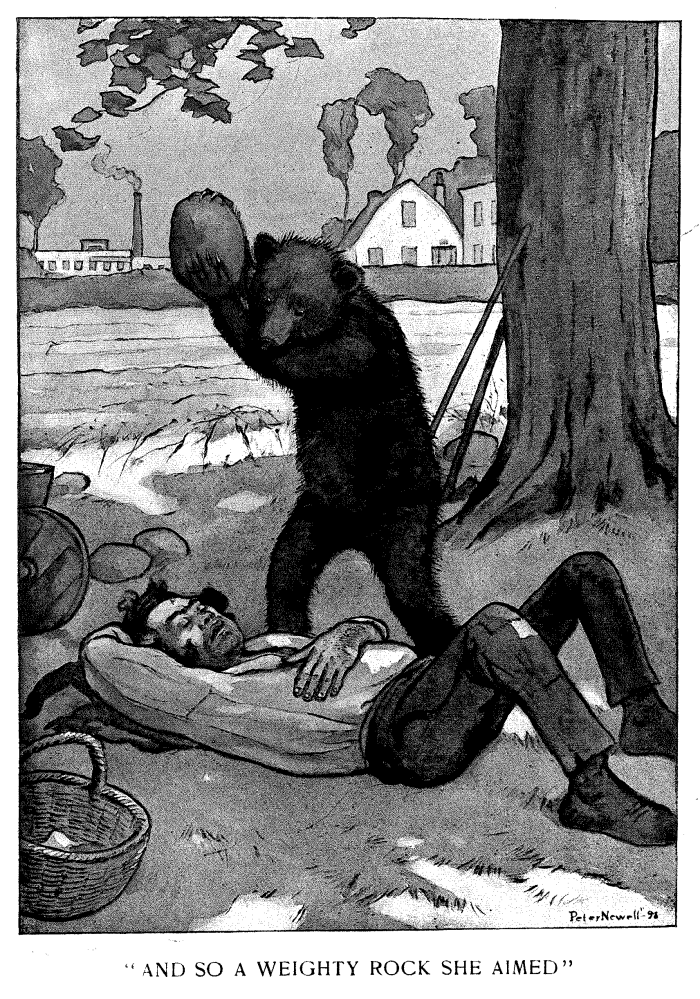
Illustration from Fables for the Frivolous by Guy Wetmore Carryl, with illustrations by Peter Newell (1898)

Class: Introduction to Creative Writing (The College of William & Mary)
Genre: Fiction
Purpose: To open up discussion about plot structure and significant details
Readings: Chapters 9 (“Fiction”) and 6 (“Story”) in Janet Burroway’s Imaginative Writing

  1. Watch a viral video without taking notes. (“Texting Guy Almost Runs Into Bear”: http://youtu.be/WYsAkjfXxzU)
  2. Write a summary of what happens in the video. (2 min.)
  3. Now write a scene from the point of view of the bear or the man. Try to tap into their thoughts and moment-by-moment perceptions. Include as many details as you can in 5 minutes. Here’s the hitch: you must tell the story in reverse chronological order! (Tell the story backwards!)
  4. Look at the inverted check mark diagram of pg. 173 in Burroway. Discuss how the check mark works for a chronological story compared to the story told in reverse. Where does the conflict fall in your scene? The crisis (climax)? Is there resolution? Were there any details you thought of telling the story backwards that you might not have thought of telling the story chronologically?

“One Story, Three Genres” Exercise

Class: Introduction to Creative Writing (The College of William & Mary)
Genre: Fiction, Nonfiction, and Poetry
Purpose: To consider how writers of three genres go about approaching similar subject matter; to introduce distinctions between the genres; and to introduce key drafting and revision considerations based on reading from Janet Burroway’s Imaginative Writing
Readings: Chapters 1 (“Invitation to the Writer”) and 7 (“Development and Revision”) in Janet Burroway’s Imaginative Writing

The_three_bears_pg_14

  1. Pick a favorite nursery rhyme, myth, or religious tale that you know by heart. Write a brief summary of the story in 2 to 5 sentences.
  2. If you were writing this narrative as a short story, how would you change it? What elements would you include? How would the style change?
  3. If you were writing this narrative as a poem, how would you change it? What would be your first steps to writing the poem? What would you leave out? What would you add in?
  4. If you were using this narrative as a basis for nonfiction, how would you frame it? How can you approach this subject matter in that way?
  5. Free write for ten minutes and begin to convert your summary into either a short story, a poem, or personal essay.

Hybrid Assignment in Introductory Creative Writing Class

For my intro to creative writing class at William & Mary this semester, I’m asking students to write one hybrid work as their final workshop piece. Often I feel like these introductory classes set up limits for students, but I wonder if allowing them to see genre as something that’s a little more fluid will encourage continued reading across the genres, an understanding that writing techniques can be used across genres, and creativity with the execution of their ideas. They will be reading a few hybrid texts at the end of the semester, too. The hybrid assignment will also give us a chance to review what we’ve gone over about the three genres by forcing us to consider their respective challenges. I think it will also give students the opportunity to tackle issues they faced across multiple assignments. Say they struggled with point of view in their poetry and concrete details in their nonfiction, but the poems presented strong images and their nonfiction offered an unwavering first-person. Perhaps they’ll be able to double up on their strengths through a hybrid work.

Regardless of the success of their pieces, I hope that we can have a great discussion that will prepare them for debates about form and theory in upper-level, genre-specific courses. Additionally, I don’t want to have a situation where I say, “You’ll discuss these forms if you choose to continue taking creative writing courses.” I want to be able to answer these inevitable questions thoroughly, not offhandedly in a minute or so in the middle of a workshop. Besides, you never know which discussion might excite a student about writing. Maybe those slippery hybrid genres are what really interest some students and they might not know it until you offer it to them!

Staggering Assignments

Distillation by Alembic, 1910. (Published before 1923 and public domain in the US.)

In my poetry class, I decided to stagger revision assignments throughout the semester instead of assigning a final portfolio, because I wanted:

  1. to avoid end-of-the-semester-grading fatigue, in order to ensure that I was always fresh and never rushed in grading;
  2. to alleviate students’ end-of-the-semester stress, so that they would be able to concentrate on revising individual poems rather than meeting basic requirements of a portfolio (better— instead of more—work at a time);
  3. to give students a better, ongoing sense of how they are progressing in the course;
  4. and to situate revision as an integral and ongoing part of the writing process that goes hand-in-hand with writing new poems and reading.

Structuring the course in this way, I felt like I was able to give more feedback, and my students’ revisions improved. In previous courses, a revision unit at the end of the semester suggested that revision was an afterthought to the writing process. By having students revise throughout the semester, workshop directly correlated to students’ next steps and, in their self-assessments, they often referred to feedback they received from their peers. Workshop, therefore, was explicitly linked to revision; it wasn’t the end but the means of their creative work—not a junkyard, but an alchemical machine.

“No River, No Bridge: Writing Poetry, Writing Nonfiction” Handout and Exercise

Ermakov, Dimitri (1846-1916).

I taught a class titled “No River, No Bridge: Writing Poetry, Writing Nonfiction” at Appomattox Regional Governor’s School’s Writers’ Fest yesterday. We discussed hybridity of poetry and nonfiction, as well as the ways in which poetry can take on and explore “truth” using essayistic strategies without the requirement of “fact.” Several students came up afterward to show me their exercises, and one told me that she felt like it was one of the best things she’s written. The class ranged from high school students to adults.

In this course we will examine works of poetry and creative nonfiction in order to open up these genres to hybrid works. We will discuss features that are shared by the genres, how to bend the rules, and look at some examples before doing an exercise.

With over forty students in a one-hour class, we had these objectives:

  1. Examine definitions of genre and the elements therein.
  2. Think about the function and aims of each genre.
  3. Read excerpts of texts that bridge the gap between poetry and nonfiction.
  4. Write some assays—yes, some attempts—that use both poetry and essay strategies.

Examine definitions of genre and the elements therein. We looked at definitions of essays and lyric essays and Edward Hirsch’s definitions of line, lineation, lyric, prose poem, and stanza from A Poet’s Glossary. We looked at these definitions because they seek to define and, therefore, draw boundaries. We needed to know these definitions in order to explode these boundaries. In particular, we looked at Hirsch’s definition of line, in which he quotes Longenbach:

“Poetry is the sound of language organized in lines,” James Longenbach asserts in The Art of the Poetic Line (2008). “More than meter, more than rhyme, more than images or alliteration or figurative language, line is what distinguishes our experience of poetry as poetry, rather than some other kind of writing.”

And compared it to the prose poem definition:

A composition printed as prose that names itself poetry. The prose poem takes advantage of its hybrid nature—it avails itself of the elements of prose (what Dryden called “the other harmony of prose”) while foregrounding the devices of poetry. . . . Baudelaire used prose poems to rebel against the straitjacket of classical French versification. He dreamed of creating “a poetic prose, musical without rhyme or rhythm, supple and jerky enough to adapt to the lyric movements of the soul, to the undulations of reverie, to the somersaults of conscience.” Baudelaire’s prose poems—along with Rimbaud’s Les Illuminations (1886) and Malarmé’s Divagations (1897)—created a mixed musical form (part social, part transcendental) that has been widely and internationally practiced in the twentieth century. “There is no such thing as prose,” Malarmé insisted in 1891. “There is the alphabet, and then there are verses which are more or less closely knit, more or less diffused. So long as there is a straining toward style, there is versification.”

We thought about these paradoxes, discussed why lineation makes a poem a poem, as well as considered some alternative definitions. We then examined Hirsch’s definition of “lyric”—

The lyric poem immerses us in the original waters of consciousness, in the awareness, the aboriginal nature, of being itself. . . . The lyric, which offers us a supposed speaker, a person to whom we often assign the name of the author, shades off into the dramatic utterance

—in juxtaposition with a discussion of point of view in essay.   Think about the function and aims of each genre. When I think about the intersections and differences of poetry and nonfiction, it’s helpful for me to illustrate the two genres with metaphors.

  1. Poem as a river. With all of their musical elements, I think of poems as a river—something fluid, flowing, that rushes and eddies, deltas, and empties out to sea. Poems are one of our oldest forms of literature and therefore seem natural to our landscape of language.
  2. Essay as a bridge. The essay, an analytical form, builds upon its subject piece by piece, element by element, fact by fact, experience by experience. We might think about this strategy as similar to building pillars with blocks, hammering planks together, supporting and trussing.

We might use these metaphors to understand hybrid works—nonfiction prose poems, lyric essays—better. Sometimes a poem is a river we want to cross; we see and hear the rushing water, but we want to examine it from a sturdy vantage point where we stay safe and dry. Some music comes into the poem, but we rely on the exposition that essays provide. Adversely, we could be in the water, prone to the rapids, splashed in the face, paddling fiercely. Just trying to stay afloat in the overflow of language, of experience. There are times, however, where we might pass under the shadow of a bridge, have insights into reason, into conquering this flow, bridging one experience to another.   Read excerpts of texts that bridge the gap between poetry and nonfiction.

  1. “Say It, Say It Anyway You Can” by Vievee Francis (two versions—the prose poem version from Rattle and the lineated version that appeared in her collection Horse in the Dark). Let’s take a look at this poem, which started off as a prose poem and then became a lineated poem. Discuss the poet’s possible reasoning for lineating the poem. What are the effects of the two forms?
  2. An excerpt from Citizen by Claudia Rankine and an excerpt from Bluets by Maggie Nelson. Talk to me a little bit about what these prose forms borrow from poetry. Are they poetry? (How were they marketed? How were they identified?) Is it enough to say something is poetry? Nonfiction? Are these true hybrids? How would you categorize it? Does it need to be categorized?

Write some assays—yes, some attempts—that use both poetry and essay strategies.

“No River, No Bridge” Exercise

  1. Select an everyday object that’s in your house. Ex. a television, a pair of jeans, a can of kidney beans. (1 min.)
  2. Now describe the object using all of your senses, with only concrete details. Do not use any metaphors or other figurative language. (2 min.)
  3. Imagine how the object was made. Write a step-by-step description of its fabrication. (3 min.)
  4. Imagine the harvesting, mining, or creation of the raw materials that went into making this object. (i.e. the shearing of sheep for your wool sweater or the mining of silicone to make your iPhone). Describe. (2 min.)
  5. Now talk a little bit about how you came to own this object (and talk about not remembering how you got it, if that’s true.) Tell us the backstory. Or, what connotations does the object have? Do you have specific memories associated with it? (2 min.)
  6. Now describe the object using only metaphors. (“My pair of jeans is muddy water reflecting sky, a bird with clipped wings . . . ”) (2 min.)

Share and discuss: How has the object changed in each iteration (concrete description, origin story, deconstruction, entrance, emotional connection, metaphorical naming)? Which form (poetry or essay) better conveys these approaches? Why? How can we combine these strategies?

Writing Poetry Final Reading Photos

My fifteen students in ENGL 305: Writing Poetry gave a final reading on my front porch yesterday morning. They each read one of their own poems and then a poem that they loved from our required texts. We all stood down on the sidewalk for each reading. Additional audience members included the mailman, pizza guy, and several passersby in cars and on foot. My hope is to continue to have my students do public poetry projects. The following students gave me written permission to share their photos here.

Kierra Collins reading poetry on December 12, 2014 in Richmond, Virginia
Kierra Collins reading poetry
Natalie Esch reading poetry on December 11, 2014 in Richmond, Virginia
Gagan Kaur  reading poetry on December 11, 2014 in Richmond, Virginia
Gagan Kaur reading poetry on December 11, 2014 in Richmond, Virginia
Colin McEligot  reading poetry on December 11, 2014 in Richmond, Virginia
Colin McEligot reading poetry on December 11, 2014 in Richmond, Virginia
Kelly-Jayne McGlynn  reading poetry on December 11, 2014 in Richmond, Virginia
Kelly-Jayne McGlynn reading poetry on December 11, 2014 in Richmond, Virginia
Mariah Monk reading poetry on December 11, 2014 in Richmond, Virginia
Auverin Morrow reading poetry on December 11, 2014 in Richmond, Virginia
Tchakalla Romeo reading poetry on December 11, 2014 in Richmond, Virginia
Alyssa Trop  reading poetry on December 11, 2014 in Richmond, Virginia
Alyssa Trop reading poetry on December 11, 2014 in Richmond, Virginia