Form’s Relationship to Subject Matter + “Escape in Brilliant Highways: A Form Imitation Exercise”

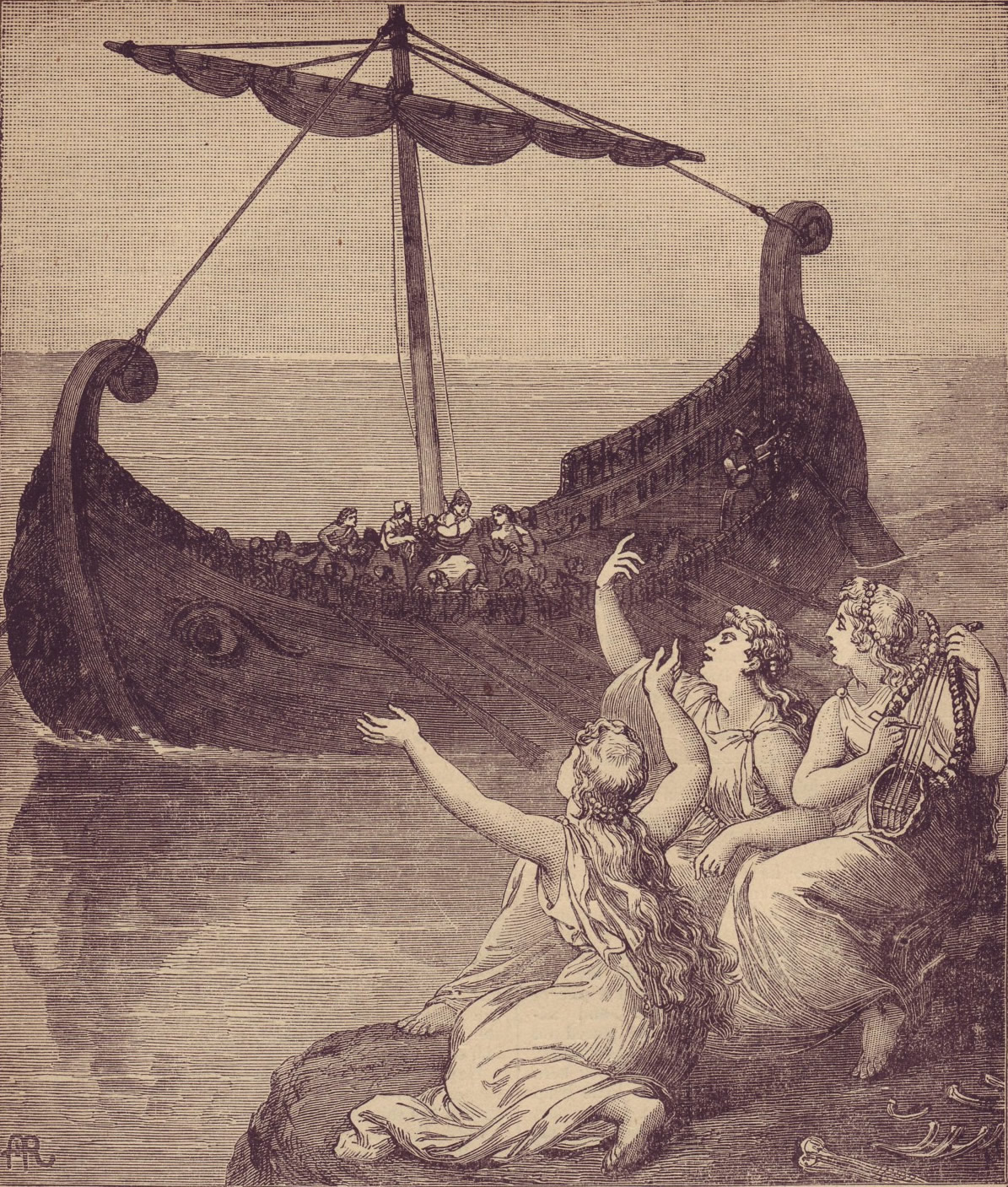
The_Sirens_imploring_Ulysses_to_stay_(1886)

Genre: Poetry
Purpose:
To consider how form changes meaning, emphasis, and tone; to practice imitation
Readings:
“Envy of Other People’s Poems” by Robert Hass along with excerpts of poems by Larry Levis, Terrance Hayes, Natalie Diaz, Lynda Hull, George Oppen, and Linda Gregerson

Let’s look at “Envy of Other People’s Poems” by American poet Robert Hass. I’ve removed the lineation so that the poem appears as prose:

ROBERT HASS
“Envy of Other People’s Poems”

In one version of the legend the sirens couldn’t sing. It was only a sailor’s story that they could. So Odysseus, lashed to the mast, was harrowed by a music that he didn’t hear—plungings of the sea, wind-sheer, the off-shore hunger of the birds—and the mute women gathering kelp for garden mulch, seeing him strain against the cordage, seeing the awful longing in his eyes, are changed forever on their rocky waste of island by their imagination of his imagination of the song they didn’t sing.

With this poem as our foundation, let’s consider the symbiotic relationship between a poem’s subject matter and language. For the purposes of this class, “form” will be used less to talk about received forms like sonnets or ghazals but more about the format of the poem on the page, including its line length, breaks (enjambments and end-stops), drop lines, stanzas, etc.

Escape in Brilliant Highways: A Form Imitation Exercise

  1. Read the following excerpts from poems by other poets and reformat the Hass poem using the formal principles apparent in each of the excerpts. Keep in mind you shouldn’t rewrite any language of the poem; only manipulate line and stanza breaks, indentions, and spacing. As you read each excerpt, make notes about unifying formal strategies that you must include in the formal imitation.

a.

LARRY LEVIS
Excerpt from “Anastasia & Sandman”

The brow of a horse in that moment when
The horse is drinking water so deeply from a trough
It seems to inhale the water, is holy.
I refuse to explain.

When the horse had gone the water in the trough,
All through the empty summer,

Went on reflecting clouds & stars.

The horse cropping grass in a field,
And the fly buzzing around its eyes, are more real
Than the mist in one corner of the field.

Or the angel hidden in the mist, for that matter.

b.

TERRANCE HAYES
Excerpt from “At Pegasus”

They are like those crazy women
       who tore Orpheus
              when he refused to sing,

these men grinding
       in the strobe & black lights
              of Pegasus. All shadow & sound.

“I’m just here for the music,”
       I tell the man who asks me
              to the floor.

c.

NATALIE DIAZ
Excerpt from “Cloud Watching”

Betsy Ross needled hot stars to Mr. Washington’s bedspread—
       they weren’t hers to give. So, when the cavalry came,
              we ate their horses. Then, unfortunately, our bellies were filled
                     with bullet holes.

d.

LYNDA HULL
Excerpt from “Tide of Voices”

At the hour the streetlights come on, buildings
turn abstract. The Hudson, for a moment, formal.
We drink bourbon on the terrace and you speak
in the evening voice, weighted deep in the throat.

They plan to harvest oysters, you tell me,
from the harbor by Jersey City, how the waters
will be clean again in twenty years. I imagine nets
burdened with rough shells, the meat dun and sexual.

e.

GEORGE OPPEN
Excerpt from “Myth of the Blaze”

night – sky           bird’s           world
to know           to know           in my life to know
what I have said to myself

the dark to escape in brilliant highways
of the night sky, finally
why had they not

killed me why did they fire that warning
wounding cannon only the one round I hold a
superstition

because of this           lost to be lost           Wyatt’s
lyric and Rezi’s
running thru my mind
in the destroyed (and guilty) Theatre
of the War           I’d cried

f.

LINDA GREGERSON
Excerpt from “Sostenuto”

       Night. Or what

                     they have of it at altitude
like this, and filtered
              air, what was

in my lungs just an hour ago is now
              in yours,
                     there’s only so much air to go

       around.

  1. After creating your formal imitations of “Envy of Other People’s Poems,” reflect on each of these imitations and jot down your thoughts to these questions: How has the new form changed the poem? Has the meaning or tone changed? How so?
  1. Discuss.
  1. Now, let’s look at the Hass poem formatted as the author intended it.

ROBERT HASS
Envy of Other People’s Poems

In one version of the legend the sirens couldn’t sing.
It was only a sailor’s story that they could.
So Odysseus, lashed to the mast, was harrowed
By a music that he didn’t hear—plungings of the sea,
Wind-sheer, the off-shore hunger of the birds—
And the mute women gathering kelp for garden mulch,
Seeing him strain against the cordage, seeing
the awful longing in his eyes, are changed forever
On their rocky waste of island by their imagination
Of his imagination of the song they didn’t sing.

  1. Discuss. What are your reactions to the poem? Why did Hass format the poem the way that he did? What might subject matter have to do with the format? How did reformatting the poem reveal the author’s intentions about his form? How does the meaning of the poem change based on its form?

“Ornithology” Poetry Analysis and Imitation Exercise

Class: Introduction to Creative Writing (The College of William & Mary)
Genre:
Poetry
Purpose:
To become more scrupulous readers of poetry

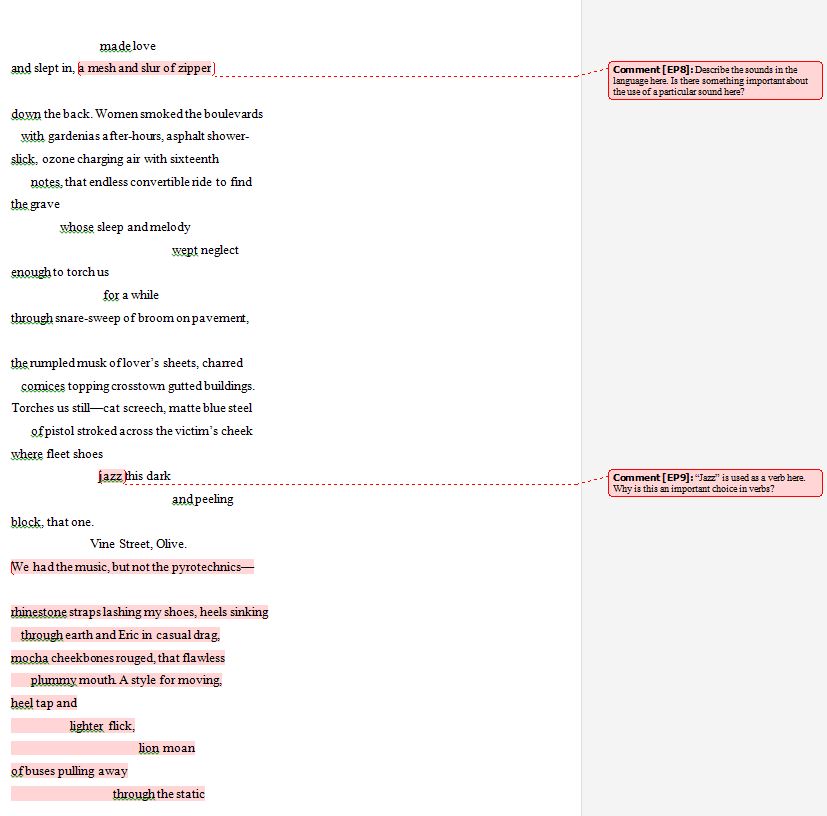
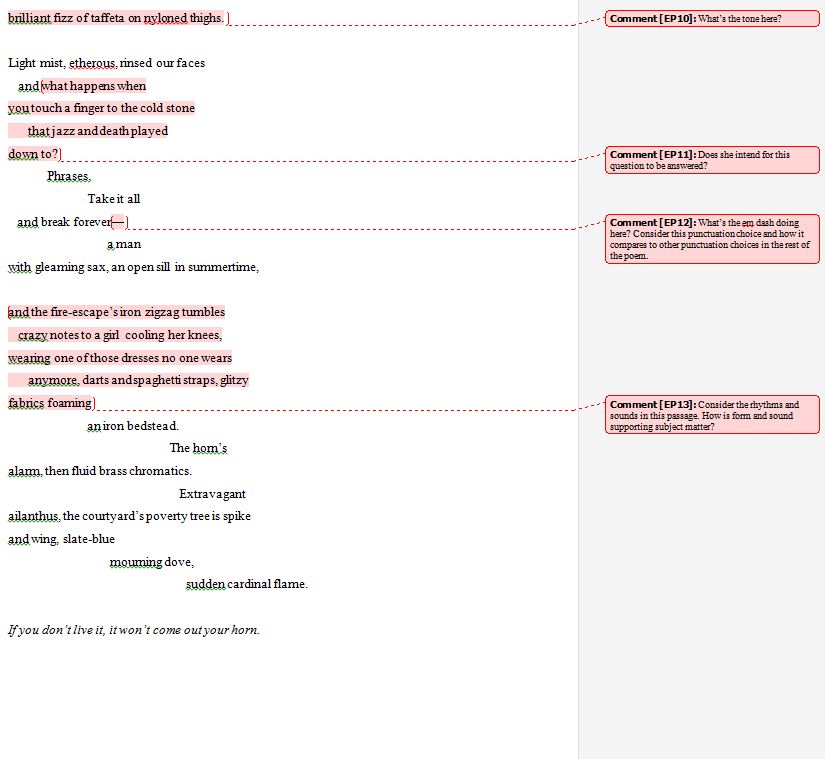
In order to prepare my Intro to Creative Writing students for talking more about poetry with regard to the author’s intentionality before their poetry workshop, I’m asking them to read and examine the poem “Ornithology” by Lynda Hull. They then have to answer questions about specifics in the poem. I’ve provided these questions via track changes in Microsoft Word:

Ornithology Poetry Analysis Exercise screenshot - 1 Ornithology Poetry Analysis Exercise screenshot - 2 Ornithology Poetry Analysis Exercise screenshot - 3

Once they respond to these questions on their own, we will then discuss the possibilities. My hope is that they will see the value in discussing the possibilities rather than strive to make proclamations about what the poem is or what it’s doing.

After they complete the analysis, I’m going to ask them to try to write an imitation of at least ten lines (the formal unit that’s repeated throughout the poem) with special attention to sound and rhythm.

“Babylon: A Place You’ve Only Heard Of” Exercise

"Abbildung der Stadt Babylon" ("Picture of the City of Babylon"),  Erasmus Francisci, copper engraving on paper, 1680
“Abbildung der Stadt Babylon” (“Picture of the City of Babylon”), Erasmus Francisci, copper engraving on paper, 1680

Class: Introduction to Creative Writing (The College of William & Mary)
Genre: Nonfiction
Purpose: To examine how place becomes setting and to cultivate an “outsider’s” point of view
Readings: “Goodbye to All That,” “Babylon,” and “No Man’s Land” from Eula Biss’s Notes from No Man’s Land and “Goodbye to All That” by Joan Didion


  1. Think about a city or country that you’ve never heard of but have never been to. This can be a real (Saigon), mythic (Troy), or imagined place. Describe what you know or imagine to know about this place. Write for 5 minutes.
  2. Now think about your hometown. Describe it as you remember it, including the homes, the landscape, the stores, the values, etc. Write for 5 minutes.
  3. Write a paragraph that considers similarities between the place you’ve never been and your hometown. Write for 3 minutes.
  4. Is there something notable or notorious about your hometown? Write for 3 minutes about how outsiders might view your hometown. Is there something unique to your hometown and therefore strange to outsiders? Would an outsider have prejudices against your hometown? Write for 3 minutes.
  5. How might you be like the outsider with the place you’ve never been? Write a meditation on these similarities for 5 minutes.

“Nobody Knows Your Name” Exercise

Kabuki Marquee (1822) by Utagawa Toyokuni I (Japan, 1769-1825)

Class: Introduction to Creative Writing (The College of William & Mary)
Genre: Nonfiction
Purpose: To explore the self as a character and subject
Readings: Chapters 8 (“Creative Nonfiction”) in Janet Burroway’s Imaginative Writing and “Nobody Knows Your Name” of Eula Biss’s Notes from No Man’s Land

Do you know the story of your name? Its meaning and its history? Do you know why your parents named you what they named you? Are there other famous people with your name? Is your name particularly popular or obscure? What does your last name say about your ancestry, if anything? What are misconceptions about your name? Is your name easily mispronounced or misspelled; if so, give us a narrative about someone getting your name wrong. Are their misconceptions about you based on your name? How would address those who make judgments on a person based on their name? If you don’t know what your name means, speculate and/or invent your own personal meaning for your name based on your experiences, the sounds in your name, etc.. Do you define your name or does your name define you? Write for 10 minutes.

“Encounter” Exercise

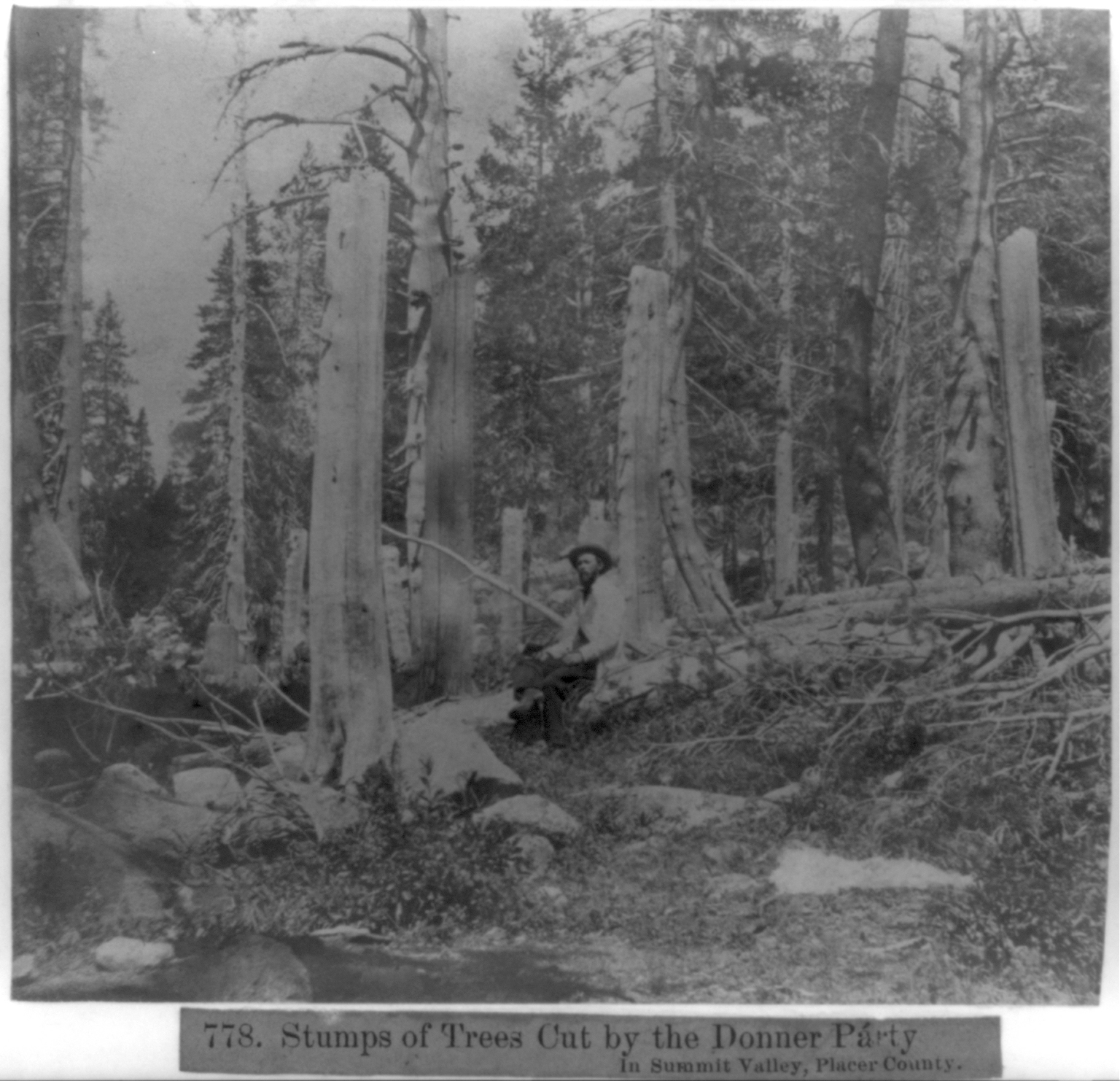
"Stumps of trees cut by the Donner Party in Summit Valley, Placer County" Grayscaled albumen print, half stereograph. (1866) via the Library of Congress
“Stumps of trees cut by the Donner Party in Summit Valley, Placer County” Grayscaled albumen print, half stereograph. (1866) via the Library of Congress

Class: Introduction to Creative Writing (The College of William & Mary)
Genre: Fiction
Purpose: To explore Burroway’s concept of “Character as Image”; examine potential of non-verbal communication; and situate the reader to receive information along with a character
Readings: Chapters 4 (“Character”) and Gabriel García Márquez’s “The Handsomest Drowned Man in the World” in Janet Burroway’s Imaginative Writing

Two characters come upon one another in the middle of a forest. Something bad—but not melodramatic*—has happened to one character and that character needs help. When the first character tries to tell the second what’s wrong, it’s revealed that the two characters don’t speak the same language. (This could include sign language.)

Write a scene from the point of view of the second character (first person “I”) while the first character tries to communicate the problem using only gestures, drawing, or other non-verbal communication. Additionally:

  • the second character cannot know what the problem is before the first character reveals it in this scene;
  • the second character should notice details throughout the interaction that reveal more about the first character (i.e. clothing, appearance, possessions, etc.)
  • the second character may or may not—or even cannot—help.

*Challenge yourself to come up with a problem that doesn’t involve far-fetched plot lines, flat characters, and easy conclusions. This means it would be best to avoid killers, aliens, and monsters. Think about more ordinary but equally tension-filled situations like a farmer whose lost a bull, a teenager who has a flat tire but doesn’t know how to change it, a hunter who accidentally shot his buddy in the foot, etcetera.

“Backwards Story a Telling” Exercise

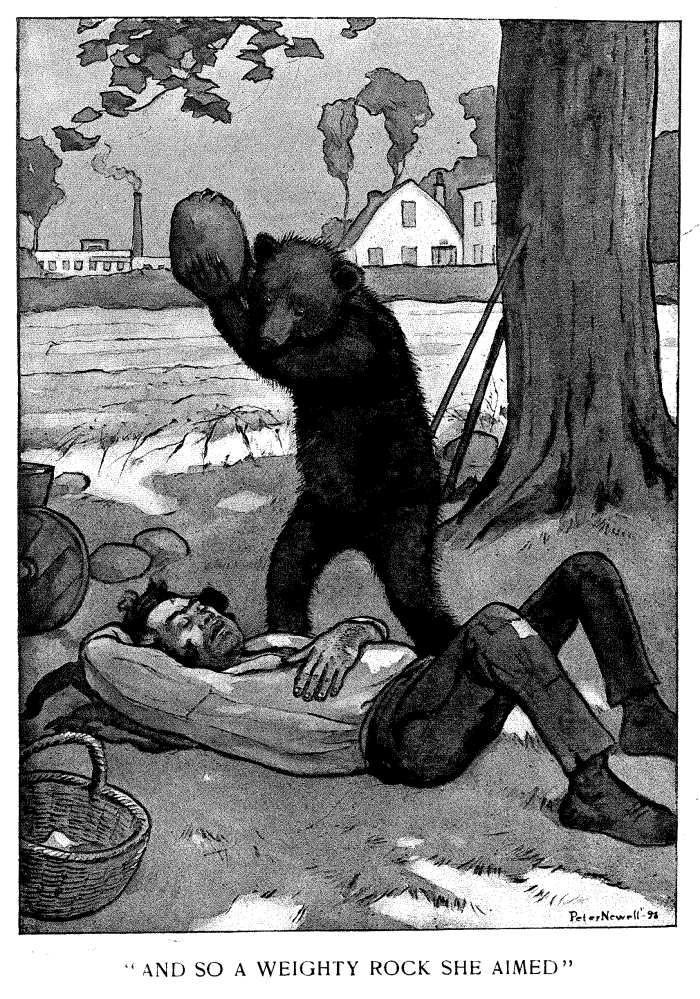
Illustration from Fables for the Frivolous by Guy Wetmore Carryl, with illustrations by Peter Newell (1898)

Class: Introduction to Creative Writing (The College of William & Mary)
Genre: Fiction
Purpose: To open up discussion about plot structure and significant details
Readings: Chapters 9 (“Fiction”) and 6 (“Story”) in Janet Burroway’s Imaginative Writing

  1. Watch a viral video without taking notes. (“Texting Guy Almost Runs Into Bear”: http://youtu.be/WYsAkjfXxzU)
  2. Write a summary of what happens in the video. (2 min.)
  3. Now write a scene from the point of view of the bear or the man. Try to tap into their thoughts and moment-by-moment perceptions. Include as many details as you can in 5 minutes. Here’s the hitch: you must tell the story in reverse chronological order! (Tell the story backwards!)
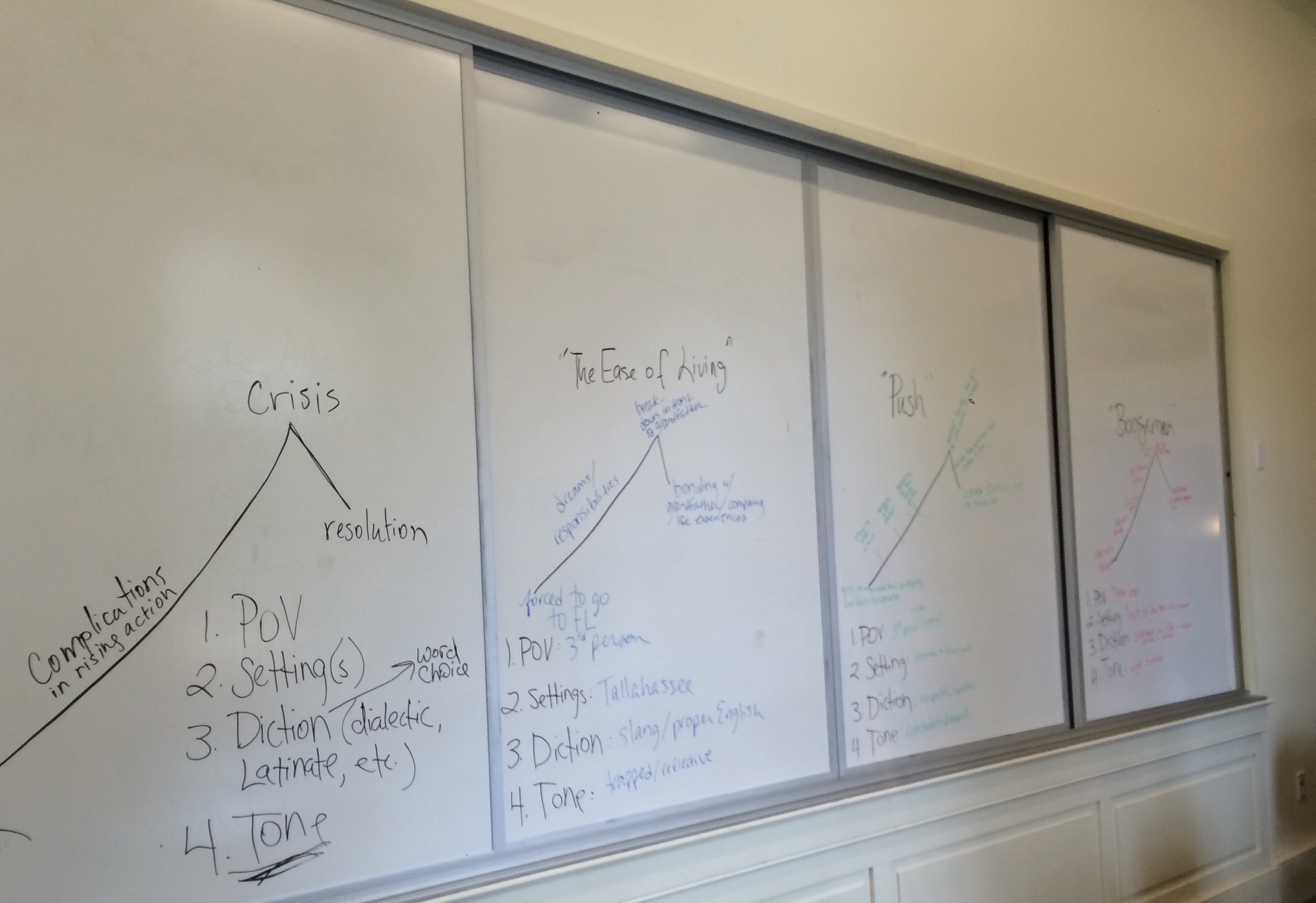
  4. Look at the inverted check mark diagram of pg. 173 in Burroway. Discuss how the check mark works for a chronological story compared to the story told in reverse. Where does the conflict fall in your scene? The crisis (climax)? Is there resolution? Were there any details you thought of telling the story backwards that you might not have thought of telling the story chronologically?

“One Story, Three Genres” Exercise

Class: Introduction to Creative Writing (The College of William & Mary)
Genre: Fiction, Nonfiction, and Poetry
Purpose: To consider how writers of three genres go about approaching similar subject matter; to introduce distinctions between the genres; and to introduce key drafting and revision considerations based on reading from Janet Burroway’s Imaginative Writing
Readings: Chapters 1 (“Invitation to the Writer”) and 7 (“Development and Revision”) in Janet Burroway’s Imaginative Writing

The_three_bears_pg_14

  1. Pick a favorite nursery rhyme, myth, or religious tale that you know by heart. Write a brief summary of the story in 2 to 5 sentences.
  2. If you were writing this narrative as a short story, how would you change it? What elements would you include? How would the style change?
  3. If you were writing this narrative as a poem, how would you change it? What would be your first steps to writing the poem? What would you leave out? What would you add in?
  4. If you were using this narrative as a basis for nonfiction, how would you frame it? How can you approach this subject matter in that way?
  5. Free write for ten minutes and begin to convert your summary into either a short story, a poem, or personal essay.

Hybrid Assignment in Introductory Creative Writing Class

For my intro to creative writing class at William & Mary this semester, I’m asking students to write one hybrid work as their final workshop piece. Often I feel like these introductory classes set up limits for students, but I wonder if allowing them to see genre as something that’s a little more fluid will encourage continued reading across the genres, an understanding that writing techniques can be used across genres, and creativity with the execution of their ideas. They will be reading a few hybrid texts at the end of the semester, too. The hybrid assignment will also give us a chance to review what we’ve gone over about the three genres by forcing us to consider their respective challenges. I think it will also give students the opportunity to tackle issues they faced across multiple assignments. Say they struggled with point of view in their poetry and concrete details in their nonfiction, but the poems presented strong images and their nonfiction offered an unwavering first-person. Perhaps they’ll be able to double up on their strengths through a hybrid work.

Regardless of the success of their pieces, I hope that we can have a great discussion that will prepare them for debates about form and theory in upper-level, genre-specific courses. Additionally, I don’t want to have a situation where I say, “You’ll discuss these forms if you choose to continue taking creative writing courses.” I want to be able to answer these inevitable questions thoroughly, not offhandedly in a minute or so in the middle of a workshop. Besides, you never know which discussion might excite a student about writing. Maybe those slippery hybrid genres are what really interest some students and they might not know it until you offer it to them!