I really want to teach a generative, one-week intensive creative writing workshop about composition practices. I’ve even written a course description/proposal, with a (rough, working) title:
Composition: What Poems Are Made Of, How Poems Are Made. A generative workshop in which students will draft their own poems using various methods. From composing aloud to writing by hand, typing on a typewriter to typing on a computer, scribbling on butcher paper to limiting oneself to a postcard, we’ll consider how each practice produces different effects on the page. Does composing aloud make the poem more musical? Does a word processor give us greater mobility across the page? For guidance, we’ll start by reading process narratives and poems by published poets, and consider how writing practices and technologies have altered poetry’s content and form.
I think the course would be really wonderful for discovering how our writing processes appeal to different parts of the brain. Students can take these exercises back to their normal writing practice, where they can try out different forms, effects, and content. Who knows, it might be an antidote to “writer’s block.” It will also provide me with an opportunity to engage in this approach of teaching poetry and provide me with insight into using drafting mediums as a pedagogical tool.
Does anyone know of any organizations looking for proposals for short-term intensives? Where would you pitch the idea? I’m thinking it might work best in a non-academic environment.
Class: Introduction to Creative Writing (The College of William & Mary) Genre: Nonfiction Purpose: To explore the self as a character and subject Readings: Chapters 8 (“Creative Nonfiction”) in Janet Burroway’s Imaginative Writing and “Nobody Knows Your Name” of Eula Biss’s Notes from No Man’s Land
Do you know the story of your name? Its meaning and its history? Do you know why your parents named you what they named you? Are there other famous people with your name? Is your name particularly popular or obscure? What does your last name say about your ancestry, if anything? What are misconceptions about your name? Is your name easily mispronounced or misspelled; if so, give us a narrative about someone getting your name wrong. Are their misconceptions about you based on your name? How would address those who make judgments on a person based on their name? If you don’t know what your name means, speculate and/or invent your own personal meaning for your name based on your experiences, the sounds in your name, etc.. Do you define your name or does your name define you? Write for 10 minutes.
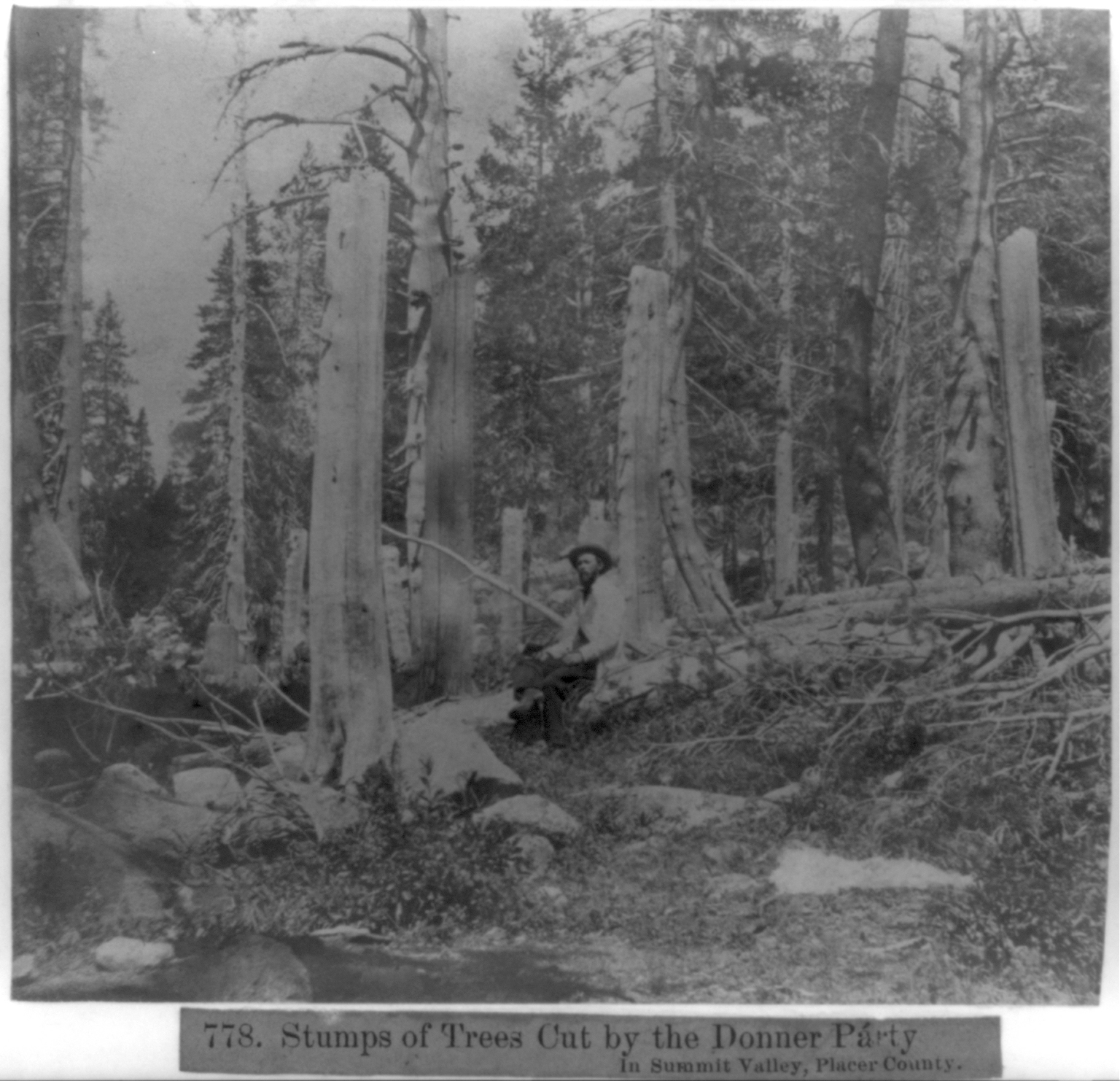
“Stumps of trees cut by the Donner Party in Summit Valley, Placer County” Grayscaled albumen print, half stereograph. (1866) via the Library of Congress
Class: Introduction to Creative Writing (The College of William & Mary) Genre: Fiction Purpose: To explore Burroway’s concept of “Character as Image”; examine potential of non-verbal communication; and situate the reader to receive information along with a character Readings: Chapters 4 (“Character”) and Gabriel García Márquez’s “The Handsomest Drowned Man in the World” in Janet Burroway’s Imaginative Writing
Two characters come upon one another in the middle of a forest. Something bad—but not melodramatic*—has happened to one character and that character needs help. When the first character tries to tell the second what’s wrong, it’s revealed that the two characters don’t speak the same language. (This could include sign language.)
Write a scene from the point of view of the second character (first person “I”) while the first character tries to communicate the problem using only gestures, drawing, or other non-verbal communication. Additionally:
the second character cannot know what the problem is before the first character reveals it in this scene;
the second character should notice details throughout the interaction that reveal more about the first character (i.e. clothing, appearance, possessions, etc.)
the second character may or may not—or even cannot—help.
*Challenge yourself to come up with a problem that doesn’t involve far-fetched plot lines, flat characters, and easy conclusions. This means it would be best to avoid killers, aliens, and monsters. Think about more ordinary but equally tension-filled situations like a farmer whose lost a bull, a teenager who has a flat tire but doesn’t know how to change it, a hunter who accidentally shot his buddy in the foot, etcetera.
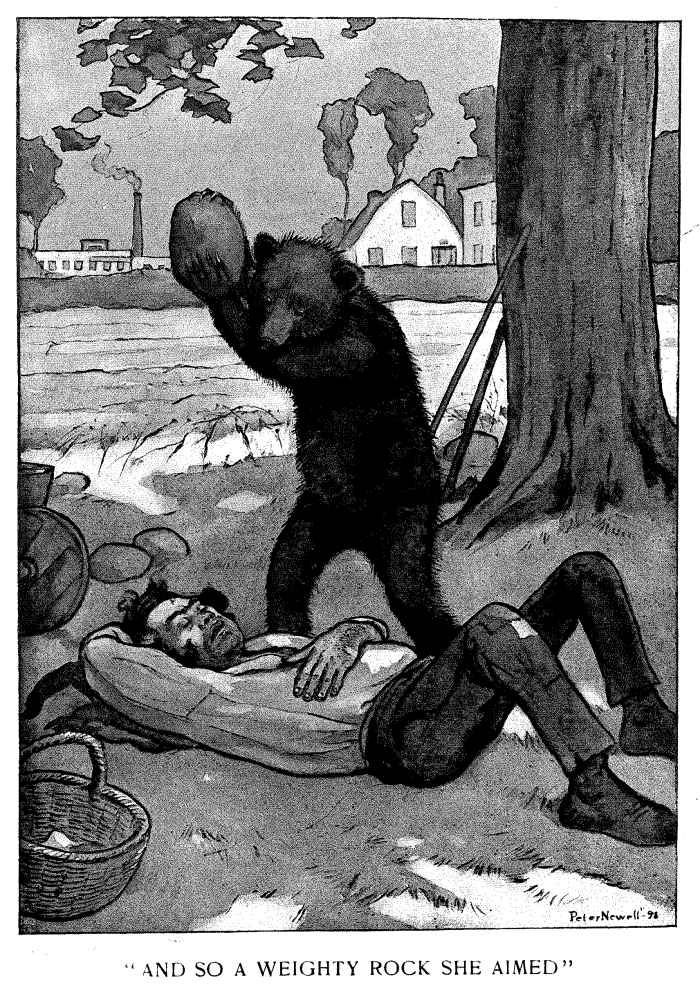
Illustration from Fables for the Frivolous by Guy Wetmore Carryl, with illustrations by Peter Newell (1898)
Class: Introduction to Creative Writing (The College of William & Mary) Genre: Fiction Purpose: To open up discussion about plot structure and significant details Readings: Chapters 9 (“Fiction”) and 6 (“Story”) in Janet Burroway’s Imaginative Writing
Watch a viral video without taking notes. (“Texting Guy Almost Runs Into Bear”: http://youtu.be/WYsAkjfXxzU)
Write a summary of what happens in the video. (2 min.)
Now write a scene from the point of view of the bear or the man. Try to tap into their thoughts and moment-by-moment perceptions. Include as many details as you can in 5 minutes. Here’s the hitch: you must tell the story in reverse chronological order! (Tell the story backwards!)
Look at the inverted check mark diagram of pg. 173 in Burroway. Discuss how the check mark works for a chronological story compared to the story told in reverse. Where does the conflict fall in your scene? The crisis (climax)? Is there resolution? Were there any details you thought of telling the story backwards that you might not have thought of telling the story chronologically?
Class: Introduction to Creative Writing (The College of William & Mary) Genre: Fiction, Nonfiction, and Poetry Purpose: To consider how writers of three genres go about approaching similar subject matter; to introduce distinctions between the genres; and to introduce key drafting and revision considerations based on reading from Janet Burroway’s Imaginative Writing Readings: Chapters 1 (“Invitation to the Writer”) and 7 (“Development and Revision”) in Janet Burroway’s Imaginative Writing
Pick a favorite nursery rhyme, myth, or religious tale that you know by heart. Write a brief summary of the story in 2 to 5 sentences.
If you were writing this narrative as a short story, how would you change it? What elements would you include? How would the style change?
If you were writing this narrative as a poem, how would you change it? What would be your first steps to writing the poem? What would you leave out? What would you add in?
If you were using this narrative as a basis for nonfiction, how would you frame it? How can you approach this subject matter in that way?
Free write for ten minutes and begin to convert your summary into either a short story, a poem, or personal essay.
For my intro to creative writing class at William & Mary this semester, I’m asking students to write one hybrid work as their final workshop piece. Often I feel like these introductory classes set up limits for students, but I wonder if allowing them to see genre as something that’s a little more fluid will encourage continued reading across the genres, an understanding that writing techniques can be used across genres, and creativity with the execution of their ideas. They will be reading a few hybrid texts at the end of the semester, too. The hybrid assignment will also give us a chance to review what we’ve gone over about the three genres by forcing us to consider their respective challenges. I think it will also give students the opportunity to tackle issues they faced across multiple assignments. Say they struggled with point of view in their poetry and concrete details in their nonfiction, but the poems presented strong images and their nonfiction offered an unwavering first-person. Perhaps they’ll be able to double up on their strengths through a hybrid work.
Regardless of the success of their pieces, I hope that we can have a great discussion that will prepare them for debates about form and theory in upper-level, genre-specific courses. Additionally, I don’t want to have a situation where I say, “You’ll discuss these forms if you choose to continue taking creative writing courses.” I want to be able to answer these inevitable questions thoroughly, not offhandedly in a minute or so in the middle of a workshop. Besides, you never know which discussion might excite a student about writing. Maybe those slippery hybrid genres are what really interest some students and they might not know it until you offer it to them!
Distillation by Alembic, 1910. (Published before 1923 and public domain in the US.)
In my poetry class, I decided to stagger revision assignments throughout the semester instead of assigning a final portfolio, because I wanted:
to avoid end-of-the-semester-grading fatigue, in order to ensure that I was always fresh and never rushed in grading;
to alleviate students’ end-of-the-semester stress, so that they would be able to concentrate on revising individual poems rather than meeting basic requirements of a portfolio (better— instead of more—work at a time);
to give students a better, ongoing sense of how they are progressing in the course;
and to situate revision as an integral and ongoing part of the writing process that goes hand-in-hand with writing new poems and reading.
Structuring the course in this way, I felt like I was able to give more feedback, and my students’ revisions improved. In previous courses, a revision unit at the end of the semester suggested that revision was an afterthought to the writing process. By having students revise throughout the semester, workshop directly correlated to students’ next steps and, in their self-assessments, they often referred to feedback they received from their peers. Workshop, therefore, was explicitly linked to revision; it wasn’t the end but the means of their creative work—not a junkyard, but an alchemical machine.
I taught a class titled “No River, No Bridge: Writing Poetry, Writing Nonfiction” at Appomattox Regional Governor’s School’s Writers’ Fest yesterday. We discussed hybridity of poetry and nonfiction, as well as the ways in which poetry can take on and explore “truth” using essayistic strategies without the requirement of “fact.” Several students came up afterward to show me their exercises, and one told me that she felt like it was one of the best things she’s written. The class ranged from high school students to adults.
In this course we will examine works of poetry and creative nonfiction in order to open up these genres to hybrid works. We will discuss features that are shared by the genres, how to bend the rules, and look at some examples before doing an exercise.
With over forty students in a one-hour class, we had these objectives:
Examine definitions of genre and the elements therein.
Think about the function and aims of each genre.
Read excerpts of texts that bridge the gap between poetry and nonfiction.
Write some assays—yes, some attempts—that use both poetry and essay strategies.
Examine definitions of genre and the elements therein. We looked at definitions of essays and lyric essays and Edward Hirsch’s definitions of line, lineation, lyric, prose poem, and stanza from A Poet’s Glossary. We looked at these definitions because they seek to define and, therefore, draw boundaries. We needed to know these definitions in order to explode these boundaries. In particular, we looked at Hirsch’s definition of line, in which he quotes Longenbach:
“Poetry is the sound of language organized in lines,” James Longenbach asserts in The Art of the Poetic Line (2008). “More than meter, more than rhyme, more than images or alliteration or figurative language, line is what distinguishes our experience of poetry as poetry, rather than some other kind of writing.”
And compared it to the prose poem definition:
A composition printed as prose that names itself poetry. The prose poem takes advantage of its hybrid nature—it avails itself of the elements of prose (what Dryden called “the other harmony of prose”) while foregrounding the devices of poetry. . . . Baudelaire used prose poems to rebel against the straitjacket of classical French versification. He dreamed of creating “a poetic prose, musical without rhyme or rhythm, supple and jerky enough to adapt to the lyric movements of the soul, to the undulations of reverie, to the somersaults of conscience.” Baudelaire’s prose poems—along with Rimbaud’s Les Illuminations (1886) and Malarmé’s Divagations (1897)—created a mixed musical form (part social, part transcendental) that has been widely and internationally practiced in the twentieth century. “There is no such thing as prose,” Malarmé insisted in 1891. “There is the alphabet, and then there are verses which are more or less closely knit, more or less diffused. So long as there is a straining toward style, there is versification.”
We thought about these paradoxes, discussed why lineation makes a poem a poem, as well as considered some alternative definitions. We then examined Hirsch’s definition of “lyric”—
The lyric poem immerses us in the original waters of consciousness, in the awareness, the aboriginal nature, of being itself. . . . The lyric, which offers us a supposed speaker, a person to whom we often assign the name of the author, shades off into the dramatic utterance
—in juxtaposition with a discussion of point of view in essay. Think about the function and aims of each genre. When I think about the intersections and differences of poetry and nonfiction, it’s helpful for me to illustrate the two genres with metaphors.
Poem as a river. With all of their musical elements, I think of poems as a river—something fluid, flowing, that rushes and eddies, deltas, and empties out to sea. Poems are one of our oldest forms of literature and therefore seem natural to our landscape of language.
Essay as a bridge. The essay, an analytical form, builds upon its subject piece by piece, element by element, fact by fact, experience by experience. We might think about this strategy as similar to building pillars with blocks, hammering planks together, supporting and trussing.
We might use these metaphors to understand hybrid works—nonfiction prose poems, lyric essays—better. Sometimes a poem is a river we want to cross; we see and hear the rushing water, but we want to examine it from a sturdy vantage point where we stay safe and dry. Some music comes into the poem, but we rely on the exposition that essays provide. Adversely, we could be in the water, prone to the rapids, splashed in the face, paddling fiercely. Just trying to stay afloat in the overflow of language, of experience. There are times, however, where we might pass under the shadow of a bridge, have insights into reason, into conquering this flow, bridging one experience to another. Read excerpts of texts that bridge the gap between poetry and nonfiction.
“Say It, Say It Anyway You Can” by Vievee Francis (two versions—the prose poem version from Rattle and the lineated version that appeared in her collection Horse in the Dark). Let’s take a look at this poem, which started off as a prose poem and then became a lineated poem. Discuss the poet’s possible reasoning for lineating the poem. What are the effects of the two forms?
An excerpt from Citizen by Claudia Rankine and an excerpt from Bluets by Maggie Nelson. Talk to me a little bit about what these prose forms borrow from poetry. Are they poetry? (How were they marketed? How were they identified?) Is it enough to say something is poetry? Nonfiction? Are these true hybrids? How would you categorize it? Does it need to be categorized?
Write someassays—yes, some attempts—that use both poetry and essay strategies.
“No River, No Bridge” Exercise
Select an everyday object that’s in your house. Ex. a television, a pair of jeans, a can of kidney beans. (1 min.)
Now describe the object using all of your senses, with only concrete details. Do not use any metaphors or other figurative language. (2 min.)
Imagine how the object was made. Write a step-by-step description of its fabrication. (3 min.)
Imagine the harvesting, mining, or creation of the raw materials that went into making this object. (i.e. the shearing of sheep for your wool sweater or the mining of silicone to make your iPhone). Describe. (2 min.)
Now talk a little bit about how you came to own this object (and talk about not remembering how you got it, if that’s true.) Tell us the backstory. Or, what connotations does the object have? Do you have specific memories associated with it? (2 min.)
Now describe the object using only metaphors. (“My pair of jeans is muddy water reflecting sky, a bird with clipped wings . . . ”) (2 min.)
Share and discuss: How has the object changed in each iteration (concrete description, origin story, deconstruction, entrance, emotional connection, metaphorical naming)? Which form (poetry or essay) better conveys these approaches? Why? How can we combine these strategies?
“Grandpa Glenn just chillin’ on his goat cart. Photo taken around 1916. Globe, Arizona” from freeparking.
Class: Writing Poetry (Virginia Commonwealth University) Genre: Poetry Purpose: To talk about not relying simply on the drama inherent to subject matter or narrative Readings: “Song” by Brigit Pegeen Kelly and student poems
Before beginning workshop today, I read aloud Brigit Pegeen Kelly’s poem “Song” to the class as a way to open up the conversation about their own use of inherently compelling or dramatic subject matter. Of course, Kelly’s goat, whose head has been severed from its body and hung in a tree by a group of boys, is interesting; but it’s only a good poem for the ways in which Kelly works with sound, imagery, and lines. As this isn’t a close reading of the poem, I won’t go in depth about our discussion, but we did consider how poems with interesting dramatic situations, narratives, or images might fool us into thinking they are “good” poems simply because we remember the content. I urged my students to consider Kelly and her artfulness in presenting compelling subject matter when they write their own poems; to not simply rely on something that seems “meaningful”; to make it meaningful through their presentation.
I haven’t had a chance yet to give this exercise to my Writing Poetry students, but I hope to give this to them by the end of the semester. A “cadenza” is a soloist’s improvisation that later gets written into a piece of music. It’s my hope that this exercise will produce in-class improvisation that later becomes a revised poem.
Class: Writing Poetry (Virginia Commonwealth University) Genre: Poetry Purpose: To consider how pace and sound relates to emotion, tone, and intensity. Readings: One might provide the students with musical examples in lieu of readings.
Each student should select a term, study its definition, and then conceive of a poem that demonstrates the qualities of the term. The poem could embody these qualities with form, syntax, diction, sound, prosody, or any combination thereof. This term must serve as the title of the poem. For instance, “Sonata” might produce a poem in four parts that each differ in tone and pace. (30+ minutes)
Students should share their results with the class for feedback on whether or not they embodied the musical terms in their poems. Open up a discussion about how line breaks, forms, and syntax/diction create a kind of music in poems and how these can be manipulated to produce certain tonal/emotional effects in addition to those implicit in dramatic situations. (10–15 minutes)
The students will then take home the poem and revise it. Share again at a later date.



 Emilia Phillips