Each class member should respond to a poem written by the person seated on their right. They can argue or interrogate an idea, provide an anecdotal narrative that relates to the first person, or work associatively away from the original kernel to access something new. Participants should remember their addressee’s personality, concerns, and
The next step has two variations. Students should then write a response to:
the response to their own poem so as to create a dialogue between the two poets, or
the response written by their original addressee so as to create a chain of communication.
Ask that the students bring in one of their favorite poems. (My students brought in “Meditation at Lagunitas” by Robert Hass, “Fever 103°” by Sylvia Plath, and “[Carrion Comfort]” by Gerard Manley Hopkins.) Have each student read the selection to the class and lead a discussion on the poem’s features, movement, and form.
Consider some of the ways one can write imitations:
Imitate all or many of the strategies of that specific poem.
Imitate general features of the poet’s style.
Write a poem in the persona of the poet. (His/her general voice, not just the voice on the page.)
Do a loose imitation using one element of the original poem. This could even include response poems, poems with lines of that poet, etcetera.
Then have them do the following exercise:
Write an imitation of the poem you brought in. (15 min.)
Write an imitation of one of the other poems. (15 min.)
Discuss. What imitation strategy did you choose? Why? Did you find yourself more able to imitate your selection or another’s? Why? Which imitation was hardest? Can you more easily discern some of your own fundamental orientation to language, ticks, go-to strategies, etcetera through the imitation process?
Think about a poem that you’ve been wanting to write for a long time but haven’t been able to successfully accomplish. It works best if this is a personal memory or other narrative.
Discuss each of the following approaches and the read their respective suggested poems:
Anecdotal: A simple story in one setting, usually in plain speech. See “Black” by Alan Shapiro.
Imperative: A second person address with instructions, based on an extended metaphor or literal. See “How to Live in a Trap” by Eleanor Ross Taylor.
Meta: A response to an event that takes into account writing’s inability to fully capture the event. See “Photograph of September 11th” by Wislawa Szymborska and “The streetlamp above me darkens” by Tarfia Faizullah.
Figurative: A characterization of an event or action through metaphor. See “Boy Breaking Glass” by Gwendolyn Brooks.
Collage: A poem that uses multiple of these approaches and usually isn’t afraid to associate away from and back again to the original motivation. See “My Story In a Late Style of Fire” by Larry Levis of “Across the Sea” by Dana Levin.
After discussing each approach, take ten minutes to write your narrative using only that approach. Move on to the next one and repeat.
At the end, ask yourself: How did the poem change? Did the poem become more or less imaginative? Which one do I like the most? Why? Share.
Belauscht (1874) by Carl Wilhelm Hübner Class: Intro to Creative Writing Genre: Drama Readings: Edward Albee’s Who’s Afraid of Virginia Woolf? Time: 45+ minutes
1. Have students pair off. One person per group should be in charge of transcription.
2. Leave the classroom. Take the students to a common area on campus like the student union, cafeteria, or the quad. Once you are there, have the groups split up and walk through the crowd. Encourage them not to linger in any one place. They should write down the most compelling and/or bizarre sentence they hear someone say. Examples: “I ate a whole pound of Swedish Fish and it cost me like 35 dollars!” “How old are you?” (10 minutes.)
3. Return to the classroom. Have each group pass their transcribed line to the group on their right.
4. On the board, write down a pair of character roles in a specific setting for each group. I gave my classes the following character/setting sets:
a. Two waste disposal workers on the back of a garbage truck.
b. A veterinarian and the owner of a pet in the exam room.
c. The host and a contestant on the game show.
d. A teenager with driver’s ed instructor in the car.
e. A police officer and an arrested person in cruiser.
f. A priest and a congregant in confession booth.
g. Two single people on a speed date at a bar.
5. Each group should read aloud the line passed to them. Assign character/setting sets to the groups based on these lines. Play it safe and assign the characters/setting to lines that seem natural, or see what happens if you make unexpected pairings. (Hint: Students often have more fun with unexpected pairings.)
6. The line provided will serve as the first line of the scene involving their assigned character/setting sets. Each student should assume the role of one of the characters. Each will respond to their partner’s line by passing the paper back and forth. (30 min.)
7. Share.
This exercise allows students to work collaboratively to create a narrative through dialogue, a skill that many of my students cite as the hardest thing to accomplish in their first plays. Additionally, their time in the crowd locates them in conversational rhythm and dynamics so that the information about the plot doesn’t seem unnatural to the conversation. The assigned lines provide them with an inciting action as well as a clue toward their new character’s personality. The hope is that once they are writing on their own, they will be able to recreate these investigative processes on characters of their own.
Woman putting a letter in a post box, United States of America.
Caption: “FOR YOU, MY DARLING. COPYRIGHT BY A.L. SIMPSON 1909.” Class: Writing Out of the Ordinary Genre: Poetry/Nonfiction Readings: Maggie Nelson’s Bluets and Claudia Rankine’s Don’t Let Me Be Lonely Time: 40 minutes
I place many objects in the table or assign them at random to students. All of the objects are old: postcards, advertisements, mugshots, taxidermy instructions, a dried beaver face, etc.
1. Select a piece of ephemera from the center of the table.
2. Describe the object. What does it look like? What is/was it used for? How old is it? (5 min.)
3. Who owned this article? Who encountered it? Speculate on their perception/reaction would have been to the object. Would the object have some special importance to them? Would they have ignored the object? Describe a situation in which the object was previously encountered. Is it similar or different to your initial reaction? (10 min.)
4. Have you ever encountered something like this before? Make parallels to your experience with similar objects. Ex. If it’s an advertisement, talk about an experience or reaction to another advertisement. (10 min.)
5. Is there a public and/or private issue that this object and your memory causes you to consider? Does it make you think about identity? The ephemeral nature of life? A shift in culture or fashion? Cruelty? Art? Talk us through your thought process. (10 min.)
6. After thinking about this object in the context of speculation, memory, and meditation, has the object changed in meaning for you? Do you appreciate it more or less? (5 min.)
***Bonus step: Now switch objects with the person on your right. Describe this object. How does this new object compare or contrast to your old object? Does it raise similar issues?
Détail de la carte de Montréal de 1859 faisant ressortir Pointe Saint-Charles. Class: Intro to Creative Writing Genre: Poetry Readings: A poetry packet featuring the poems listed below Time: 30 minutes
Group 1: “Wherever My Dead Go When I’m Not Remembering Them” (Shapiro) and “In the Waiting Room” (Bishop) Group 2: “Perpetually Attempting to Soar” (Ruefle) and “The Lovers of the Poor” (Brooks) Group 3: “Your Wild Domesticated Inner Life” (Banias) and “Dorothy’s Trash:” (Johnson) Group 4: “My Story in a Late Style of Fire” (Levis) and “The Day Lady Died” (O’Hara) Group 5: “The Mare of Money” (Reeves) and “In Colorado My Father Scoured and Stacked Dishes” (Corral) Group 6: “Scrabble with Matthews” (Wojahn) and “Ode to Browsing the Web” (Wicker) Group 7: “The streetlamp above me darkens” (Faizullah) and “A Pornography” (Rekdal) Group 8: “To a Fig Tree on 9th and Christian” (Gay) and “Animals Are Passing From Our Lives” (Levine)
Read each poem assigned to your group. Answer these questions:
What’s the dramatic situation of the poem? Meaning, what’s going on? What’s the scene or the conflict? (Ex. For Matthew Olzmann’s “Notes Regarding Happiness,” the speaker is attempting to post a happy birthday message on a friend’s Facebook wall.)
How does each poem get from its beginning to its end? Is it narrative (a story) and therefore moves in a linear fashion? Are there associative connections between images? Examine the relationship between images in these poems.
Describe the tone. Is the poet sincere?
Describe the style of this poem. Is the language conversational or esoteric? What does the poem sound like?
Describe the form of this poem. Is it in couplets? A single stanza? Etcetera? How long are the lines? Why do you think the poet chose this form?
Do these two poets have anything in common in terms of their style, strategies, or motivation for writing?
If you were going to write an imitation of one of these poets, who would you pick? How would you begin? Start drafting a few lines using the strategies you described above.
“Dead City III (City on the Blue River III)” (1911) by Egon Schiele Class: Writing Out of the Ordinary Genre: Poetry/Nonfiction Readings: Maggie Nelson’s Bluets Time: 30 minutes
Identify one thing you have been obsessed with for quite some time.
Detail a direct encounter with that thing. Be as descriptive as possible.
Name the first person you can think of who is missing from your life.
Write down something you never told them. (A confession, an idea, a story, etcetera.)
Remind that person of something you did together. Tell the narrative.
Is there a connection between the thing and the person? Explain.
Write down the first thing and then write the next five words that come to your mind in an associative chain from one word to the next.
Now pick one of those things on the list and write about an encounter you had with that thing.
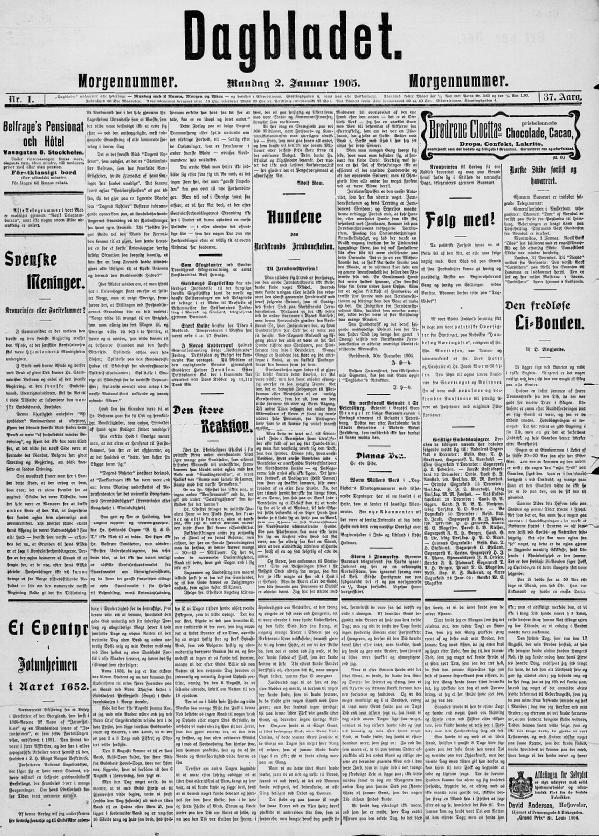
The front page of the Norwegian newspaper Dagbladet from the 2nd of January 1905. (Published before 1923 and public domain in the US.) Class: Intro to Creative Writing Genre: Poetry Readings: Matthew Olzmann’s Mezzanines Time: 20–25 minutes
Mayor To Homeless: Go Home Stabbing Disrupts Anger Management Class Missippi’s Literacy Program Shows Improvement One-Armed Man Applauds the Kindness of Strangers Statistics Show That Teen Pregnancy Drops Significantly After Age 25 Federal Agents Raid Gun Shop, Find Weapons
Pick one of the (real) headlines above as the title of your poem.
Now begin to write a narrative poem about the situation that provoked the headline.
Go back and read what you’ve written. What else does it remind you of? (The first thing that comes into your head.) Start writing about that.
Go back and read what you wrote about the second thing. What does that make you think of? Write about it.
Is there a way to get back to the first story? Is there something else you missed in the first story? What images connect across each of these stories? How are the motives of the characters different? How are they alike?
Drawing of Stage Door Johnnies (1894)Class: Writing Out of the Ordinary Genre: Creative nonfiction Readings: A packet of persona poems and dramatic monologues Time: 10 minutes
1. Pick a celebrity, sports star, cartoon or comic book character, product mascot (ex. Count Chocula, the Geico gecko, etc.) or newsworthy individual (Octomom, Charles Manson, etc.).
2. Create a mundane problem for that character or person. (Kobe Bryant can’t open a jelly jar. Elvis Presley can’t fit into his old slacks. Speedy Gonzalez gets stuck in a mouse trap.)
3. Free write for ten minutes in the voice of that character as they’re attempting to resolve the problem. What concerns them? Are they worried about their public image? How does this problem relate to bigger problems for them? What sorts of language do they use? Are they thinking about the problem at hand or something else? Where are they at? More specific questions: What are they wearing? What kind of jelly is Kobe Bryant trying to get into? Strawberry or grape? Who set the trap for Speedy? Has Elvis tried dieting? (Hint: You don’t have to answer these specific questions, but be sure to take leaps like this with your own characters.)



 Emilia Phillips